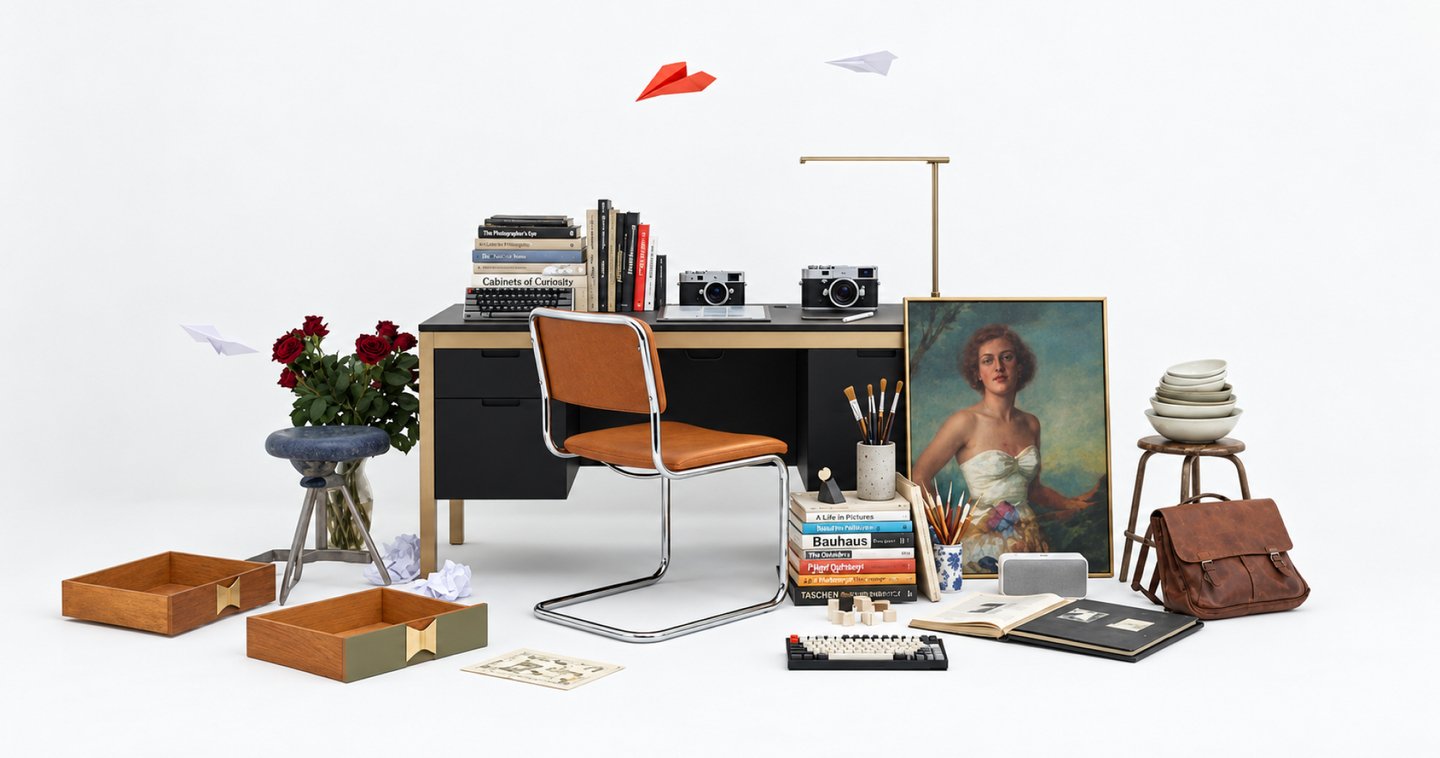
The room speaks—a media project that explores personal space as a reflection of the individual. Through photographs of rooms and individual objects, the project investigates the habits, character, and lifestyle of their owners, aligning visual observations with the personal narratives of the subjects.
We are accustomed to learning about people through interviews, but they don’t always speak about themselves directly. Their environment constantly provides information: objects on the desk, books, the refrigerator, organization, items by the bed. «The Room Speaks» proposes viewing space as a self-portrait: we photograph it, highlight details, and build assumptions. AI helps us notice connections, but we validate the final narrative with the person. We are not claiming that a person’s character can be objectively determined by their room—we are exploring the discrepancy between how they describe themselves and what accidentally manifests in their space.
Objective
Investigate the discrepancy between what a person says about themselves and what their environment reveals, using AI to generate hypotheses that are tested on the protagonist.
To us, ordinary objects are part of a cultural context. We examine the relationship between people and objects: why we interact with things in specific ways, what meanings we attribute to them, and what this reveals about the society in which they exist.
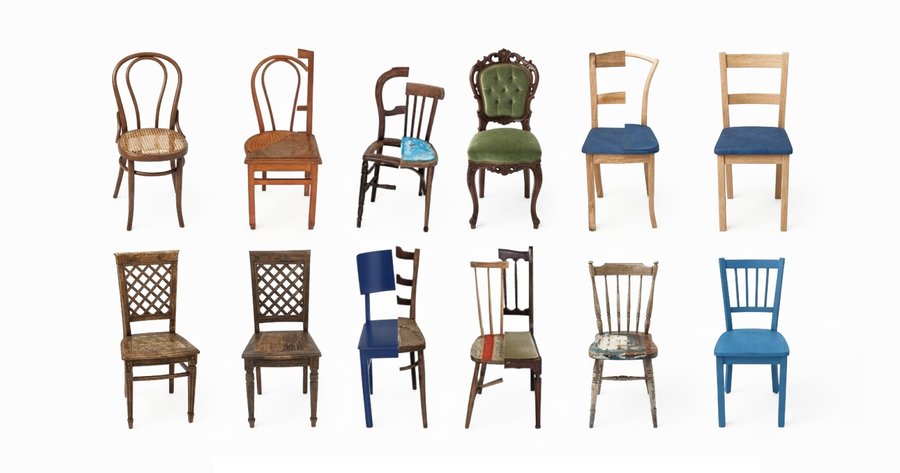
Martin Hamper, «100 Chairs in 100 Days, ” 2007.
Topic
«The Room Speaks» explores everyday objects and personal space as elements of social life. In these items, we perceive not only function but also cultural meaning—through them, we can discuss habits, values, roles, and norms. AI helps establish connections, while humans confirm or refute hypotheses.
Competitor Analysis
1. Subject Matter and Approach
«The Room Speaks”—media about the human through personal space. The object is the central focus here, but it is examined not as a functional or design item, but as a carrier of cultural information. Approach: material culture + anthropology of everyday life + visual journalism. Through the object—to habits, memory, social roles, and norms.2. Target Audience and Positioning
Segments: the curious observer, the enthusiast of objects and visual environments, the self-explorer, the protagonist. Needs: to glimpse real life, to understand people through their possessions, to see oneself from an outside perspective, to share one’s story without relying on achievements. Positioning: not media about interiors, but media about personality through space.3. Platforms
Primary: TikTok / Reels / Shorts. Second tier: Telegram. Archive: website. Additional: VK, YouTube, mailing list. Instagram* — only as a supplementary channel. Application and podcast—not at launch.4. Formats and Tools
Short-form, 30–90 seconds: one room / object / hypothesis. Photo stories, cards, detailed breakdowns, interviews, user narratives, interactives, polls, stories. AI: computer vision, pattern recognition, OCR, clustering, generating interview questions. AI is an editorial tool, not a diagnostician.5. Platform Adaptation
Material is not duplicated, but reconstructed. Vertical video—hook and hypothesis. Telegram—the full story, photos, comments, polls. Website—long-form article and archive. VK/YouTube—adapted versions. One release = multiple formats.6. Visual Language
Documentary photography of real spaces, natural light, detailed close-ups, without glossy staging. Museum-archival aesthetic: captions, object numbering, annotations. Typography, AI markup, collage, motion highlighting of details. Restrained color, emphasis on the objects.7. Tone of Voice and Depth
Observational, inquisitive, respectful, free from judgment or pseudo-diagnosis. Not „the room determines the character, ” but „we noticed, we hypothesized, we asked.“ Depth: not just a fact about an object, but the object’s connection to the person, habits, memory, norms, and culture. Formula: object $\rightarrow$ hypothesis $\rightarrow$ person $\rightarrow$ story $\rightarrow$ cultural context.
Direct Competitors
The Selby
A project about people through personal spaces. Since 2008, Todd Selby has photographed creative individuals in their homes, illustrating how the environment reflects personality. Audience: those interested in design and culture. Platforms: website, books, social media. Format: photographic projects. Visuals: documentary photography, natural light. Tone: observant, friendly. Focus: how a person lives. Distinction: «The Room Speaks» uses AI to find patterns and tests hypotheses through interviews.Apartment Therapy
Media focusing on real homes. Key format—House Tours: users showcase their apartments. Audience: those interested in interior design and daily life. Platforms: website, social media, YouTube. Formats: articles, photos, videos, user-generated content. Visuals: real interiors, practical solutions. Tone: friendly, practical. Focus: how to arrange a space. Distinction: «The Room Speaks» explores the cultural meanings of objects rather than their functionality.Architectural Digest Open Door
A video series where celebrities showcase their homes. Audience: broad, interested in design and celebrity life. Platforms: YouTube, website. Format: video. Visuals: glossy, professional. Tone: admiring, exclusive. Focus: the celebrity home. Distinction: «The Room Speaks» works with ordinary people, emphasizing hidden meanings and hypotheses.
Overview of Potential Competitors
All three projects use the object as a starting point, but they approach it differently: Arzamas explores the history of the object, 99% Invisible reveals large cultural processes through it, and Museum of Material Memory works with personal and collective memory.
«The Room Speaks» could occupy a distinct position by treating private space and everyday objects primarily as sources of information about a person—their habits, values, social roles, and norms. AI assists in finding visual patterns and formulating hypotheses, which are then tested through conversation with the subject.
Indirect Competitors
The Public Domain Review — an archival media platform focused on culture and history. Essays, collections, and newsletters. Visuals feature archival images and engravings. The intersection lies in the object as a carrier of cultural information. The difference: it works with historical archives, while «The Room Speaks» engages with contemporary private space, hypotheses, and interviews.Aeon — a media outlet covering society, culture, and behavior. Features longform essays. The intersection is the movement from private observation to broad conclusions about culture. The difference: Aeon focuses on ideas and text, whereas «The Room Speaks» focuses on visual space, objects, and AI analysis.Wallpaper — media covering design, architecture, and lifestyle. Characterized by strong object photography and art direction. The intersection is the visual presentation of objects. The difference: Wallpaper* is about design and aesthetics, while «The Room Speaks» is about meaning, behavior, and norms.
Overview of Indirect Competitors</span>
All three projects engage with material and visual culture, yet each approaches it differently: The Public Domain Review focuses on archives and historical artifacts; Aeon explores ideas and social processes; and Wallpaper* centers on design and aesthetics. «The Room Speaks» occupies a unique niche: the object and the personal space it inhabits serve as a source of information about a person—their habits, values, and norms—while AI functions as an editorial tool for identifying visual patterns and formulating hypotheses, which are then tested in conversation with the subject.
Potential Competitors
Google Arts & Culture — a digital platform for culture: museum collections, exhibitions, interactive experiences, 3D/AR. Its visual aesthetic is technological and museum-like. The common ground is the engagement with visual culture and digital formats. The key difference: it showcases museum heritage, whereas «The Room Speaks» focuses on modern, personal space, hypotheses, and interviews with AI.
Smithsonian — a museum-media system that uses everyday objects to tell stories about history and society. Formats include articles, podcasts, videos, and digital exhibitions. The common ground is the object as a carrier of cultural information. The key difference: it deals with objects of museum status, while «The Room Speaks» uses ordinary objects in a personal space.
PostNauka — a popular science media outlet covering anthropology, sociology, and history. Formats include articles, lectures, podcasts, and videos. While it can explore themes of everyday objects, its structure revolves around an expert or a specific scientific topic, rather than the object itself. «The Room Speaks» places the object and the space at the center, using AI as an editorial tool.
General Profile of Potential Competitors
All three projects use an object as their starting point, but they do so in different ways: Arzamas explores the history of the object, 99% Invisible reveals larger cultural processes through it, and Museum of Material Memory engages with personal and collective memory.
«The Room Speaks» may occupy a separate position, examining personal space and everyday objects primarily as a source of information about a person—their habits, values, social roles, and norms. AI helps identify visual patterns and formulate hypotheses, which are then tested through conversation with the subject.
Kimberly Kulka, «Newspaper Chair, ” 2008
Insights
1. Everyday Objects — The Foundation of Media
Objects and interiors frequently appear in historical, design, and lifestyle projects, but usually as standalone vignettes. Media entirely built around material culture and personal space is far less common.2. Material Culture and the Human Element
Competitors utilize objects to speak about the past, memory, design, or social processes. These approaches often exist in silos: some focus on the object’s origin, others on the owner, and still others on aesthetics and function. «The Room Speaks» connects the object, the space, and the individual.3. A Difference in Perspective
«The Room Speaks» does not necessarily hunt for unique artifacts. Its distinction lies in its anthropological perspective and AI analysis: it looks not just at what an object is, but what it reveals about habits, values, social roles, norms, and interpersonal relationships. AI assists in identifying visual patterns and formulating hypotheses, which are then tested through conversations with the subject.4. From Object to Person and Society
The object ceases to be the final topic; instead, it becomes a launchpad for a broader discussion. A book by the bedside can prompt a conversation about routine and rest; a charger on the desk can lead to discussions about work and time; a concert ticket can speak to memory and attachment.5. Visuals as Part of Positioning
Competitors often separate deep research from expressive visuals. «The Room Speaks» can merge cultural analysis with documentary photography of space, detail, AI annotation, diagrams, collage, and motion.6. One Subject, Multiple Formats
A single investigation can exist as a short-form video, an article, a series of cards, a Telegram post, a survey, or a photo essay. This allows the depth of the subject matter to be maintained while adapting it for diverse platforms.
Distribution Channel
Content is distributed across different platforms depending on the format. Social media (Reels, TikTok, Shorts) features short videos focusing on a single hypothesis to capture attention and drive traffic to Telegram. Telegram hosts the full hero story, photographs, polls, and hypothesis validation. The website features long-form articles, an archive of episodes, and methodology. VK and YouTube receive adapted versions, and email newsletters deliver a digest. Each episode is tailored to the platform while maintaining the core logic: topic $\rightarrow$ hypothesis $\rightarrow$ person $\rightarrow$ story $\rightarrow$ context.
VK / Instagram / YouTube Shorts — Quick Topic Introductions
Short vertical videos: one room, one object, one hypothesis. For example: «Why is the coffee on her desk always cold?» or «What does a concert ticket from a month ago reveal?» The goal is to hook the viewer with a detail and show that a story about a person and their habits lies behind it.Telegram — Topic Development
This is where full character narratives are published: space photographs, detail analysis, AI hypotheses, and human responses. Additionally, there are polls, discussions, and links to research on material culture. Telegram allows users to revisit previously published rooms and connect them to new ones.Website — Project Material Archive
The website features long-form articles with photographs, diagrams, AI annotations, and interviews. Each issue is compiled into an archive, allowing navigation from one room to another, and from one object to a theme. The website serves as the repository for the project’s methodology and all research.