Mushrooms are significant in art because they embody aesthetic, symbolic, and ecological value. They inspire artists with their unusual forms, help convey complex ideas about life and nature, and open possibilities for experimentation with new materials.
Mushrooms captured my attention due to their unusual shapes, diverse colors, textures, and symbolic meanings.At first glance, mushrooms appear to be simple organisms of nature, but in art, they can take on entirely different meanings. They are associated with mystery, fairy-tale worlds, processes of growth, decay, and rebirth. I became curious as to why artists of different eras have turned to mushroom imagery and how their perception changes depending on the cultural context.
I was particularly interested in the fact that mushrooms can serve not only as a source of visual inspiration but also as material for creating works of art and design objects. Contemporary artists are using mycelium to experiment with eco-friendly materials, exploring the relationship between humanity and nature.
The goal of my research is to explore the influence of fungi on art—how their forms and symbolism manifest in artistic works, and why this topic remains relevant to contemporary artists. For me, this subject offers the opportunity to view a familiar natural object from a different perspective and to understand how something mundane can become a source of unconventional artistic ideas.
Mushrooms as a source of inspiration
Mushrooms have inspired artists, illustrators, sculptors, and designers for many centuries due to their unusual shapes, diverse colors, and enigmatic nature. They are unique natural objects that can appear simultaneously beautiful, whimsical, and even fantastical. Mushrooms are particularly often used in fantastic and surrealist art, where they help create magical, mysterious worlds. One of the main reasons for artists' interest in mushrooms is their visual diversity. Mushrooms can have round, elongated, wavy, and asymmetrical forms. Their surface can be smooth, velvety, scaly, or translucent. These characteristics allow artists to experiment with composition, texture, and color. For instance, the shape of a mushroom cap can serve as the foundation for creating a lamp, sculpture, piece of furniture, or architectural structure.
Fungi in Contemporary Art and Design
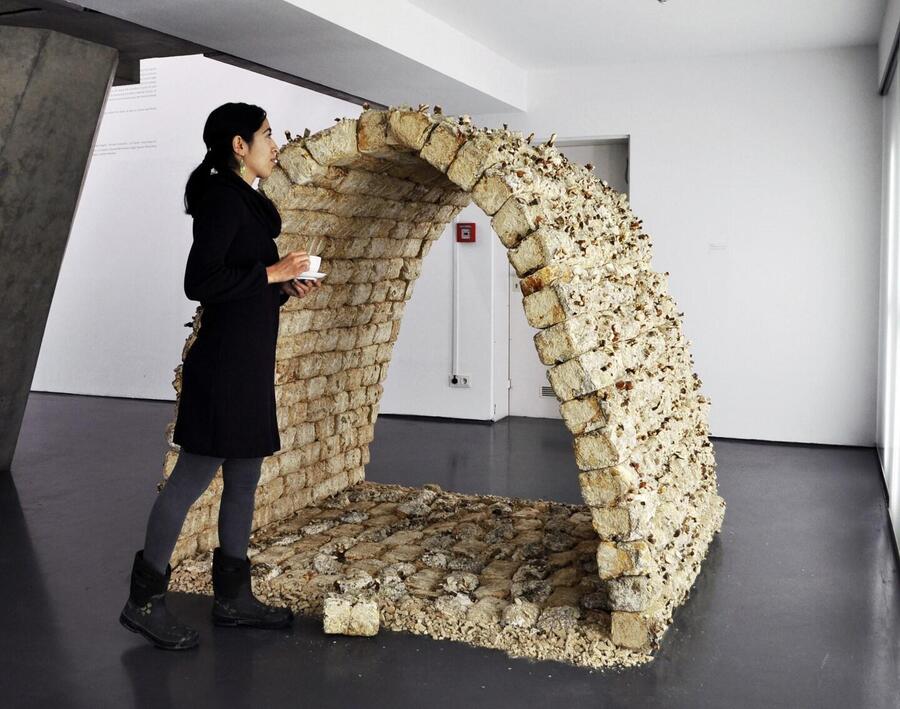
By Aaron Leitko
«Mushrooms may become a building material; archaeologists probe caves in Nepal»
Today, mushrooms are becoming not just an image but a material for creativity. Artists and designers are experimenting with mycelium—the vegetative part of fungi from which lightweight biomaterials can be grown. This allows for the exploration of new ways to create sculptures, furniture, lighting fixtures, and decorative objects, while also raising issues of ecology and sustainable production.
Touch-Control Dome Mushroom Frosted Ambient Table Lamp
In contemporary art, fungi inspire artists not only through their appearance but also through their biological properties. Their ability to form complex underground networks, thrive in unusual conditions, and participate in natural cycles forms the basis of artistic exploration. Designers draw upon fungal forms when creating furniture, lighting, textiles, and decorative objects. Furthermore, mycelium is being utilized in the development of new materials, bridging artistic creativity with ecology and technology.
Mushrooms are fascinating because they combine opposing qualities: they can seem delicate yet resilient, familiar yet mysterious, attractive yet dangerous. This allows artists to create multifaceted imagery that evokes diverse emotions and associations in the viewer.
The Symbolic Meaning of Mushrooms
In art, mushrooms can symbolize various ideas:
- Life and death—mushrooms participate in the decomposition of organic matter and the cycle of life.
- Rebirth and change—the appearance of mushrooms is linked to natural renewal processes.
- Mystery and the unknown—the mycelium hidden underground is associated with unseen connections.
- Human connection to nature—mushrooms serve as a reminder of the interdependence of living organisms. The meaning of mushrooms depends on the culture, era, and the artist’s intent.
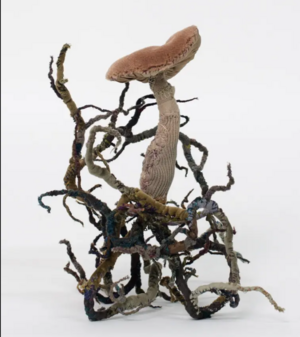
Lynda Draper Australian, b. 1962
Lynda Draper is an Australian visual artist who works primarily in ceramics
The main feature of fungi in art is that they can simultaneously serve as an image, a symbol, and a material for a work of art. This is precisely what makes them an interesting subject for the study of both traditional and contemporary art.
The Role of Fungi in Painting
Mushrooms have been an ancient subject, inspiring artists throughout history. They have influenced various aspects of art, from the psychedelic era of the 1960s, when mushrooms evoked creative visions, to the appearances of fungi in Medieval art.
The symbolism of mushrooms is visible even in Christian paintings, such as Hieronymus Bosch’s «The Garden of Earthly Delights,» which features a red fly agaric. The complexity of this painting’s symbolism has been shrouded in numerous scientific interpretations; however, one possible reading suggests a connection between the mushroom and the temptation of humans to alter their consciousness using psychotropic substances.
Galkin Ilya Savich. Mushrooms.
Kuklin Leonid Vladimirovich. First Fungi. 1907.
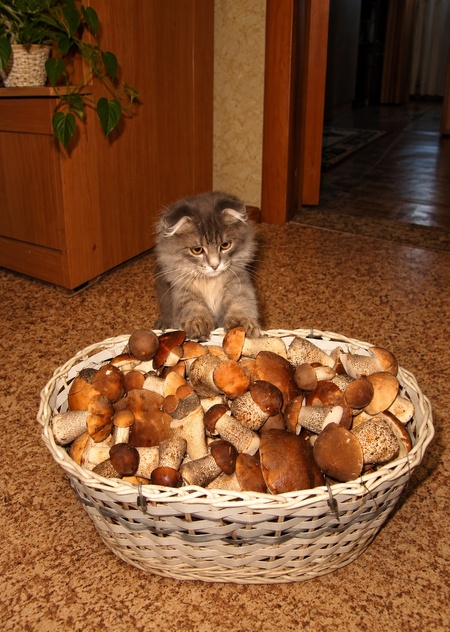
Who doesn’t love mushroom picking? I think it’s one of the most popular hobbies in Russia. But after coming home with a basket full of magnificent porcini, aspen mushrooms, and russula, don’t you want to somehow capture all that beauty? So you can admire it yourself, recalling the bountiful mushroom season, or share it with others. Now, it’s easy to do—everyone has a smartphone in their pocket, and anyone can take a reasonably decent picture. But a hundred years ago, none of that existed. However, there was always skill and inspiration, which allowed genuine masterpieces to emerge from the painter’s brush. It is also very interesting to discuss the significance—then and now—of mushrooms in Russian and global painting.
The Use of Fungal Imagery in Contemporary Art
In recent years, interest in fungal imagery in art has been growing, as mushrooms symbolize both the beginning of life and death. The exhibition «Rooted Beings» at the Wellcome Collection in London combined collections of fungi and artists' works to illustrate the connection between humans and the environment and the ecological crisis.
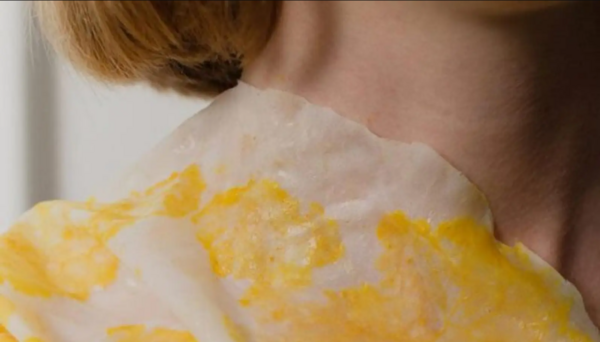
Some artists, such as Xiaojing Yan and Jay Lim, use fungi in projects related to life extension and immortality. They create sculptures from mycelium and mushrooms, as well as burial suits capable of transforming a deceased body into mycelium.Other artists, like Maurizio Montalti and Nur Mobarak, explore the theme of decomposition through fungi in art, sparking interest in ecosystems and new technologies. These projects allow artists to investigate new possibilities across art, architecture, and biotechnology.
Inspiration from Fungi in Music