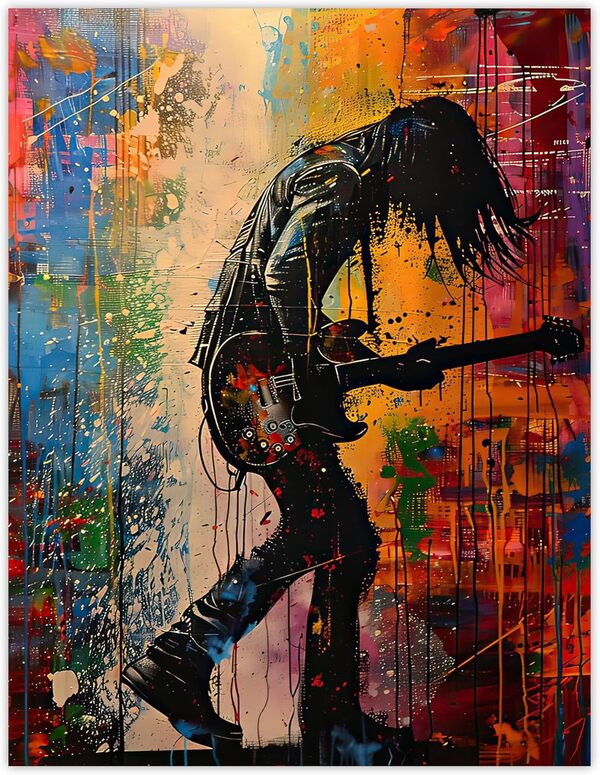
«Just because you’re paranoid / Don’t mean they’re not after you.»
Table of Contents:
Introduction
Part 1. The Body as Weapon and Victim
· Punk and Black Metal · John Lennon. Bed-in for Peace
Part 2. The Body as Remnant (Grunge)
· Seattle, Flannel, Visual Style · Nirvana and Alice in Chains. Paranoia and the Panopticon · Sound and Lyrics. Rejection of Politics · Letter to Geffen. Comics from a Diary
Part 2. Cobain’s Mentors and Allies
· Meat Puppets, The Vaselines, Daniel Johnston · The Melvins, Mark Lanegan, PJ Harvey (slides)
Part 3. Capturing the System
· MTV, Rolling Stone, Marc Jacobs
Part 4. Cyber-Schizoid
· Nine Inch Nails, Radiohead, Crystal Castles
Part 5. What Remains
· Post-Grunge and Nostalgia
Part 6. Conclusion
· Conclusions. Six Modes of the Body
Bibliography and Image Sources

Posing the Question
Various countercultural movements of the 20th century have left behind distinct visual traces that continue to serve as identity markers. Punk captured broken instruments and aggressive poses; hip-hop cemented wide-leg pants and gold chains; and black metal created corpse paint and images of ritual aesthetics. Grunge, for its part, left behind flannel shirts—a garment that is now sold in every chain store and worn by students worldwide, though the flannel in early photos of Nirvana and Alice in Chains looks entirely different. The bodies of the musicians in these pictures do not challenge or perform for the audience; they stand on stage with their heads bowed, as if trying to minimize their presence or simply dissolve into the air.
This study asks how this body is constructed—why it does not fight, scream, or display aggression in the presence of viewers, but instead exists in a state of slow fading, unseen, amidst internal decay and chronic pain. The work is structured around several modes of bodily presentation that can be traced from 1970s punk to the digital underground of the 2000s.
Structure and Methods
The first section examines punk and black metal—a mode in which the body functions as both weapon and victim, offering itself up for the audience’s catharsis. Next, we analyze the rupture introduced by John Lennon in 1969 when he lies in bed and stills all movement, transforming inertia into a political gesture. Subsequently, grunge is analyzed as a moment when the body loses its last connection with the viewer, becoming fuel for sound—a consumable material rather than a sign or a symbol.
Separate sections are dedicated to bands and musicians whom Cobain regarded as his teachers or allies: Meat Puppets, The Vaselines, Daniel Johnston, The Melvins, and Mark Lanegan. PJ Harvey is examined separately, whose female body in grunge functions differently, evolving from an object of the gaze into an instrument of control over that gaze. Finally, a fourth mode is introduced—the cyber-schizoid (Nine Inch Nails, Radiohead, Crystal Castles)—where the body becomes an interface for digital overload, and resistance to the system is enacted through its hypertrophy.
The material consists of photographs, music videos, magazine covers, letters, and drawings from Kurt Cobain’s diaries. The theoretical foundation draws upon the works of Michel Foucault (Panopticon, biopolitics), Guy Debord (Society of the Spectacle), Jean Baudrillard (simulacra), Gilles Deleuze and Félix Guattari («body without organs»), as well as Mark Fisher (capitalist realism and cyber-psychedelia).
Part 1. The Body as Weapon and Victim
Punk, hardcore, and black metal: musicians use their bodies as material for a public ritual, transforming the stage into a space of ultimate tension.
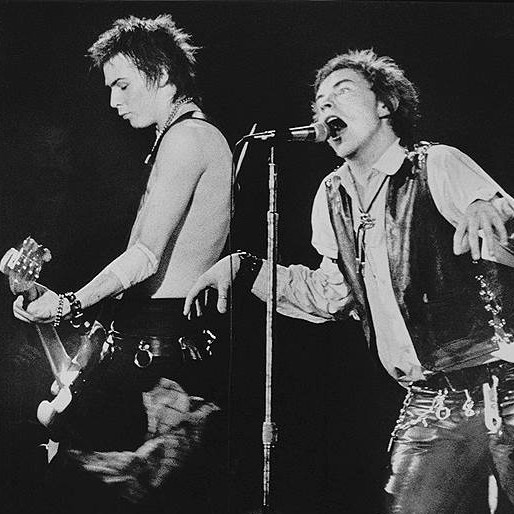
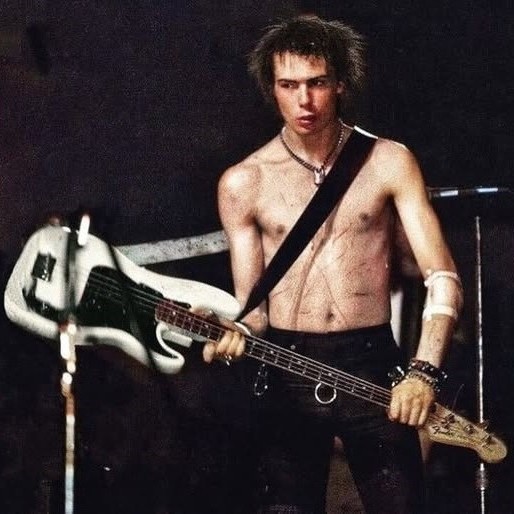
Sid Vicious. Sex Pistols
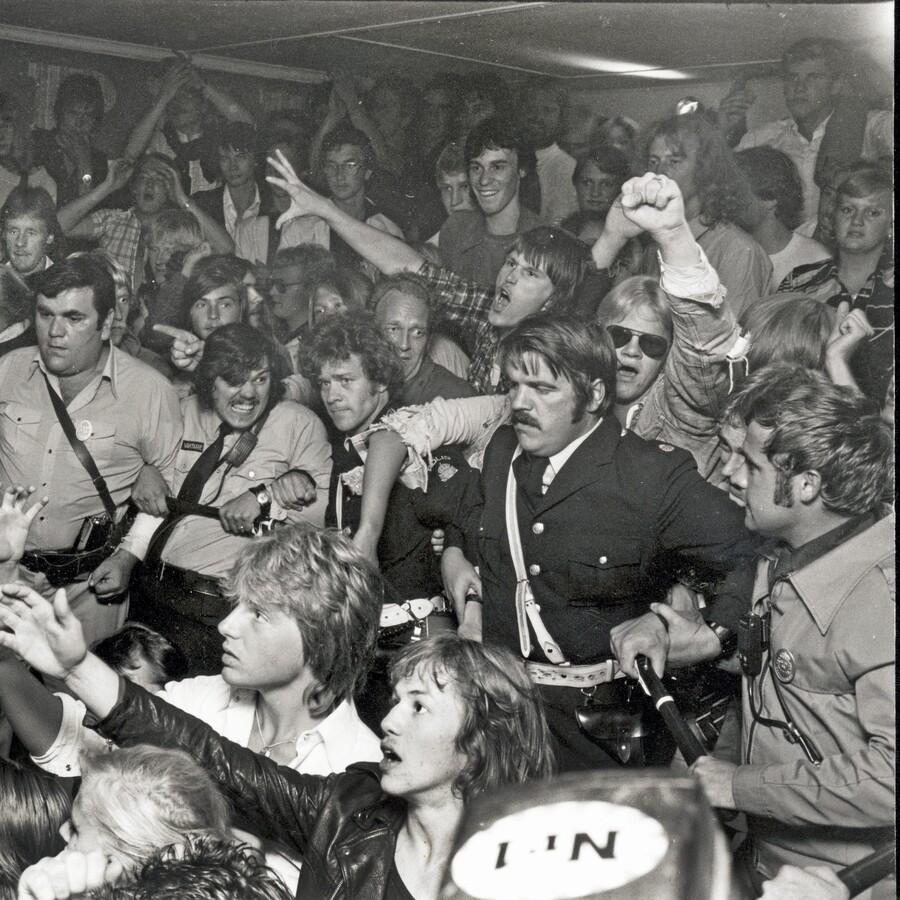
Dead from Mayhem. Black metal
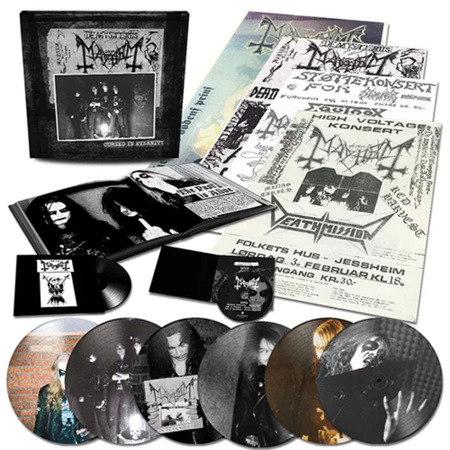
Black metal advances the ritualization of stage performance further than punk. Dead applies corpse paint, transforming his face into a skull, and creates a stage persona that balances between life and death. This photograph from a box set shows how Dead’s image was commodified decades after his death. His face adorns vinyl records, posters, and T-shirts, even though in life he was a marginal figure even within the black metal scene. The gesture demands witnesses, and Dead looks into the camera; Michel Foucault, in Discipline and Punish, describes public executions of the old regime, where the criminal’s body was tortured in the square so that the entire crowd might remember the king’s power, and punk and black metal invert this schema—now the musician himself becomes the object of the ritual, demonstrating the limits of human endurance, even though the structure remains the same: there is a stage, an audience, and an intense spectacle.
In both cases, the body functions as a sign referring to something beyond itself. The gestures of Sid Vicious and Dad signify suffering, resistance, or sacrifice, yet they are always directed toward the viewer and presuppose a response because the addressee is present. The body does not belong to the individual; it belongs to the gaze, and this very belonging constitutes the essence of the ritual mode that will be problematized by subsequent generations of musicians.
In the late 1960s, a figure emerged who broke this pattern, replacing active action with passive inertia—a substitution that would become a crucial bridge to grunge.
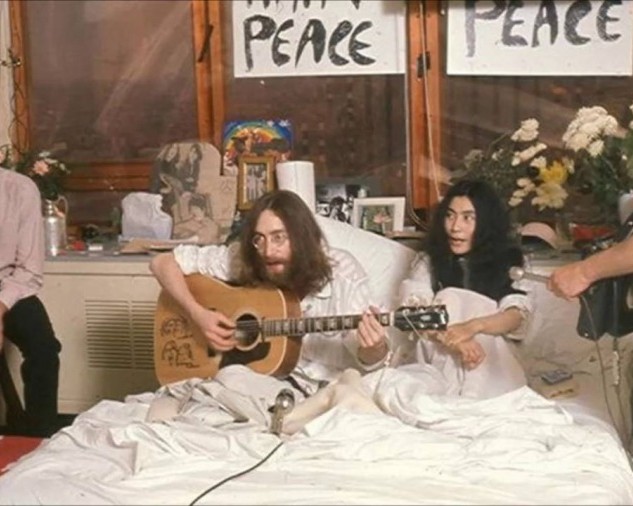
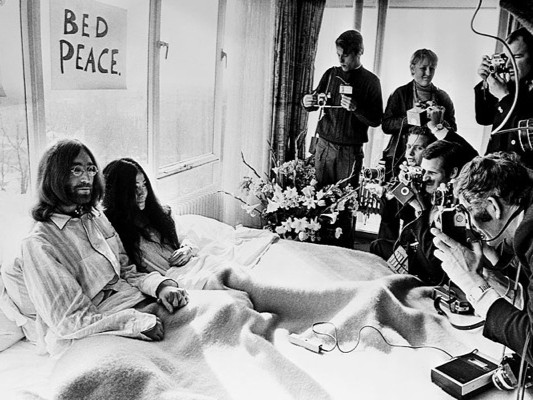
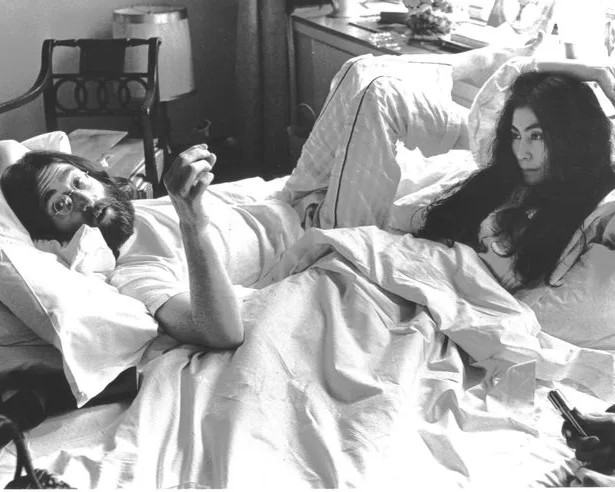
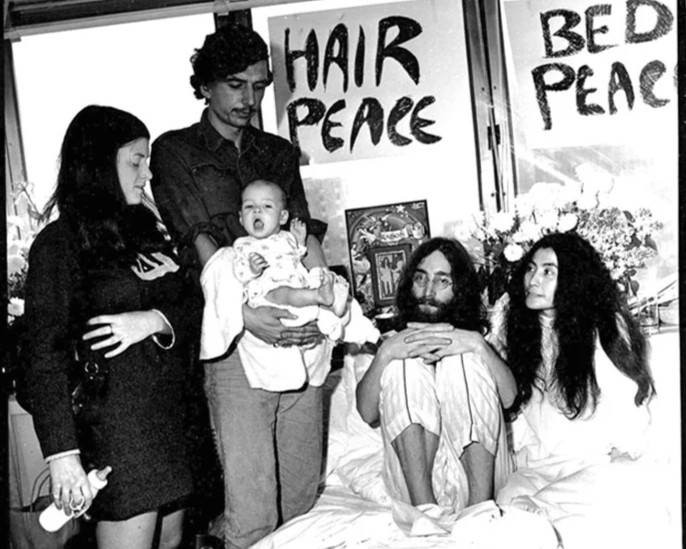
Lennon’s Death as a Symbolic Watershed
In 1980, Mark Chapman shot Lennon outside his New York home. Lennon was returning from the recording studio, holding tapes of songs for the album Double Fantasy, dressed in a plain coat—without any heroic posture or security detail. The shot did not strike the symbolic body that had graced stages and appeared in bed before cameras for decades, but rather the ordinary body walking home from work. This event helps explain much of the grunge movement; the counterculture had lost a figure who transformed inaction into a political gesture, forcing the next generation of musicians to find alternative ways to engage with the body.
Part 2. The Body as Remnant (Grunge)
Grunge from Seattle: flannel, altered states of consciousness, and the pose that turns away from the camera because faith in the viewer has been lost.
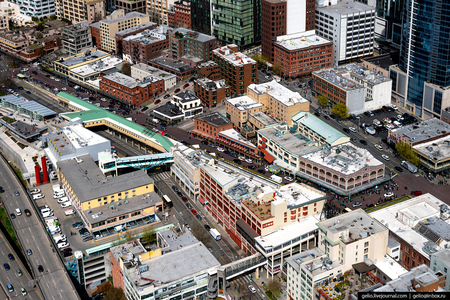
The Genesis of Grunge. Late 1980s Seattle
Grunge emerged within specific geographical and economic conditions that are rarely accounted for in purely musicological histories of the genre. Seattle in the late 1980s was losing factories from Boeing and lumber mills, leaving young people unemployed and without prospects. Some of these jobless individuals picked up guitars. The scene took root in basements—damp and heavy with atmosphere—and the musicians were not concerned with pleasing an audience, because for them, the public was just as adrift. Thus, they played slow, dirty music and did not rely on applause.
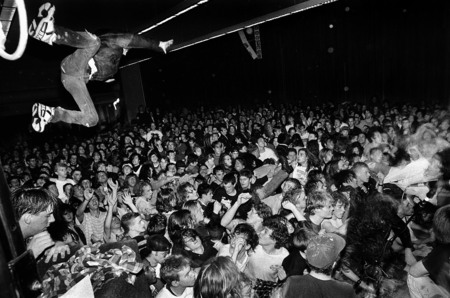
Charles Peterson. The Visual Aesthetic of Grunge
Charles Peterson, the lead photographer for the Sub Pop label, shaped the visual aesthetic of grunge precisely because he photographed bands in basements and clubs using a wide-angle lens and direct flash, almost never asking them to pose. Jonathan Poneman, the founder of Sub Pop, describes Peterson’s work this way: «Charles was a fundamental component, especially in the very beginning. His photographs conveyed the very essence of this music.» Peterson doesn’t glamorize grunge or turn it into a polished affair. He captures it as a document—where film grain and dim lighting function not as an artistic device, but as a direct result of the fact that the basement was genuinely dark and grimy.
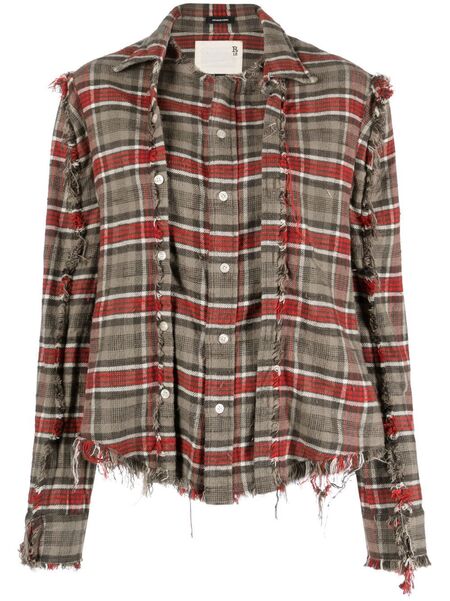
Flannel Shirt as a Rejection of Messaging
The flannel shirt in 1980s Seattle was the uniform of a warehouse worker, one Cobain bought at a thrift store, and it was always two sizes too big for him because he either didn’t have the money or the desire to tailor his clothes. The shirt hangs loosely on his body—it neither emphasizes nor conceals his physique. It simply exists, and in this clothing, there is no message. Instead of proclaiming, «I am a rebel» or «I am beautiful, ” it asserts, „I don’t care how I look because nobody truly sees me anyway.“

Ripped Jeans: A Trace, Not a Statement
The holes in grunge jeans differ from those in punk in both their origin and the meaning they convey. Punks deliberately and aggressively create holes—as part of a rebel’s uniform—while hippies wear jeans until they naturally wear out, unconcerned with appearance. Grunge gets its holes from prolonged neglect, lack of money for new clothing, and a complete indifference to outward appearance; thus, the hole here is a sign of weariness and a lack of care for presentation.
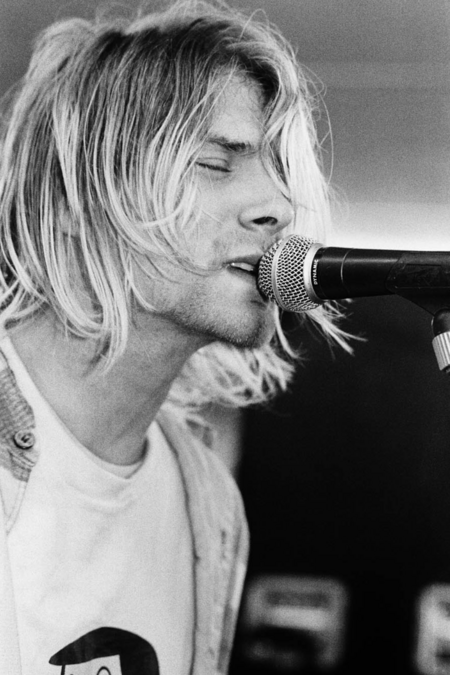
Nirvana at Beehive Records. August 1991
In this shot, Cobain lowers his head, letting his hair fall across his face, closing his eyes against the camera because he shows no interest in whether anyone is capturing him. Chris Novoselic, Nirvana’s bassist, recalled this concert: «After that show, everything changed. We weren’t that old group anymore; Kurt retreated.» Cobain stops believing in the existence of the viewer as an audience; the camera is meaningless to him because he doesn’t know who he’s playing for. In metal, the musician stares into the lens with sparkling eyes; in punk, he spits at the camera—but Cobain simply turns away out of exhaustion.
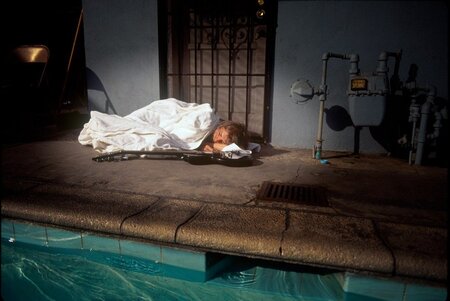
Nevermind Photoshoot. Kirk Weddle
Photographer Kirk Weddle gathered a group early in the morning at a Los Angeles pool, where the water was icy. In this shot, Cobain looks exhausted and withdrawn. He sleeps as if trying to minimize his presence or dissolve into the twilight. The photographer added a guitar to the frame, expressing a pose of someone consumed by their passion but unwilling to be seen.
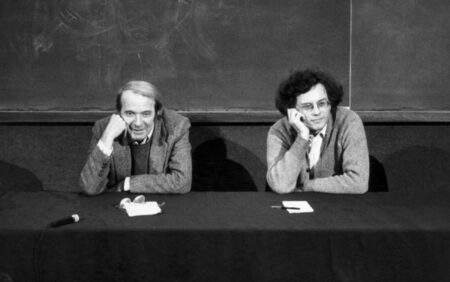
Body without Organs. Deleuze and Guattari
Gilles Deleuze and Félix Guattari introduce the concept of the «Body without Organs» in their book A Thousand Plateaus (1980), describing a body that has shed all social roles and compulsory functions—ceasing to be strong, beautiful, sexual, or aggressive—and begun simply to exist. Cobain’s body in most photographs approaches this state. He likely never read Deleuze, but grunge, as a cultural form, spontaneously found this gesture. Without calling for anything, the body simply occupies space on stage, emitting sounds. And Cobain finds himself in this pose, without deliberately choosing it.

Paranoia and the Panopticon
The line from «Territorial Pissings”—“Just because you’re paranoid / Don’t mean they’re not after you”—becomes a key to interpreting grunge because Cobain isn’t just describing a state of fear; he is documenting a reality. The surveillance system is always active, even when it is unseen, making paranoia an adequate response to the world as it is. Michel Foucault explains this state through the concept of the panopticon—a prison where the guard sits in a high tower, and the inmates do not know if they are being watched, leading them to behave as if they are constantly under surveillance. Foucault extends this model to all of modern society, and Cobain translates this logic into a musical gesture. For the musician, there is no point in looking into the camera, because the camera is already inside.
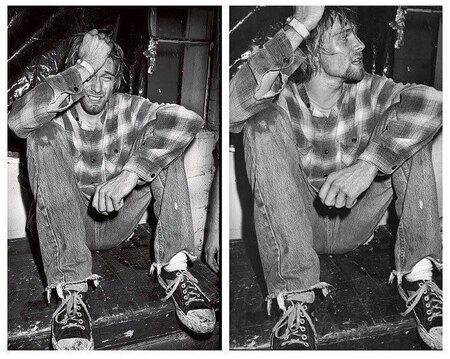
Cobain’s Physical Pain as a Factor
Another factor is added here, one rarely considered in cultural analyses of grunge: Cobain suffered from chronic stomach pain, doctors could not provide a diagnosis, and he screamed on stage not only from despair but also to drown out a physical pain that held no social significance and did not refer to any system. The body ached on its own, independent of capitalism and the panopticon, and grunge became a way to transform this pain into sound—that is, pure vibration—that lasted three minutes, vanished, and ultimately left only noise.
Lane Staley. Alice in Chains
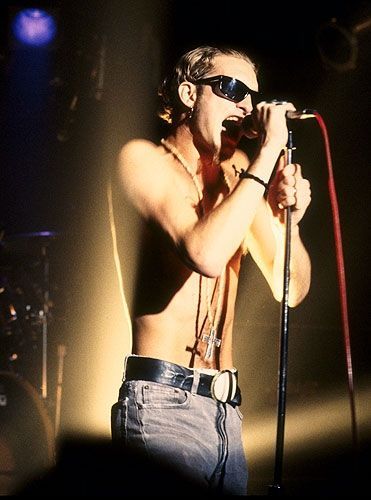
Lane Staley charts a different trajectory within grunge because his posture is so exaggerated that the line between expressing pain and theatricalizing it begins to blur. He bends over, gripping the microphone with both hands, his face contorted in a grimace that is impossible to imitate, yet which the camera fixes as an image. Instead of screaming toward the audience, he seems to sing into an inner void, but unlike Cobain, Staley still maintains a belief in the possibility of change, warning in interviews about the destructive consequences of a certain lifestyle—drawing a boundary between right and wrong that Cobain no longer does.
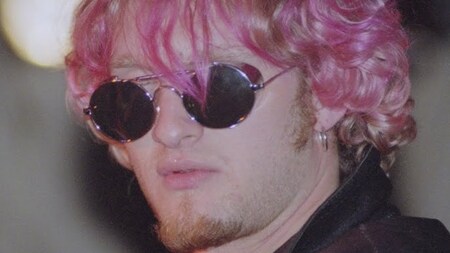
The Passing of Lane Steely
In 2002, Steely died in his apartment. His mother found his body two weeks later after he stopped answering calls, but neither neighbors nor friends raised an alarm. This ending illustrates grunge in its purest form—the body vanishes without witnesses, without making a public gesture on stage, and without leaving a farewell letter; it simply ceases to exist in his room, and the camera does not capture his final moments because grunge achieves its logical conclusion in the complete absence of an audience.
The Sonic and Semantic Texture of Grunge

Dynamics
The sound of grunge continues the same logic as its visual aesthetic: Nirvana borrows the «quiet-loud-quiet» dynamic from Pixies, but Cobain infuses it with a different substance. The verse sounds like a whisper from under a blanket, the chorus explodes into a scream, and then it settles back into a whisper—but one marked by breakage, rasp, and the sense that the voice never recovered from the preceding explosion. The listener is not hearing song dramaturgy or a structure built around a climax and resolution. Instead, they are observing fragmented selves, adrift and unsure of their place, and the volume does not serve to amplify meaning but to register a loss of control.