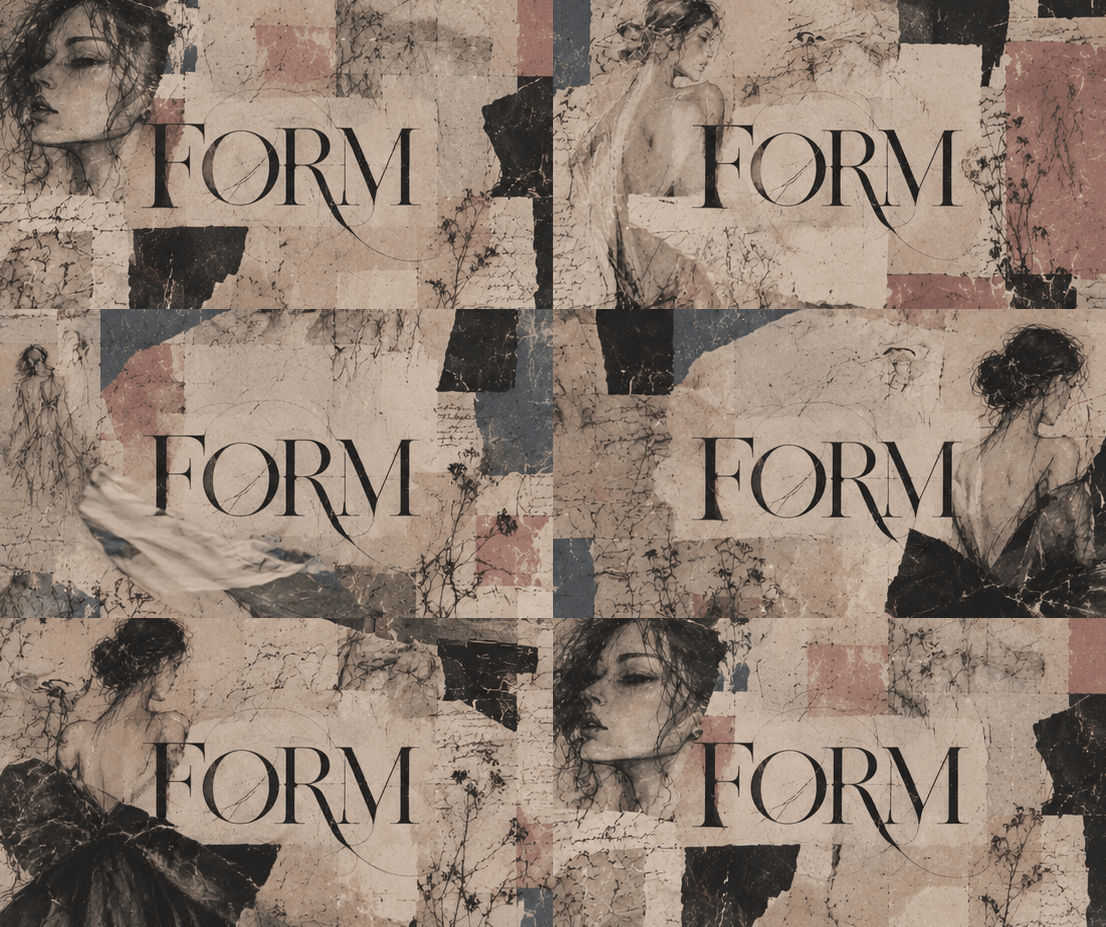
Media on the history of fashion through the origin and construction of design solutions. How an idea becomes clothing.
MEDIA GOAL
FORM—a digital media platform about the history of fashion that encourages viewing clothing not merely as an outcome, but as a consequence of specific ideas, circumstances, and design decisions.
Fashion history is typically narrated through dates, names, collections, and iconic items. FORM is interested in the next level: why these items adopted a specific shape and what motivated their emergence.One study connects:
designer $\rightarrow$ era $\rightarrow$ personal and cultural context $\rightarrow$ sources of inspiration $\rightarrow$ collection $\rightarrow$ specific object $\rightarrow$ form $\rightarrow$ construction.
This approach allows us to view clothing as the result of a thought process, rather than as an isolated visual object.
USER PROBLEM
There is a lot of information about the model, but it exists in fragments.
To truly grasp the history of a single object, one must now consult various sources. A designer’s biography is in one place. Collection photographs are in another. The history of an era is in a third. Information about the source of inspiration is in a fourth. And there might not even be a separate document detailing the construction of a specific item.
Ultimately, the core task is often not finding information, but weaving it together. The user must independently determine:
What information relates to a single theme? What sources are trustworthy? What was the original source of inspiration, and what is a later interpretation? How is the historical context connected to a specific collection? How did the idea manifest directly in the clothing? What structural solutions allowed for the desired form?
The form makes this connection part of the media product itself.
The problem isn’t that there’s nothing to learn about fashion. On the contrary, there is so much information that research easily devolves into a collection of isolated tabs, images, and quotes. You can quickly find Alexander McQueen’s biography, but that is insufficient to understand his work. The following questions demand a different level of inquiry:
What shaped his visual language?
What historical and cultural sources did he reinterpret?
Why are his silhouettes constructed in this specific way?
What ideas recur across his various collections?
How does a specific source of inspiration transform into clothing design?
What construction techniques create this visual effect?
The form is built around these questions, not simply around providing reference information. Therefore, the primary unit of content is not a biography or a news article—it is an exploration of a specific design solution.
WHAT THE USER GAINS
FORM offers three levels of work with fashion:
UNDERSTAND Grasp the historical and cultural context. SEE Learn to notice the connection between the source, form, proportions, and details. APPLY Use the principles discovered as material for your own research and design.
The foundation is a network of interconnected objects: designers and their creative biographies, fashion houses and the history of their development, historical periods and their cultural context, sources, motives, and visual ideas. Collections—their concepts and context—as well as individual garments, their constructive and technological features. This allows the same material to exist in multiple contexts simultaneously. A user can begin an exploration from any object.
For example, you can open a dress and navigate: dress → designer → collection → era → inspiration source → other pieces → design solutions.
Or you can start from the source: architect → designers who referenced his work → collections → specific models.
Or you can start from a historical period: era → cultural changes → designers → new silhouettes → specific garments.
TARGET AUDIENCE
COMPETITIVE ENVIRONMENT
FORM identifies several types of competitors:
DIRECT — media and educational projects that systematize fashion history. VISUAL ARCHIVES — museum collections, fashion house archives, and image platforms. RESEARCH SOURCES — museums, libraries, books, exhibition catalogs, and academic publications. SUBSTITUTES — search engines, Pinterest, and AI assistants.
The last group is especially important: the user already knows how to find information independently. Therefore, FORM does not promise him «just more information about the fashion.»
- FASHION HISTORY TIMELINE
The Fashion History Timeline from FIT organizes fashion history through archival materials, imagery, and object analysis.
Its strength lies in its chronological structure and its utilization of museum and educational resources.
FORM operates on a different organizational principle:
it focuses not only on «what happened in fashion history, ” but also on „how a specific design decision emerged within that history.“
- THE MET COSTUME INSTITUTE
The Met possesses a vast collection of historical clothing and accessories, as well as professional research and conservation infrastructure.
Its value lies in working directly with the historical artifacts and museum sources themselves.
FORM does not attempt to replace the museum.
Its objective is different—to connect an individual object to a broader system of context and to show its place among other design solutions.
- VOGUE RUNWAY
Vogue Runway is valuable primarily as a large-scale visual archive of shows and collections.
FORM uses imagery differently.
The image here is not the final result of a search, but the beginning of an exploration.
After viewing a photograph, the user should be able to navigate to the designer, the collection, the source of inspiration, the form, and the constructive analysis.
- SEARCH ENGINE & AI
FORM does not compete with these for the speed of receiving a single answer.
The difference lies in the structure of the process.
SEARCH ENGINE
Query $\rightarrow$ Multiple results
The user selects the materials and connects them themselves.
AI
Question $\rightarrow$ Formulated answer
The user receives a synthesis of information, but they still determine the subsequent research trajectory.
FORM
Object $\rightarrow$ Context $\rightarrow$ Relationships $\rightarrow$ Visual analysis $\rightarrow$ Next object
The research path is already built into the product’s structure.
CORE COMPETITIVE ADVANTAGE—NOT MORE INFORMATION, BUT LESS EFFORT TO CONNECT IT.