Media Concept and Goal
Concept:
A media navigator, «Frameless, ” for Moscow’s exhibitions and visual arts. It helps users find a suitable exhibit, understand the purpose of attending, and gain basic context before visiting.The media integrates current exhibition listings, editorial selections, and easily digestible context about art—including artists, specific works, genres, and movements.User Problem:
Information about exhibitions is scattered across museum websites, event listings, city media outlets, and social networks. While users can see the exhibition title, dates, and description, they often cannot determine if it is right for them or if it is worth their time and money.Goal:
To create a media tool that allows a person to quickly find a relevant exhibition and understand why they should attend, even if they are not deeply knowledgeable about art.Media Topics
Segment:
1. Culture; 2. Visual Arts; 3. Urban Cultural Leisure.Niche Topic:
Exhibitions and visual art for people who are interested in art but need a simple way to choose an exhibition and get the necessary context before visiting.Media Components:
1. Poster/Flyer; 2. Curated Selections and Guides; 3. Artists; 4. Disciplines/Movements; 5. Interactive Features.Naming
«Without Borders» plays on both the literal frame of a painting and the concept of transcending conventional boundaries of artistic perception. The title supports the project’s format, where the poster connects with a clear explanation of what to see and why.
Competitors and their analysis

Selection Methodology:
Competitors were sourced through searches such as «exhibitions Moscow,» «Moscow exhibition listings,» «modern art exhibitions Moscow,» «where to go to an exhibition,» «exhibitions of the week Moscow,» and «art media.» Additionally, we analyzed competitors' official websites, their exhibition sections, social channels, newsletters, apps, and public audience data.To gauge audience reaction, we utilized available public data: app reviews, comments, saves, the LiveDune service, and proprietary platform data concerning high-engagement formats.
6 Analysis Criteria:
1. Platforms; 2. Content Adaptation; 3. Visual Style; 4. Tone of Voice; 5. Audience Reaction; 6. Tools.How Competitors Are Segmented
1. Direct competitors solve the most closely related user problem: they help users find an exhibition in Moscow and provide additional editorial context.Indirect competitors compete for the same time and attention of the audience interested in cultural leisure in Moscow, though exhibitions and visual art are only one part of their content.
Potential competitors do not replicate the entire project concept but already possess an audience, content, or service infrastructure that allows them to approach it relatively easily.
Direct Competitors
1. ArtGuide
A specialized Russian media outlet focusing on art, featuring sections for events, exhibition selections, institution addresses, and editorial content. The project’s Telegram channel describes «ArtGuide» as a journal dedicated to the art scene and a platform for communication among art professionals and enthusiasts.2. KudaGo Moscow
A major city events service with a dedicated, well-developed exhibition category, filtering options, and listings for free events.3. Afisha
A service for discovering cultural events that includes a separate exhibition section, categories, ratings, curated collections, ticket sales, a mobile application, and editorial content.Indirect Competitors
1. Culture.RF
A federal cultural portal that aggregates event listings, cultural materials, lectures, and educational content.2. City x M24
A Moscow lifestyle media focused on the city, featuring dedicated coverage and selections of exhibitions alongside features on restaurants, cinema, music, urban life, and other leisure activities.3. Moskvich Mag
A city-focused media outlet offering curated articles on Moscow, cultural life, and exhibitions.Potential competitors
1. Yandex Afisha
A strong service competitor offering event search, ticketing, an application, categories, and personalized recommendations. While it is not currently a specialized art media outlet, it already possesses most of the infrastructure needed for an art navigator.2. Arzamas
A Russian educational project focused on the history of culture, literature, art, and anthropology.3. The Art Newspaper Russia
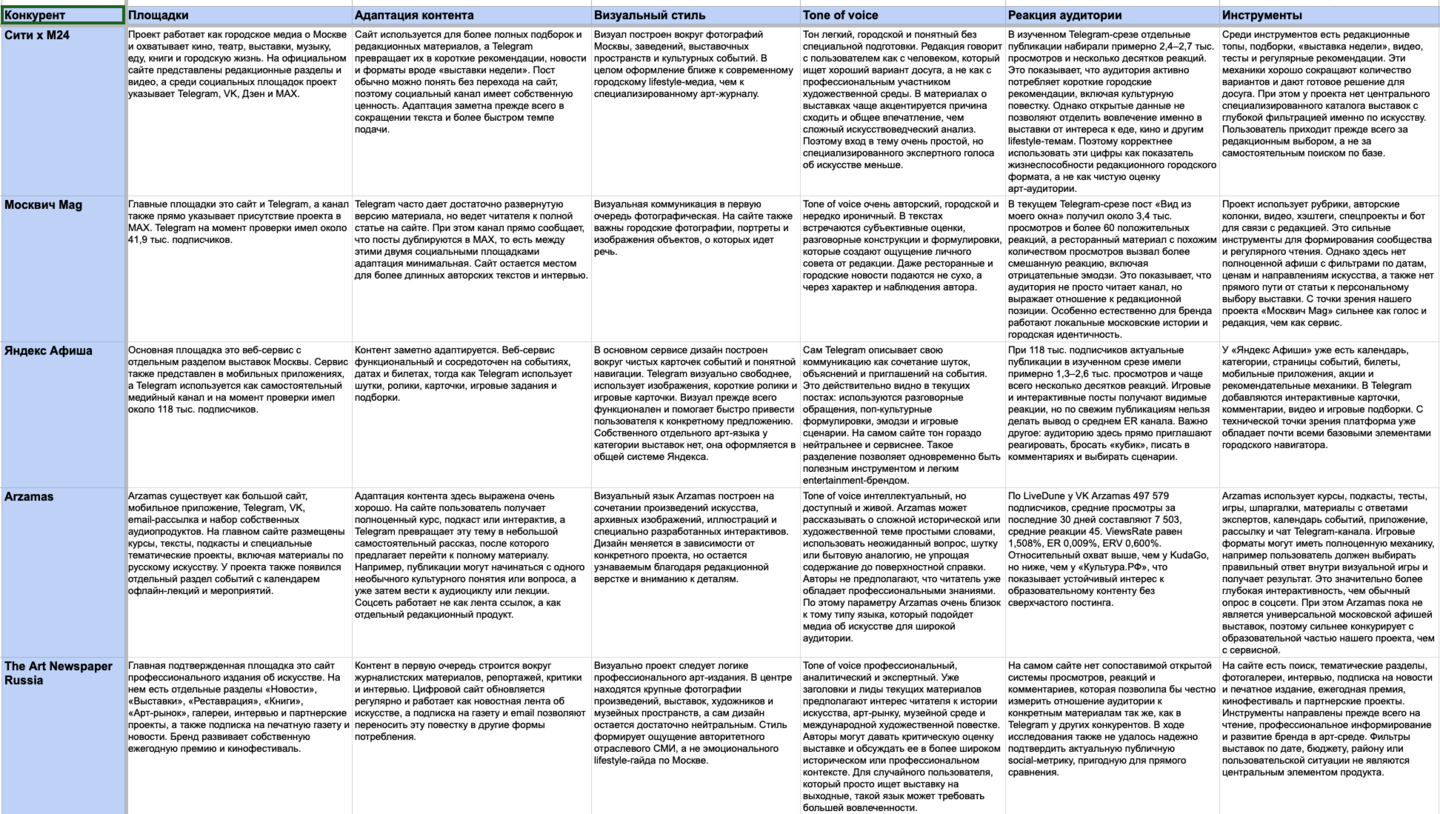
A professional art media outlet featuring news, criticism, reviews, and an exhibition section. Its primary focus is currently journalism about art, rather than a leisure-finding service.Comparative Analysis
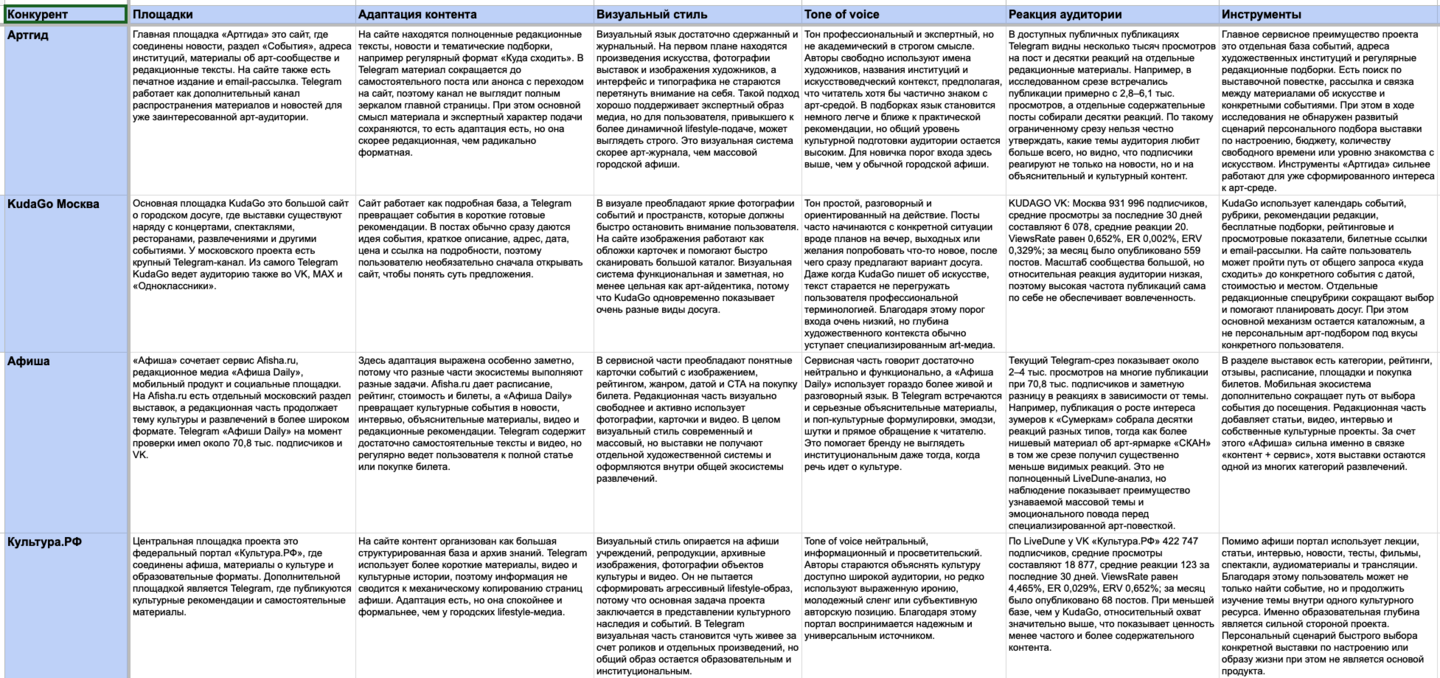
Conclusions

The Market is Split Between Services and Media.
KudaGo, «Afisha, ” and „Yandex Afisha“ do a good job of answering the question, „What’s happening and where can I go?“ They work with catalogs, dates, tickets, curated selections, and quick recommendations, but art is merely one category of urban leisure for them. Therefore, the context of a specific artist or artistic movement rarely becomes the central element of the product.«ArtGuide» Is Closest to the «Frameless» Project.
It’s on the same subject matter but targets a more informed art audience. It already integrates exhibition agendas with editorial content, events, and institutions. Furthermore, the language, thematic range, and overall visual aesthetic suggest a higher level of interest in the professional art scene.Editorial Curation is a Way to Manage Event Overload.
«ArtGuide, ” KudaGo, „City x M24, ” and other competitors regularly utilize formats like „Where to Go, ” „Editor’s Picks, ” „For the Weekend, ” thematic roundups, and „Exhibition of the Week.“ This means users value not just a comprehensive catalog, but also a curated selection that has already passed through an editorial filter.Content Cannot Simply Be Duplicated Across Platforms.
Arzamas, «Afisha, ” and „Yandex Afisha“ demonstrate the clearest difference between their primary product and their Telegram presence: the website holds the complete material or service, while the social media channel provides an independent narrative, a profile, a game, a video, or a quick prompt to proceed further.Arzamas Has the Most Promising Tone of Voice.
«ArtGuide» and The Art Newspaper Russia offer expertise, but they present a higher barrier to entry. KudaGo and «City x M24» are understandable to any user, but they usually fail to provide deep artistic context. Arzamas proves that a complex cultural topic can be explained in simple, relatable language without becoming simplistic.Interactivity Should Solve User Problems, Not Just Exist for Entertainment.
«Yandex Afisha» already offers gamified recommendations on Telegram; Arzamas features comprehensive quizzes and games; and mass-market event platforms provide filters and ticketing infrastructure.Distribution Channel
The website will be the primary channel for disseminating information. It will feature articles, event listings, collections, quizzes, program tracks, and exhibition recommendations.To encourage regular return visits, we will utilize a Telegram channel featuring content such as «Where to Go This Week, ” exhibition openings, brief facts, „Exhibition of the Day, ” and polls.
Target Audience Profile
Audience Type: B2C
The project operates under a B2C model because the primary user of the media is the general public—someone who wants to select an exhibition, learn more about it, or better navigate contemporary art.Initial Geography: Moscow.
Core Audience:
Residents of Moscow, approximately aged 18–35, who are interested in cultural leisure and visual art, though they differ in their level of engagement and the reason for visiting exhibitions.Audience Segments

Segment 1. «I’m interested in art, but I’m not very knowledgeable about it»
Anya, 22 years old Moscow, student / junior specialist. Interested in culture, film, music, and design; occasionally visits museums and exhibitions.
Context Anya sees photos of a new exhibition on social media or hears about it from friends. She feels interested in going, but the artist’s name or the movement doesn’t mean anything to her. Before visiting, she tries to find information online but encounters either very brief promotional material or lengthy art historical texts.
Need To understand in simple terms what the exhibition is about, why it might be interesting, and what is helpful to know before attending.
Problem Existing materials often assume the reader already understands art. Because of this, it is difficult for people to determine if an exhibition suits them or what they should focus on while visiting.
Desired Outcome To select an interesting exhibition and attend it with a basic understanding of the context, without having to study the subject for several hours.
JTBD When I see an interesting exhibition but know little about the artist or the movement, I want to quickly get a clear context to decide whether it’s worth going, and to better understand what I will see.
What the project offers this segment Exhibition cards with a short explanation of «why to go, ” articles written in plain language, materials on „what you need to know before visiting, ” and stories about artists, movements, and individual works.

Segment 2. «I want to go somewhere»
Maxim, 27 years old Moscow. He works in the digital field. He doesn’t follow art constantly, but he enjoys interesting city events and goes to exhibitions with friends or on dates a few times a year.
Context Maxim has a free evening or weekend. He wants to go somewhere and considers an exhibition as one leisure option. He opens several event listings and sees dozens of happenings, but it’s hard to know what to choose based on the titles alone. For him, specific details are important: what is on today, how much the ticket costs, where the exhibition is located, how much time the visit will take, and whether it aligns with his interests.
Need To quickly find an exhibition that fits a specific situation without browsing dozens of websites and events.
Problem Standard event listings offer a vast catalog, but the user has to figure out independently which exhibition will truly suit them.
Desired Outcome Within minutes, to find a suitable option for that evening or weekend and know what to expect from the exhibition.
JTBD When I want to go somewhere in my free time, I want to quickly find an exhibition that matches my mood, budget, interests, and available time, so I don’t waste an hour deciding.
What the project offers this segment Filters by date, budget, time, theme, and mood, as well as curated collections: «where to go on the weekend,» «free exhibitions,» «if you only have an hour,» «for a date,» «something unusual,» and «beautiful and visual.»

Segment 3. «I regularly attend exhibitions»
Sasha, 30 years old Moscow, works in media / communications. Is interested in contemporary culture and regularly visits museums, galleries, and cultural centers.
Context Sasha is already familiar with the major museums and large exhibition spaces in Moscow. He gets information about new events from Telegram channels, museums' social media, media outlets, and friends' recommendations. The problem arises because this information is scattered across numerous sources.
Need To track the current exhibition scene in Moscow in one central location and find not only the most well-known events.
Problem To stay informed, he has to monitor countless museums, galleries, media sources, and channels simultaneously.
Desired Outcome To quickly see new and relevant exhibitions, discover less obvious events, and save interesting options for later.
JTBD When I am planning a cultural week or weekend, I want to see relevant and interesting exhibitions in one place so that I don’t miss new projects and don’t have to check dozens of sources.
What the project offers this segment A unified, current events guide, an exhibition calendar, curated lists of new discoveries, information on smaller galleries and art spaces, the ability to save interesting events, and personalized recommendations.

Segment 4: «Seeking Visual Inspiration»
Liza, 24 years old Moscow, graphic designer. She is interested in photography, fashion, contemporary art, and visual culture. For her, exhibitions are a way to find new ideas and references.
Context Liza needs new visual experiences for her studies, work, or personal projects. She wants to see photography, typography, digital art, costume, architecture, or multimedia, but she has to search for relevant events in different sources. When choosing an event, the theme and visual language are more important to her than the exhibition’s popularity.
Need To find exhibitions and artists related to her professional and creative interests.
Problem Most event listings are organized by date or location, not by user interest. Therefore, it is difficult to quickly find, for example, exhibitions about photography, fashion, or architecture.
Desired Outcome To find an event that provides new visual ideas, introduces her to an artist or a discipline, and serves as a source of references.
JTBD When I need new ideas and visual inspiration, I want to find exhibitions based on my interests so I can gain new experiences and references for my projects.
What the project offers this segment Thematic collections and personalized recommendations based on interests: photography, design, fashion, architecture, film, digital art, multimedia, contemporary art; articles about artists and works; saving favorite exhibitions.
Unique Selling Proposition