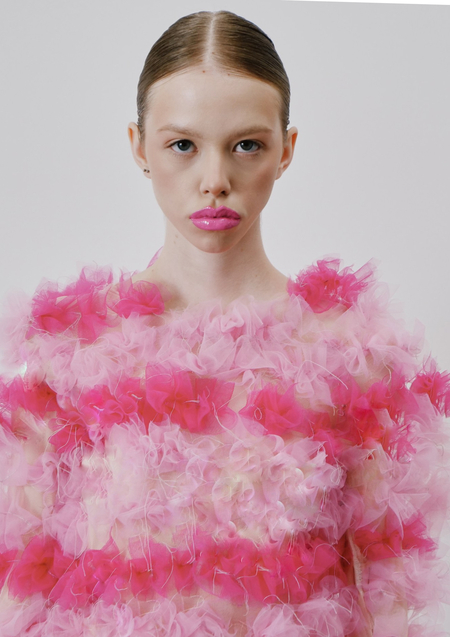
concept
Warm-up is the state in which the ballerina’s body exists before stepping onto the stage—the «before» of transforming into the idealized image. Warm-up attire marks the threshold between the mundane and the artistic, between the «self» body and the «other» scenario. Examining this visual layer allows for a fresh perspective on the ballerina’s image—not through the tutu and pointe shoes, but through the gaiters, sweaters, and striped trousers. In my project, I pay special attention to the semiotics of stripes—the tradition of ballet gaiters and sweaters that function both as a signifier of «insiders» and as camouflage. In my project, I pay special attention to the semiotics of stripes—the tradition of ballet gaiters and sweaters that function both as a signifier of «insiders» and as camouflage.
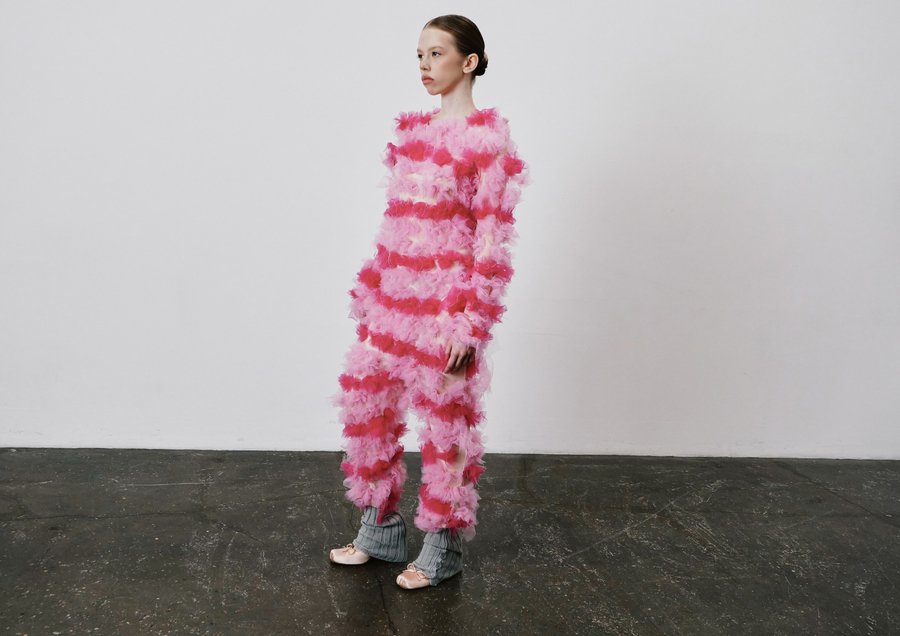
The jumpsuit was created as part of a project exploring ballet training wear. It captures the moment when the body transitions from the routine to the ideal. The design is based on a classic slim jumpsuit silhouette, complemented by the expressive addition of satin stripes that evoke the tutus of dancers.
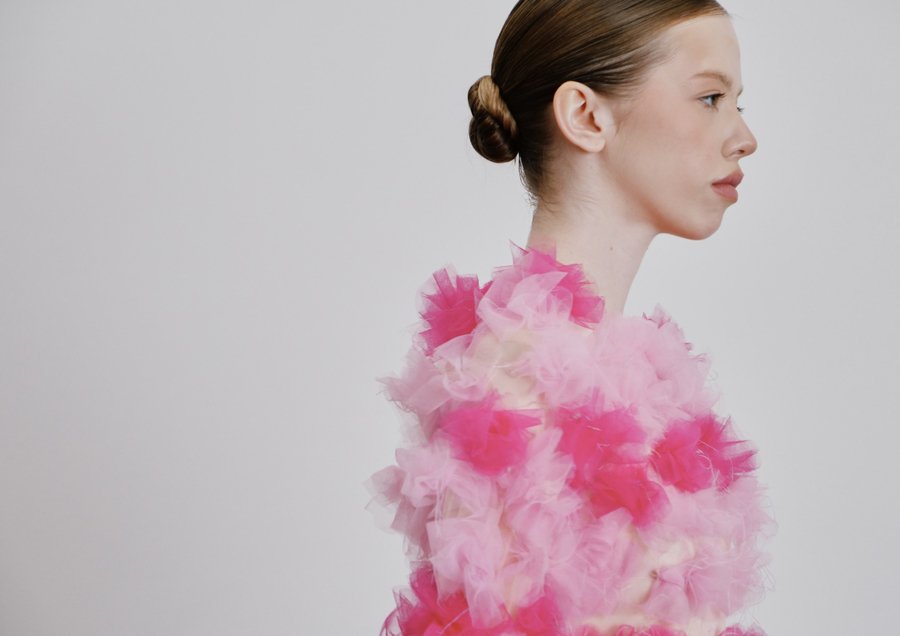
visualization
Technical Requirements
Designer Jumpsuit — a full jumpsuit made of elastic mesh, featuring decorative trim of multi-layered satin ruffles.The designed size is 42.The main garment parameters are calculated for size 42 with an assumed height of 170 cm. The silhouette is fitted, with long sleeves and trousers. The surface of the garment is adorned with horizontal bands of ruffles, alternating in color to create a pronounced, voluminous texture.Material — elastic mesh, ensuring comfortable fit and freedom of movement. The decorative trim is made of light satin gathered into multi-layered ruffles.Color — a combination of soft pink and vibrant bright pink.Decoration method — attachment of multi-layered satin ruffles onto the mesh base, forming alternating horizontal bands along the entire length of the jumpsuit.
The jumpsuit features a seamless construction, a fitted silhouette, and long sleeves and legs. The main material is an elastic mesh fabric, which ensures a snug fit and lightweight structure. The jumpsuit surface is decorated with voluminous, multi-tiered ruffles made of satin, arranged along the entire length of the garment. The neckline is finished with a facing made from the primary material. The construction accounts for the elasticity of the mesh and the characteristics of connecting it with the decorative elements.
Materials, cost estimation for manufacturing
Production of one experimental jumpsuit sample — 17,600 ₽.Cost to produce the main batch of 10 units — 176,000 ₽.Total budget for producing the experimental sample and the main batch of 10 jumpsuits — 193,600 ₽.Estimated retail price per jumpsuit — 25,000 ₽.
Stages of Production
- Sketching and Technical Description Development
Defining the silhouette, sleeve and trouser length, neckline shape, degree of fit, and placement of ruffles. Preparing front and back technical drawings of the garment.
2. Construction Development and Pattern Making
Creating basic patterns for the bodice front, back, and sleeves, accounting for the stretch of the mesh. Refining allowances for fit, garment length, and seam allowances.
3. Material Selection and Preparation
Choosing stretchy mesh fabric for the base and organza for the decorative ruffles. Preparing threads, elastic trim, and necessary sewing accessories. Testing the stretch and transparency of the materials.
4. Garment Component Cutting
Laying out the patterns on the mesh fabric, considering the stretch direction. Cutting the pieces for the bodice front, back, and sleeves. Separately cutting the organza into strips to achieve the required ruffle width and length.
5. Assembling Main Components
Joining the bodice front and back pieces along the shoulder and side seams. Setting in the sleeves, finishing the crotch and inseam of the trousers. If necessary, installing the closure and trimming the neckline with elastic trim.
6. Creating Decorative Ruffles from Organza
Cutting organza strips, gathering them by machine stitching, and shaping voluminous folds. Preparing ruffles of uniform length and density, sorting elements by width and fullness.
7. Attaching Ruffles to the Jumpsuit
Marking the lines for the placement of decorative elements on the front and back sections, sleeves, and trousers. Sequentially attaching the ruffles in rows, ensuring even distribution of volume and symmetry.
8. Edge Finishing and Final Assembly
Finishing the bottom hems of the sleeves and trousers, the neckline, and other open edges. Securing the ends of the seams, removing excess threads, and checking the security of the ruffle attachments. Finishing must account for the stretch of the mesh.
- Fitting and Sample Adjustment
Checking the fit against the body, range of motion, garment length, and sleeve length. Evaluating the transparency of the mesh, comfort when worn, and evenness of the ruffle placement. Modifications to the patterns and construction are made if necessary.
10. Final Finishing and Quality Control
Performing steam and heat treatment in a gentle mode suitable for the mesh and tulle. A final inspection of the seams, verification of the symmetry of decorative elements, defect removal, and preparation of the finished item for packaging.
Production Files
A set of two files—one containing the pattern pieces and one with the technical sketch—has been prepared as production materials.
The main files are prepared for a size 42, with a height of 170 cm and measurements of 76/58/87.
All files are prepared for further use while maintaining the original proportions and image quality.