Concept
The jazz club, as a space where music gains a material presence, has remained an active participant in shaping perceptions of jazz throughout the last century, rather than serving as a neutral backdrop for performance.Viewing the club as a cultural text, this study aims to reveal how architectural and environmental decisions reflect the evolution of jazz—moving from music for dancing to music for listening, from a subcultural laboratory to institutional heritage.The methodological foundation integrates art historical analysis, focusing on composition, light, and material, with environmental design approaches that consider layout, pathways, and functional zones as tools for programming behavior.

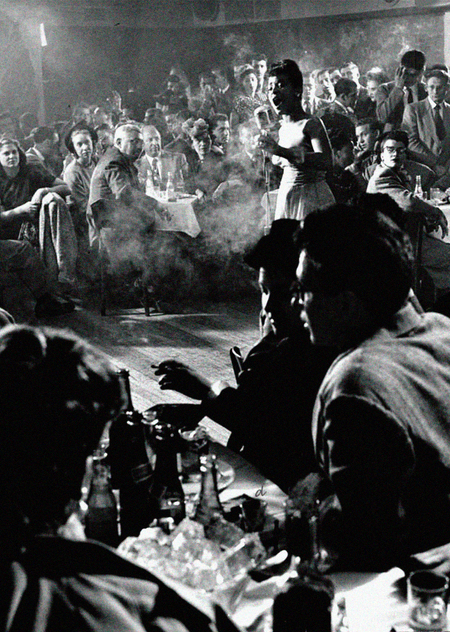
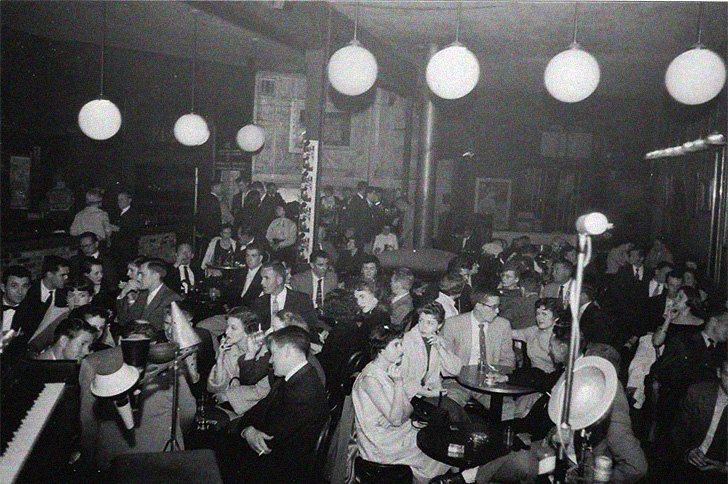
Special attention is paid to threshold spaces, stage configuration, bar placement, and lighting type, as these elements shape the mode of musical perception and the viewer’s physical experience. For this longread, I selected visual sources that, in my opinion, most fully capture the characteristic features of each space type: archival photographs of interiors, hall plans, posters, album covers, and stills from documentary films.
The selection of venues is explained by the possibility of classifying them according to a specific stage in the evolution of jazz culture, based on functional and visual tonality, as well as the high degree of expressiveness of the environmental design. Consequently, the research presents a typology of jazz clubs, structured as a sequence of transitions between six types, each analyzed through visual sources that allow us to document stable characteristics and moments of shift. By analyzing these spaces, it becomes possible to see how floor plans, lighting, and furniture—within the club owner’s discretion—became co-authors of new meanings arising within jazz culture.
Material Selection Principle:
For this long-form article, I selected stills and scenes from archival photographs, blueprints, and documentary evidence that, in my view, most fully reflect the distinctive characteristics of each type of jazz space. The selection of these venues is based on their ability to be assigned to a specific stage in the evolution of jazz culture—in terms of functional and visual tone—as well as the high expressiveness of their environmental design.
Principles of Visual Research Categorization (Work Structure):
- Research Concept
- Introduction (Established Principles of Jazz Space)
- Club Typology (The direct language of idea expression)
- Conclusion