From the sacred stadiums of Olympia to the digital arenas of the 21st century—sport has always been a mirror of the era. Its evolution reflects key processes of world history: religious cults and imperial propaganda, the knightly code of honor and the ideologies of the modern age, the Industrial Revolution, and globalization. This timeline will guide you through the major milestones, showing how the rules, goals, and meaning of competition have changed, and how sport has become what it is today—a complex phenomenon at the intersection of culture, politics, business, and technology.
776 г. до н. э. — 393 г. н. э.
Ancient Olympics
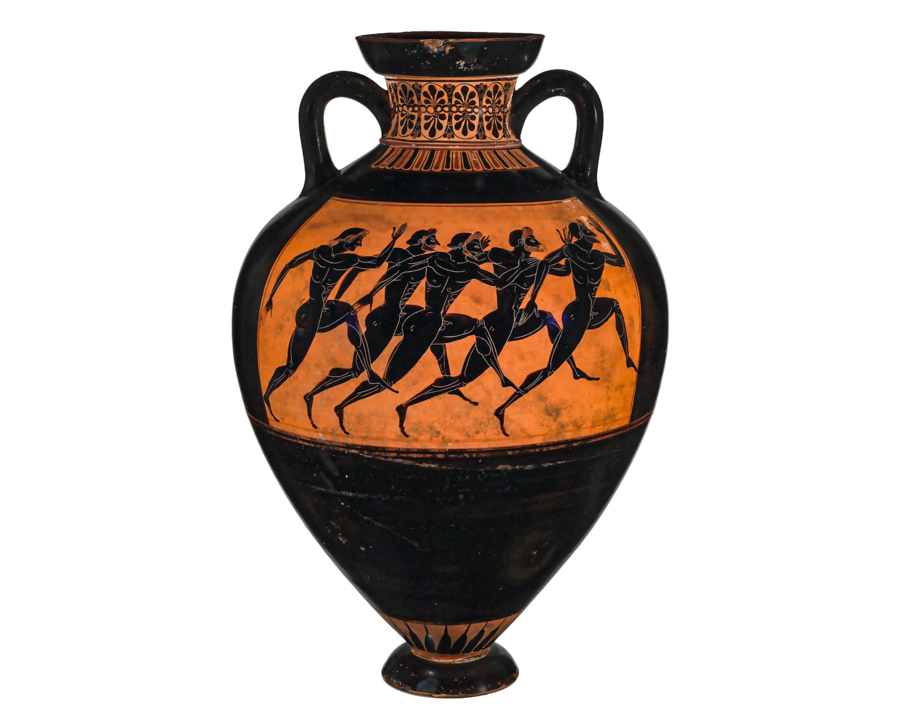
Terracotta amphora, a prize from the Panhellenic Games. c. 530 BCE
The Ancient Olympic Games (776 BCE — 393 CE) were an Pan-Hellenic religious and athletic festival held every four years in Olympia, on the Peloponnese. The Games were dedicated to Zeus, the supreme god of the Greek pantheon, and served as one of the primary instruments for the cultural and political unification of the disparate Greek city-states (poleis). During the Games, a sacred truce (ekecheiria) was declared throughout Hellas, guaranteeing the safety of participants and spectators. This tradition, which spanned 292 Olympiads, was halted by the decree of the Roman Emperor Theodosius I in 393 CE because it was associated with pagan worship.
The Olympic Games evolved from a simple race over one stadium (about 192 meters) to multi-day competitions. These included various running events, pentathlon, wrestling, boxing, chariot races, and pankration—a brutal, full-contact martial art with minimal restrictions. Only freeborn citizens of Greek descent were permitted to participate; women were forbidden from attending the competitions under penalty of death. Athletes competed nude. The highest reward was not a material prize but a wreath of sacred olive branches and eternal glory. The victor (Olympian) received lifelong honors in their hometown. The Games were a vibrant expression of the Greek ideal—the harmonious development of spirit and body in the pursuit of divine favor.
II век до н. э. — V век н. э.
Gladiator Games and Circus Spectacles
Girolamo Mercuriale. Engraving from the 1672 edition of «On the Art of Gymnastics»
Gladiatorial games and circus spectacles were arguably the paramount public amusements of the Roman Empire, evolving from religious funerary rites into grand political dramas. They reached their peak during the Late Republic and early Empire, becoming a tool for consolidating power and a means of managing the mood of the urban plebs. In 80 CE, the Flavian Amphitheater (the Colosseum) opened in Rome, becoming the symbol of these bloody spectacles. Their decline in the 5th century CE is linked to economic crisis, the spread of Christianity, and barbarian invasions.
The spectacle program was diverse, comprising three main components: morning gladiatorial combats (munera), daytime wild-beast hunts (venationes), and afternoon mass executions of criminals and Christians. Gladiators included slaves, prisoners of war, criminals, or freedmen who trained in specialized schools (ludi). Success brought them fame, wealth, and sometimes freedom. Unlike Greek athletes who fought for personal honor, Roman gladiators were part of a large-scale, compulsory spectacle for its participants—a display designed to showcase the might of Rome and entertain the crowd through the «bread and circuses» program (panem et circenses).
Knightly Tournaments and Folk Games
Duke Wilhelm competes against five knights. The tournament depicted in the engraving, named Gesellenstechen in the caption, was a form of merry knightly entertainment popular in the Late Middle Ages.
Knightly tournaments and folk games—a vivid reflection of the hierarchical society of Western European Middle Ages, where the warrior aristocracy and urban population each maintained their own forms of leisure. The knightly tournament, which originated in Northern France around the 11th–12th centuries, evolved into an almost pan-European court competition by the 13th–14th centuries, showcasing the valor and nobility of the military aristocracy. Its evolution was tied to the development of warfare: in the 14th–15th centuries, as the role of infantry increased in actual battles, foot combat in armor became popular at tournaments alongside mounted jousting. Tournaments were a privilege of the nobility, serving as a vital social ladder and an instrument of political representation.
Folk games and city festivals developed within the social environment of peasant communities and, particularly, the burgeoning towns from the 12th to 13th centuries. Leisure time for common people was closely tied to the church calendar, which constituted one-third of the year. During this period, mysteries (religious dramas) and morality plays (allegorical plays) were staged in public squares, and wandering actors—jugglers, musicians, and poets—performed. Guild associations of artisans held their own processions, shooting competitions, and unique tournaments that mimicked the nobility. Dances, mass games, and visits to fairs, where trade occurred and exotic animals were displayed, were also common.
XV–XVII века
Renaissance of Physical Culture
Hendrick Avercamp. Skating in the Village. 1610
The Renaissance was a period of fundamental rethinking regarding the role of physical education in human life. Influenced by humanistic philosophy, which revived ancient ideals, physical perfection ceased to be viewed as something sinful and regained its value as part of the harmonious unity of body and spirit. This manifested both in art, which celebrated the beauty of the human form, and in pedagogy, which fostered health within it. Thus, Vittorino da Feltre created the «House of Joy» school, where, alongside sciences and arts, students practiced fencing, swimming, horseback riding, and gymnastics.
Physical education of the era was distinctly practical and stratified by social class. For the nobility and military classes, key disciplines included fencing, archery and arquebus shooting, equestrian training, and tournaments—all of which remained relevant. Concurrently, within university circles and among city dwellers, ball games (precursors to tennis and soccer), ice skating, and traditional wrestling became popular. The theoretical foundation was drawn from the works of ancient authors (Galen, Hippocrates), which were re-examined, alongside new treatises such as The Art of Gymnastics by Hieronymus Mercurialis (1569). In it, he systematized knowledge about various types of exercises, dividing them into therapeutic, military, and athletic categories. Thus, the Renaissance laid the intellectual and pedagogical groundwork for the subsequent development of modern sport, establishing the principle of «a sound mind in a sound body» (mens sana in corpore sano) as a cultural standard.
XVIII–XIX века
The British «sporting revolution» and the codification of rules
Charles Lis. Golfers. 1847
The British «sporting revolution» and the codification of rules (18th–19th centuries) became a pivotal stage in the formation of modern global sport. This process, closely linked to the Industrial Revolution, urbanization, and the growth of the middle class, transformed local folk games and aristocratic pastimes into standardized, strictly regulated sports. Britain, as the economic and colonial leader of the era, served as the «cradle» for numerous disciplines, including football, rugby, cricket, tennis, and boxing—whose English names and terminology were subsequently adopted by other languages.
The mid-19th century was marked by a «mania for codification”—the widespread creation of unified rules and national governing bodies. This impulse originated from public schools and universities, where standardization allowed for interschool and intercollegiate competitions. In 1863, the Football Association (FA) was founded, establishing uniform rules and separating soccer from rugby. Subsequently, the Rugby Union (1871), the All England Lawn Tennis and Cricket Club (1868–1877), and other associations were established. Codification, the expansion of railroads, and the growth of the printing press enabled regular national and international competitions, which finally shaped sport into a mass spectacle and industry soon exported worldwide.
Meyer Albert. 1896 Olympic Games. Preparation for the 100-meter race.
The revival of the Olympic Games and the establishment of the international sports movement (1894–1914) is a pivotal period that laid the foundations for modern global sports. The initiative was spearheaded by the French public figure, Baron Pierre de Coubertin, who viewed sport as a tool for youth education and the promotion of world peace. His idea was endorsed at the International Athletic Congress in Paris in June 1894: the International Olympic Committee (IOC) was established, and the first modern Games were decided to be held in Athens, Greece, in 1896. Fundamental principles were adopted: the four-year cycle (the Olympics), the rotation of host cities, and the exclusively modern nature of the sports contested.
The first Olympic Games in Athens (1896), despite the participation of only 14 nations, were successful and rekindled interest in the ancient ideal. However, subsequent competitions in Paris (1900) and St. Louis (1904), which were tied to World’s Fairs, caused a crisis due to poor organization and excessive sprawl. A turning point came with the 1908 Games in London, where rules were clearly systematized for the first time, an opening ceremony featuring a team parade was introduced, and the concept of the Olympic flag was presented. By 1912, when Stockholm hosted the Games, they had evolved into a respected international event with an increasing number of participating countries and a high level of competition. Concurrently, the architecture of world sport began to form: the first international sports federations were created (FIFA in 1904, FINA in 1908, IAAF in 1912), and the IOC solidified its leadership role. Russia also played an important part in this movement, having been represented in the IOC since its founding by General Alexei Butovsky. Thus, by 1914, the Olympic movement had not only materialized but had also developed stable operational mechanisms, surviving its formative period and its first serious challenges.
1928 Olympic Games in Amsterdam. Cycling
Following World War I, sport definitively transformed from a purely competitive activity into a powerful instrument of state ideology and international prestige. In Soviet Russia, physical culture became a component of state policy aimed at creating the «New Man» and preparing the populace for labor and defense. On the international stage, the Olympic Games—intended to be apolitical—became a venue for settling political scores, which was starkly evident in the exclusion of Germany and its allies, as well as Soviet Russia, from the 1920 Antwerp Games. This period laid the groundwork for perceiving athletic victories as proof of the superiority of one socio-political system over another.
In the USSR during the 1920s and 1930s, a centralized system was established that subordinated sports to state objectives. Mass sports societies were created, such as «Dynamo» (under state security organs) and the future CSKA (under the army), which cultivated athletic training closely tied to military application skills. As an ideological counterpoint to the «bourgeois» professional Olympic movement—which the USSR initially rejected—there were All-Union Spartakiads. These were positioned as genuinely popular competitions designed to showcase the achievements of the Soviet system. Simultaneously, in the West, although in less totalitarian forms, sport was also utilized to strengthen national spirit and prestige. Thus, by the late 1930s, sport had fully solidified as a critical arena for ideological confrontation, where battles for political and cultural influence were waged on sporting fields, prefiguring the intense rivalry of the Cold War era.