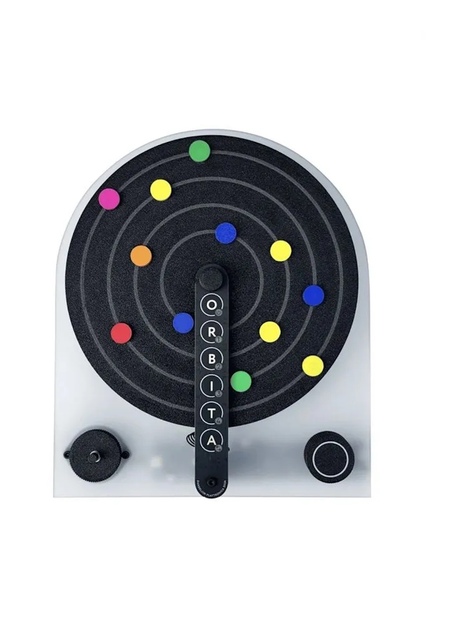
This rotary sequencer is a musical roulette for beginner ravers and designers.
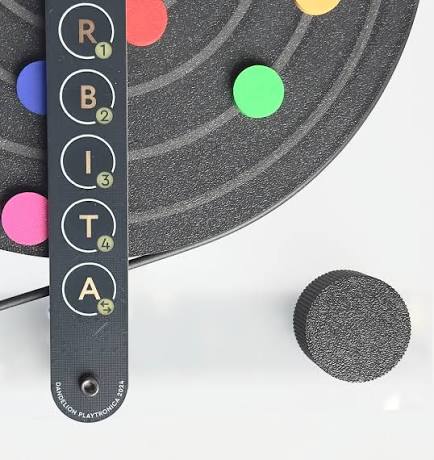
Orbita — a unique MIDI sequencer by Playtronica that transforms colored magnets into music. The device resembles a small rotating disk with four concentric tracks. Colored magnetic tokens are placed on these tracks, and an integrated RGB sensor reads their color as the device spins. The color determines the note, and the magnet’s position on the circle dictates when it sounds.
Thus, the musical sequence is literally arranged by hand on the device’s surface. The four tracks can play different parts simultaneously—for example, bass, drums, chords, and melody. The rotation speed of the disk controls the tempo, and the tracks can be turned on and off during playback.
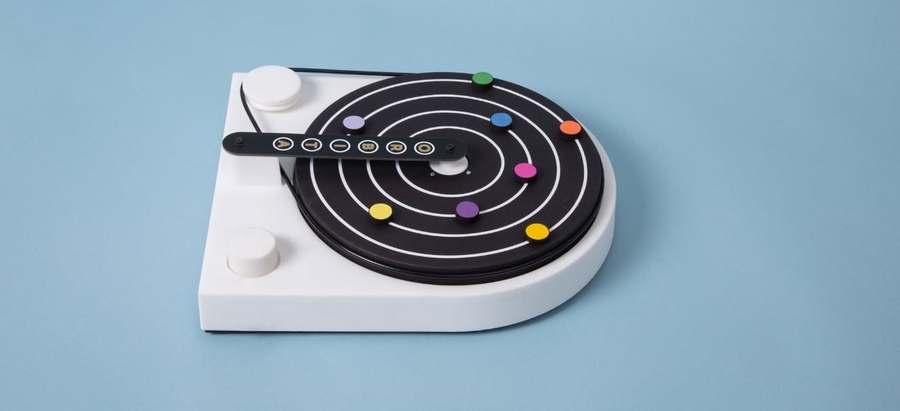
However, the Orbita sound unit itself does not generate sound—it is merely a MIDI controller that transmits commands to a computer, DAW, or external synthesizer. There is also a more experimental mode where color does not control pitch, but instead controls a MIDI CC message—meaning it can manipulate synthesizer or effect parameters. This creates a kind of color score: for example, different colors can change the amount of reverb or the volume.
The idea for Orbita grew out of Playtronica’s experiments in translating color into sound. Before the device’s release, the company developed the Pipette sensor, which was capable of recognizing color and converting it into MIDI signals. The next step was adding a rotating disc: color transformed into a note, and movement around the circle became a musical sequence.
The first prototypes of Orbita appeared back in 2021, and by 2022, the device was already demonstrated as a functional instrument. The project was managed by the Playtronica team; early materials name among the creators the Stockholm designer Axel Blume, engineer Sami Sabik, and industrial designer Olaf Thiel. Playtronica itself does not name a single individual as the sole author of the device in its current materials, so it is more accurate to refer to it as a team development.
In 2025, Orbita finally transitioned from an experimental prototype to a mass-produced product. The device received recognition at the MIDI Innovation Awards, where it was noted for its unconventional physical and visual interface for music creation.
The primary allure of Orbita isn’t in its technical specifications. A typical sequencer today exists on a screen: a grid, little squares, and a mouse. Orbita proposes almost the opposite approach—you can literally hold the music in your hands. Rhythm becomes rotation, a note becomes color, and a sequence becomes the physical arrangement of objects.
Orbita is interesting not as just another—albeit very beautiful—MIDI controller, but as a small model of what a musical instrument can possibly be. Here, music isn’t drawn on a screen or arranged like bricks—it’s laid out in a circle.
This beauty is priced at 400 euros and is already available on the company’s website.