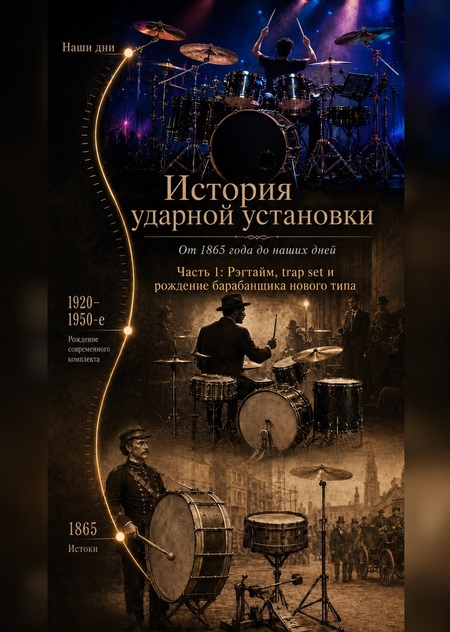
Chapter 2. Ragtime, Trap Sets, and the Birth of the New Drummer.
1890–1910: From Apparatus Collections to the Future Drum Kit
If the period after 1865 was the time of the first attempts to gather several percussion instruments around a single person, then the 1890s–1910s marked the time when this idea began to take form. Not yet the modern configuration—not yet what we see on stage, in the studio, or in the rehearsal room today—but already sufficiently recognizable. In the 1890s, the percussionist increasingly became more than just an executor of the small or bass drum part; they became the person responsible for an entire sonic system. In front of them was the bass drum, next to it the snare drum, and around them appeared cymbals, wood blocks, bells, whistles, Chinese toms, noise effects, and various devices that were collectively referred to as «traps» at the time.
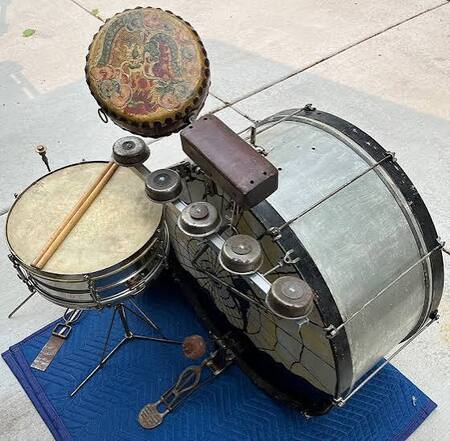
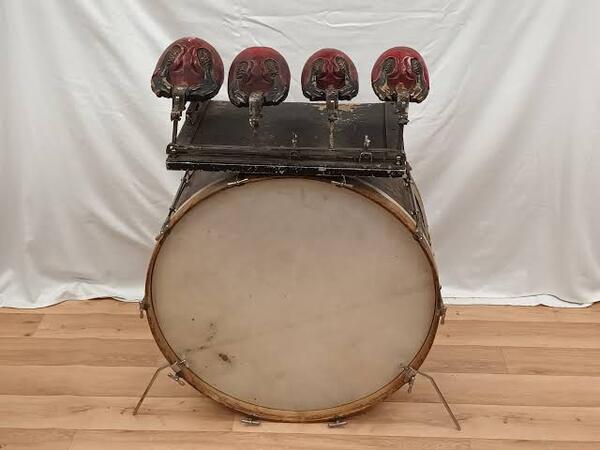
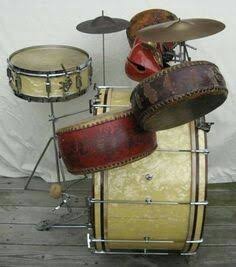
This is how the trap set gradually emerged—the ancestor of the modern drum kit. It wasn’t yet a drum set in the conventional sense, but it was no longer just «a few drums placed next to each other.» It became the workspace for a new musician who needed to simultaneously maintain rhythm, create effects, service the stage action, and react to the music. In short, it was doing everything that drummers would later do with a serious demeanor while everyone else argued about who forgot a cable.
Ragtime: The Music That Needed a New Pulse
The 1890s were the golden age of ragtime. This music became one of the most vital bridges between the marching traditions of the 19th century and the future of jazz thinking. Ragtime still retained a connection to the march—a steady beat, clear form, a sense of step. But beneath this external discipline, a completely different life was taking shape—syncopations, displacements, playing with accents, and rhythmic elasticity for dancing.
It was ragtime that began to fundamentally change the nature of rhythmic accompaniment. Previously, the bass drum could simply emphasize the downbeats, while the snare added clarity and crispness. But ragtime demanded more: lightness, mobility, responsiveness to syncopated melodies, and the ability to create not only a marching foundation but also a danceable groove.
In the Vic Firth educational series on drumset history, the 1890s period is directly linked to ragtime and the emergence of new elements in the early kit, including Chinese toms as some of the first tonal drums to enter the early drum set.
This is a crucial turning point. The drummer is no longer just marking time. They begin working with the character of time. In a march, time must be straight. In ragtime, it starts to smile, stumble, wink, and drift slightly off-beat. The music becomes less rigid and more visceral. People no longer just needed to walk in time—they needed to dance.
And when people start to dance, the drummer has to think differently.
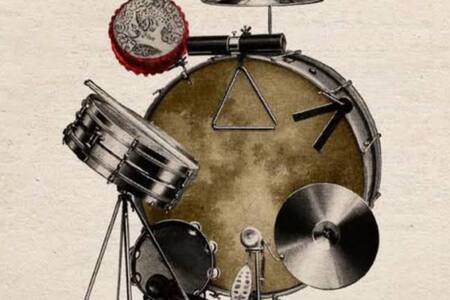
Trap Set: Ancestor of the Drum Kit and Small Sound Effect Cache
The word «trap» in the history of the drum kit is associated with various auxiliary percussion and noise devices. These could include woodblocks, cowbells, small cymbals, whistles, rattles, horns, bells, Chinese toms, and other items that allowed the percussionist not only to create rhythm but also to generate stage sound.
In theaters, variety shows, minstrel shows, vaudevilles, and early cinema, this function was especially vital. The percussionist could depict footsteps, a gunshot, a fall, a character’s entrance, a comic pause, a dramatic accent, a moving train, or anything else the director decided to delegate to the person in the corner of the stage. Sound engineers with laptops did not yet exist, so humanity had to rely on drummers. Sometimes progress looks like a complex journey toward replacing a living person with a button.
The trap set was not just a collection of toys. It became the laboratory for the future drum kit. Various timbres gathered around a single musician, and each could perform its function: the bass drum provided depth and foundation, the snare drum offered clarity, the cymbals delivered accents and brilliance, and the toms and blocks supplied color, while the sound effects provided drama.
This name encapsulates almost the entire philosophy of the early drum kit: it was not a noble, academic instrument, but an ingenious construction—a device, an apparatus, a working machine, a musical workshop.
And that is wonderful. Because the modern drum kit was born not from a pursuit of formal purity, but from a desire to make music more vibrant, denser, louder, and more stage-friendly.
The Foot Enters the Game
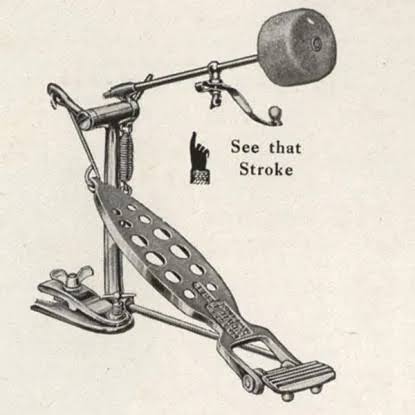
Initially, the drummer tried to play everything with his hands: snare, bass drum, cymbals, effects. This was possible, but inconvenient and severely restricted the freedom of play. For the drum kit to become a true system, the bass drum had to transition to the foot. This is where early foot mechanisms—homemade pedals and the first attempts to free the drummer’s hands—emerge. In this context, New Orleans drummer Dee Dee Chandler is often mentioned; he is considered one of the first notable musicians to use a pedal for the bass drum. Perhaps he wasn’t the only or absolute first, but he is significant as a symbol of the shift: the drummer begins playing with both hands and feet simultaneously. By the 1890s, trap drummers were increasingly using such solutions, and in 1909, the Ludwig bass drum pedal established this principle not as a makeshift trick but as a stable technical standard. From this moment, the kit ceases to be merely a collection of drums beside the musician and begins transforming into a coordination machine. This paragraph will work better this way: not as a standalone historical note, but as part of the dramatic narrative—the hands can’t manage it $\rightarrow$ the foot connects $\rightarrow$ the kit becomes a system. The history suddenly starts behaving properly.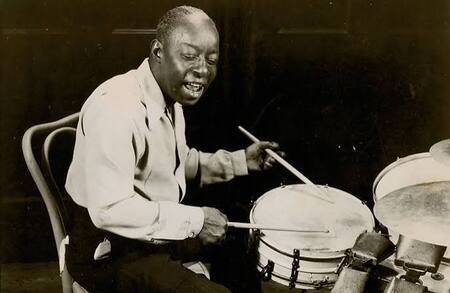
Dee Dee Chandler and Early Pedal Mythology
In the history of the early drum kit, the New Orleans drummer Dee Dee Chandler is often mentioned. He is credited as one of the first musicians to use a homemade pedal to play the bass drum with his foot while playing the snare with his hands. Smithsonian phrases this cautiously: others may have done something similar before, but Chandler was perhaps one of the first prominent drummers to adopt this practice.This is an important caveat. In music history, it is dangerous to claim «the first.» Usually, five minutes later, someone shows up who did the exact same thing earlier, in another city, without a photograph, but with a relative who remembers it all. Therefore, it is more accurate to speak not of a singular inventor, but of the environment that made such an idea necessary.
New Orleans—its theaters, its dance music, its street bands, ragtime, and early forms of jazz—all created a context where one drummer had to play more, be more flexible, and be more versatile.
Chandler is significant not just as a specific name, but as a symbol of transition. The drummer ceases to be someone who simply stands behind a drum. He sits down or settles behind a kit, connects his foot, delegates functions, and begins transforming into the master of groove that would come to be.
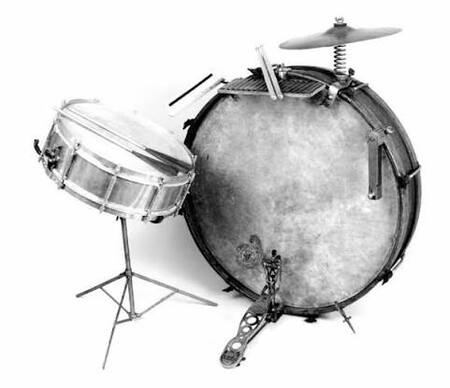
Why 1890–1910 is a Transitional Bridge
If the first chapter was about the birth of an idea, this chapter is about the birth of a mechanism.
During the 1860s–1890s, the idea emerges: one person can play the drum kit. Between 1890 and 1910, this idea gains its tools: the trap set, the regular use of pedals, an expanded range of effects, new timbres, ragtime rhythms, and the first industrial solutions.
This is not yet the era of the classic jazz drummer. It is the prelude. But it is already clear where everything is headed.
The drummer is no longer peripheral to the musical process. He becomes its engine. Not a decorative sound maker, not a person for the final «boom» at the end of a number, but a participant who shapes the music’s momentum.
It is here that the path begins toward what would later become the foundation of jazz, swing, rock and roll, funk, soul, and pop music.
The backbeat in the form we are used to hearing in rock and roll does not yet exist. But the groundwork for it is being laid: the snare drum assumes an increasingly expressive role, the bass drum becomes a constant foundation, and the drummer learns to distribute accents between hands and feet.
This later leads to a great simplicity: bass drum, snare on beats two and four, cymbals or hi-hat, and the whole world starts to move. But to reach that simplicity, it had to pass through decades of experimentation—of mechanics, ragtime, theater, dance halls, and trap drummers.
The Period’s Major Discovery: The Setup Becomes a System
The main takeaway from 1890–1910 can be summarized as follows: the drum kit stopped being just an idea and began to become a system.
• A system of instruments.
• A system of movements.
• A system