SCIENCE AND POPULAR MEDIA ON THE HIDDEN LIFE OF PLANTS
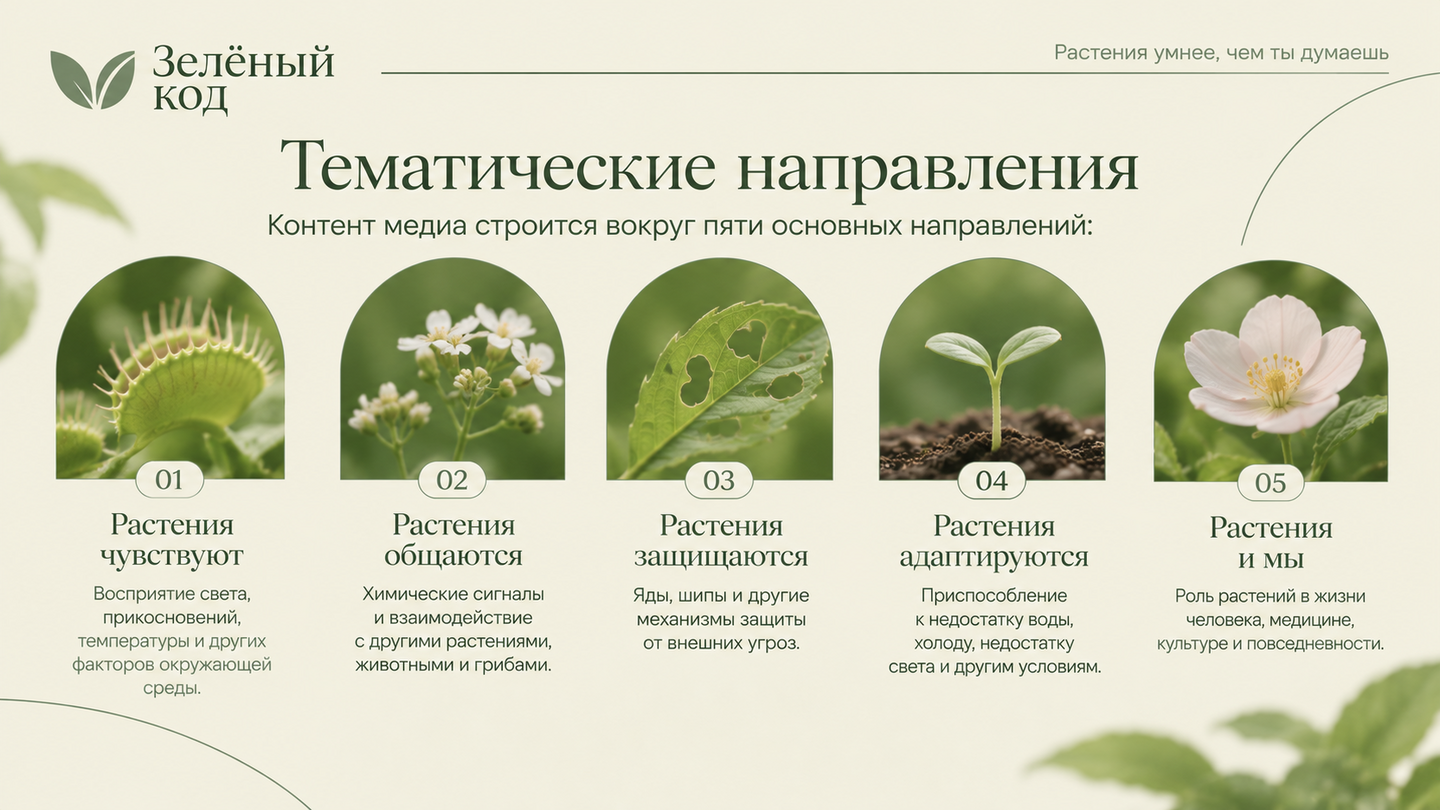
«The Green Code» explores plants as complex living organisms capable of sensing their environment, interacting with other organisms, defending themselves, and adapting.
Core Idea: to demonstrate the complex biological processes hidden beneath the apparent stillness of plants.
«Plants are smarter than you think»
DATA SOURCES
Scientific, educational, and visual sources are used for preparing publications
01. Scholarly Publications
— Scientific articles on botany and plant physiology. — Research in the field of ecology. — Scientific reviews and meta-analyses.
02. Scientific Databases
— Google Scholar. — PubMed. — JSTOR. — ScienceDirect.
03. Research and Educational Organizations
— Universities — Botanical Gardens — Research Centers — Science Museums
04. Visual Materials
— Scientific photography. — Macro photography. — Botanical atlases. — Videos of experiments and observations.
TYPES OF DATA USED
In media studies, four main data types can be identified:
Textual Data — scientific articles, research papers, descriptions of experiments, and observations.Numerical Data — experimental results, measurements, statistics, and comparative indicators. Visual Data — photographs of plants, microscopic images, diagrams, and illustrations. Audiovisual Data — video recordings of experiments, growth time-lapses, and documentary materials.
DATA PROCESSING SCHEME
How does data become a publication?
Human Processing
Computer Processing
General Scheme
AUTOMATED SERVICES GUIDELINES