Navigation
1. Concept 2. Central Question I. The Apple as an Attribute of the Ancient World II. The Middle Ages: How the Image of the Forbidden Fruit is Formed III. The Renaissance: Original Sin, the Human Body, and the Apple 3. Conclusion
Concept
Apple: From Symbol of Beauty to Symbol of the Fall of Man
The apple holds a special place in the history of European art. For centuries, this familiar fruit became part of narratives connected with beauty, love, desire, rivalry, and transgression. Its association with the story of Adam and Eve became particularly entrenched in culture: today, the apple is almost automatically perceived as the very fruit that led to the fall of the first humans. However, the biblical text does not specify its exact appearance. Consequently, the image familiar to us did not originate directly from Holy Scripture but developed under the influence of subsequent artistic and cultural tradition.
The process of forming this image is the basis of my visual research. I am interested in tracing how a single object can change its meaning when it moves from one cultural context to another. Not only the depicted object itself plays a significant role here, but also the history it belongs to, its position within the composition, and its interaction with other elements of the artwork. In one instance, an apple embodies attractiveness and desire; in another, it signifies temptation and the consequence of human choice. Comparing these interpretations allows me to examine how art shapes and solidifies the symbolic meaning of commonplace objects.
The first stage of my research involves engaging with ancient mythology and its reflection in visual art. Here, the apple is examined primarily within the context of the image of Aphrodite and the myth of Paris’s Judgment. Its significance is immediately tied to several concepts: beauty, desire, rivalry, and the necessity of making a choice. Using examples from ancient sculptures, as well as works by Lucas Cranach the Elder and Peter Paul Rubens dedicated to mythological subjects, I explore how artists utilize the apple to convey the relationships between characters. Next, the research transitions to Christian art, where the concept of the apple as the fruit associated with the Fall gradually develops. It is important to note that early depictions of the biblical narrative do not always allow for a clear identification of the specific fruit portrayed on the Tree of Knowledge. Various works feature conventional representations of fruit, alongside versions resembling figs, grapes, and other produce. Thus, the apple was not the only initially established option.
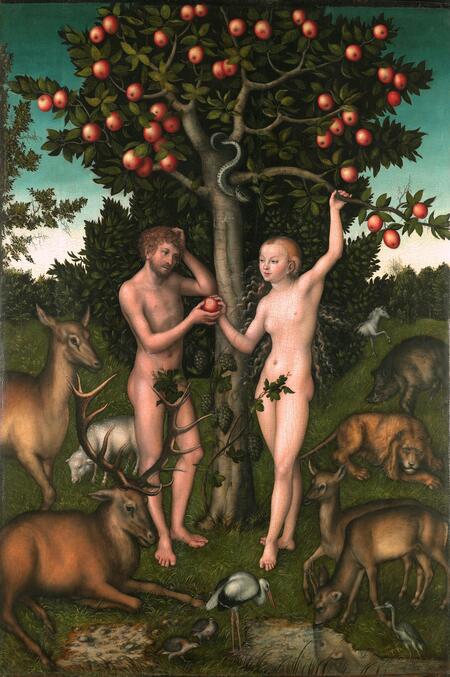
Its establishment as a visual marker for the forbidden fruit occurred gradually and possessed distinct regional characteristics. In this section of the work, I examine how artists constructed the visual narrative of the Fall through a series of interconnected details. Significance is derived not only from the depicted fruit but also from the placement of the tree, the serpent’s presence, the gesture of the hands, and the moment the fruit is transferred between characters. All these elements collectively form a visual account of the transgression. Gradually, the apple becomes one of the most recognizable attributes of this narrative, although other iconographic variations of its depiction persist in European art. The final part is dedicated to interpretations of the Fall during the Renaissance. For comparison, two works were selected: Albrecht Dürer’s engraving «Adam and Eve» (1504) and Lucas Cranach the Elder’s painting «Adam and Eve» (1526). Despite drawing from the same biblical story, the artists offer divergent ways of visually interpreting it. Comparing these two works allows us to observe how the same subject matter, within the span of a single era, can yield varied artistic interpretations and how a familiar symbol can acquire new compositional functions.
The main objective of my work is to demonstrate that the symbolic meaning of an object is not fixed and does not exist independently of its context. It is shaped by myths, religious beliefs, and artistic decisions, and is subsequently cemented within collective visual perception. The history of the apple allows us to see how art can transform an ordinary object into a multifaceted cultural symbol.
Main Question
How did the symbolic meaning of the apple change in European art from antiquity to the Renaissance?
I. The Apple as an Attribute of the Ancient World
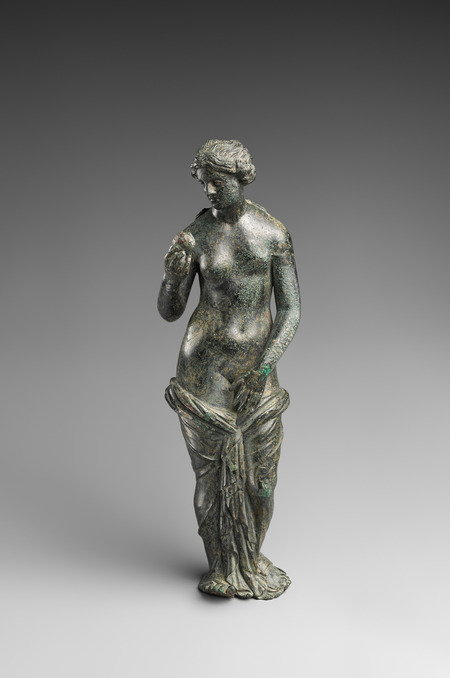
In ancient art, the apple could serve as an attribute of Aphrodite. In this context, it relates not to the Fall of Man, but to beauty, love, and mythological choice. It is important not to project a Christian interpretation of the fruit onto the ancient world—the meaning of the object is determined by the narrative in which it appears.
Aphrodite Statue with Apple, Imperial Period, 1–2nd Century CE, Roman Culture, Bronze. Dimensions: H: 6 3/8 in. (16.2 cm). Credit Line: Gift of Henry G. Markanda, 1897. Object Number: 97.22.4
Bronze statuette of Aphrodite with an apple, 3rd–1st century BCE, Metropolitan Museum of Art.
In this sculpture, the apple serves as a recognizable attribute of the goddess. Its meaning is revealed through the figure of Aphrodite, rather than through the fruit’s independent symbolism. The object becomes part of the character’s visual identification.
Paros’s Judgment: The Apple as a Reward
Lucas Cranach the Elder, The Judgment of Paris, circa 1528, Metropolitan Museum of Art
In myth, the golden apple becomes the prize in a contest among three goddesses. It symbolizes not merely beauty, but the necessity of choice and the competition for supremacy.
2. The Golden Apple as a Symbol of Choice
Peter Paul Rubens, The Judgment of Paris, c. 1632–1635, National Gallery, London.
Rubens depicts the moment Paris gives the apple to Venus. The composition revolves around a choice: the apple becomes a small object that dictates the further development of the myth. It does not occupy a large portion of the canvas, yet it determines the meaning of the characters' actions. This example demonstrates that an object’s symbolic significance is not necessarily dependent on its size.
3. The Apple and the Ideal of Beauty
Lucas Cranach the Elder, «Judgment of Paris,» 1530, St. Louis Art Museum
The apple is more than just a detail in mythological narrative: it organizes the relationships between characters. In this plot, it becomes a material signifier of recognized beauty.
4. Two Contexts—Two Meanings
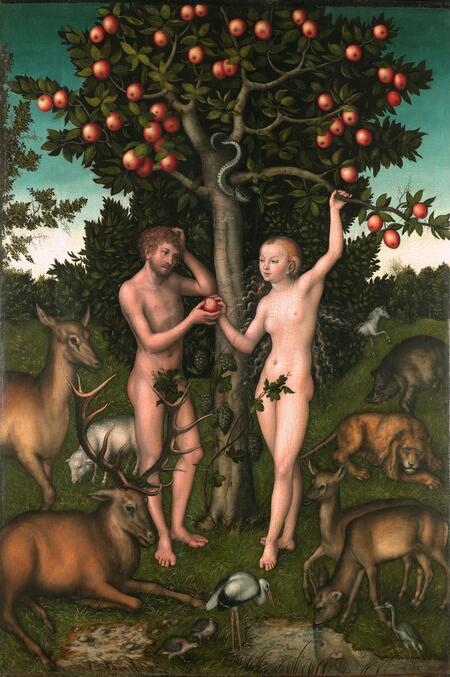
In one instance, the apple is linked to beauty and triumph; in another, to the transgression of a prohibition. This comparison illustrates that symbolic meaning does not reside within the object itself. Rather, it is formed through the narrative, the characters, and the composition.
5. Transition to the Christian Tradition
Fragment of a sarcophagus with Biblical scenes, early Christian relief, Vatican Museums.