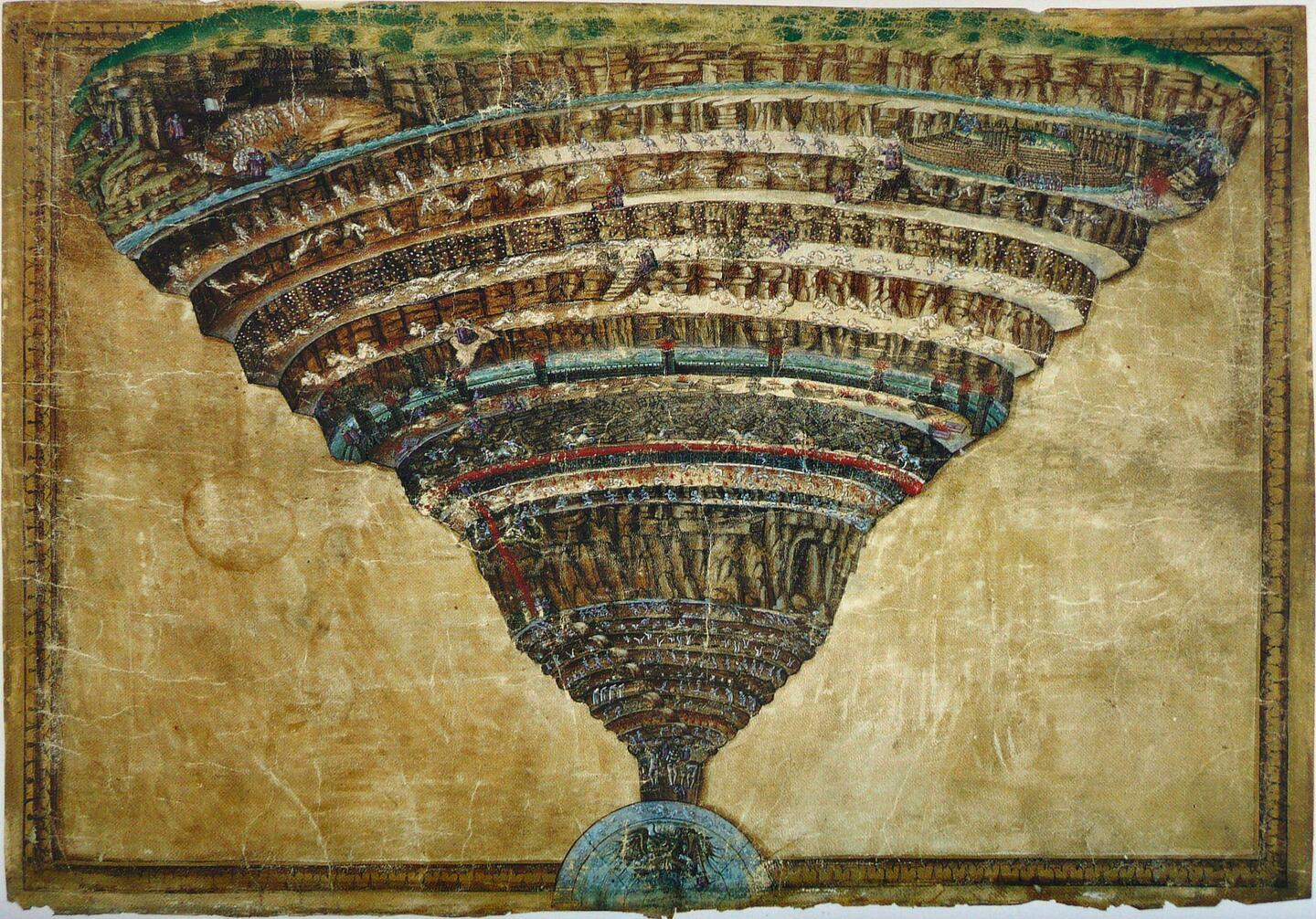
ВООБРАЖАЯ АД
Как художники представляли себе пространство загробного мира?
CONCEPT
I have always been interested in how humans imagine things they have never seen and probably never will. The afterlife is one of the most enigmatic expressions of our imagination. For centuries, people have tried to formulate what awaits them after death, where the souls of the departed reside, what the place of eternal punishment looks like, and who inhabits it.
In European culture, hell has become one of the most expressive images. It is frightening, contradictory, and infinitely diverse. I am interested not so much in the religious meaning of the underworld, but in its visual representation—how artists of different eras perceived the afterlife and what means they used to convey it. Hell did not exist for them as something that could be depicted faithfully; therefore, every artist essentially created their own version of the unknown.
In early medieval art, Hell often appears as something terrifying and almost inseparable from the image of evil itself. Initially, Hell was defined as the complete opposite of Heaven. Gradually, this image becomes increasingly complex. Artists begin to draw upon literary descriptions of the afterlife, depict journeys into the underworld, populate it with unusual creatures, and imbue the events there with their own logic, structuring the space itself.
Dante Alighieri’s «Divine Comedy» played a particularly vital role in this process. As a veritable medieval encyclopedia of scientific, political, philosophical, moral, and theological knowledge, the epic poem offered one of the most detailed and influential descriptions of hell in European culture.
Thus, for some, hell becomes a place of divine judgment, where each sin corresponds to a specific punishment. For others—it is a realm of nightmarish visions where the human body, familiar objects, and natural phenomena take on frightening, distorted forms. In the works of Hieronymus Bosch, Michelangelo, Simon Marmion, and other masters, hell ceases to be merely an illustration of the religious concept of punishment. It transforms into an independent artistic reality, filled with its own characters, events, and imagery.
I am building my visual investigation as an attempt to trace the history of the imagination of Hell—from early medieval conceptions to the complex fantastic imagery of the early Modern period. I want to understand how not only the external appearance of the afterlife changed, but also the artists' attitude toward what lies beyond human experience. In the end, Hell in art is much broader than a reflection of death concepts; it becomes a peculiar mirror of the earthly world. And perhaps for this very reason, its imagery has never remained static.
INDEX
1. THE FIGURE OF THE UNKNOWN
2. THE FIRST BOUNDARIES OF THE UNDERWORLD
3. THE FORMATION OF THE GEOGRAPHY OF THE AFTERLIFE
4. MONSTERS AND THE SPACES OF PUNISHMENT
5. CONCLUSION
1. THE UNKNOWN IMAGE
In medieval art, hell is often depicted not as an independent territory, but as the antithesis of paradise—a place where human existence is subject to entirely different laws. A striking example of this portrayal is the tympanum of the west portal of Saint-Foy Church in Conques. Its composition revolves around the figure of Christ the Judge, separating the righteous from the sinners.
«The Last Judgment.» 1130–1135. Abbey Church of Saint-Foy, Conques, France
Heaven and hell are positioned on opposite sides of the central figure, forming two opposing models of posthumous existence.
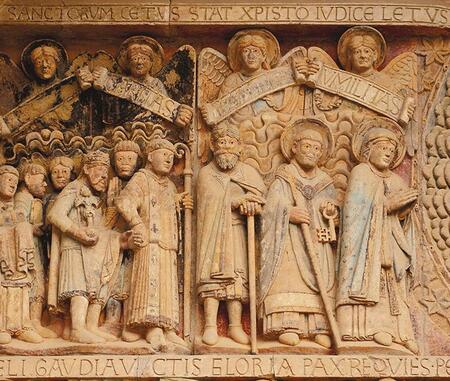
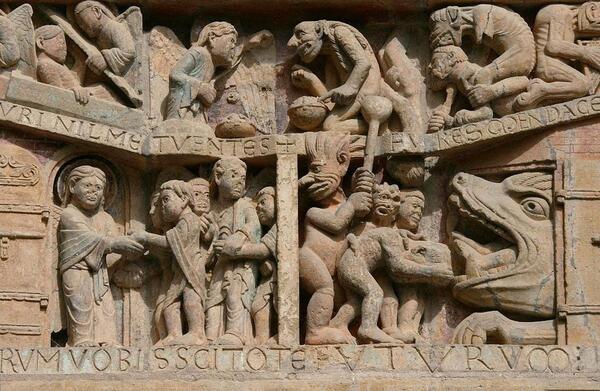
«The Last Judgment.» 1130–1135. Saint-Foy Abbey Church, Conques, France
In medieval iconography, the entrance to hell often takes the form of a monstrous, gaping maw. This image allows us to conceive of the afterlife not merely as a distant place, but as something that literally devours the human being. This metaphor is particularly striking in the miniature «The Descent of Christ into Hell» from an English manuscript dating to the late 12th century. It illustrates one of the early ways of visually representing the afterlife: hell lacks complex geography, but it already possesses a distinct boundary, an entrance, and an internal space.
«The Descent of Christ into Hell.» 1190–1200
In Giotto’s «Last Judgment,» the space of hell becomes more autonomous and organized.
Giotto di Bondone. «The Last Judgment» (Ad). 1303–1305. Cappella Scrovegni, Padua, Italy
Within the infernal zone, the damned are positioned against a backdrop of fiery streams that seem to descend from above, enveloping the human figures. Fire here functions not only to depict torment but also becomes the primary organizational element of the space. It delineates the boundaries of the hellish territory, connects individual scenes, and creates the impression of a continuous environment from which escape is impossible.
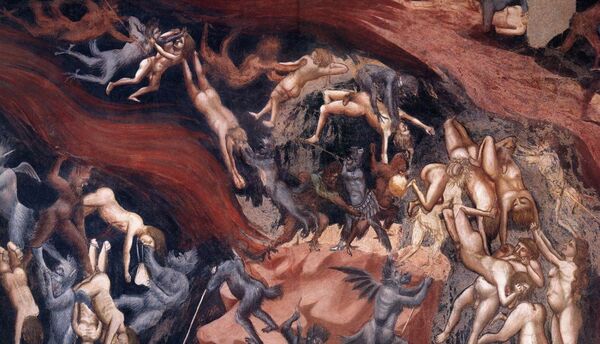
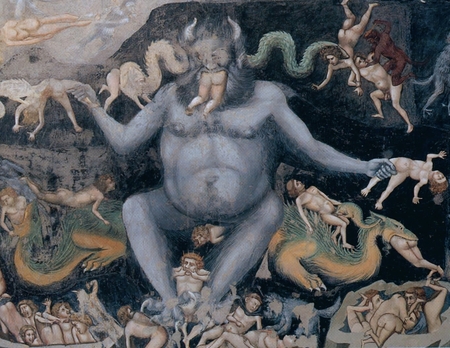
Giotto di Bondone. «The Last Judgment» (Altar). 1303–1305. Scrovegni Chapel, Padua, Italy
A large figure of Lucifer is positioned at the bottom of the composition. His placement underscores the hierarchical structure of hell: there is a center of power above the condemned, to whom the surrounding demons and punishments are subservient.
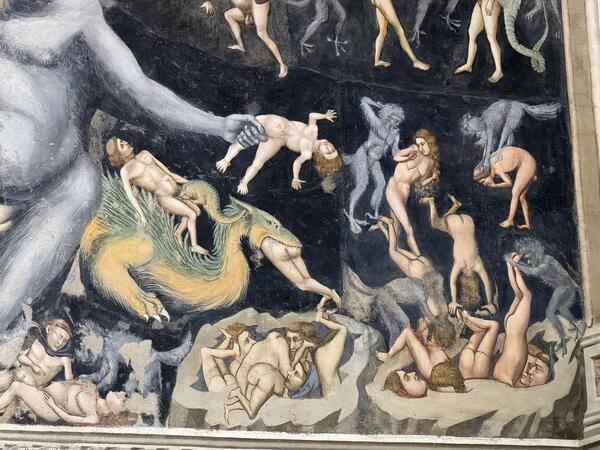
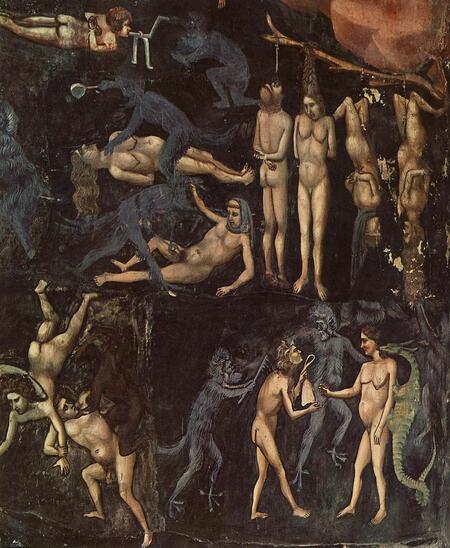
Giotto di Bondone. «The Last Judgment» (Altar). 1303–1305. Cappella Scrovegni, Padua, Italy
«The Vision of Tundal» is an illustrated manuscript from 1475, created to depict the journey of the soul of the knight Tundal through the afterlife. The text is by David O’Brien, and the miniatures were executed by Simon Marmion.
The miniature «Acheron Beast» is another example of how the entrance to hell is depicted as the maw of a colossal monster, capable of devouring human souls in its fiery jaws until they dissolve into nothingness.
Simon Marmion. «Acheron Beast.» 1475. Ghent, Flanders
«The Torments of the Unbelievers and Heretics» illustrates how the space of hell itself becomes an active participant in the process of punishment. Demons throw people into fire, pull them out with red-hot hooks, and transport them into the icy abyss.
Simon Marmion. «The Torment of Unbelievers and Heretics.» 1475. Ghent, Flanders
Simon Marmion. «Gates of Hell and Lucifer.» 1475. Ghent, Flanders
2. THE INITIAL BOUNDARIES OF THE SUPRAORDINATE