CHAPTER 1. Concept
The unicorn is a mythical creature representing a magical figure that captivates with its mystery. Interestingly, it was in the Middle Ages that the unicorn gained a popularity it previously lacked—both in literature and in visual art. In earlier traditions, the unicorn was depicted not only as a horse but also as a bull or a goat. Unicorns were sometimes attributed with elephant legs and a boar’s tail, leading to the suggestion that the unicorn prototype might have been the rhinoceros—a hypothesis that holds some merit, given that Pliny attributes the homeland of unicorns to the lands of the Indians and Central Africa.
The authority of sacred scripture in the life of the medieval person reinforced the fact of the animal’s existence: the Psalter, the Book of Job—sources rich with mentions of the mythical creature’s form. In Old Russian literature, for instance, the unicorn is called by different names: yunikorozhets, monoser, monokiros, intron, and symbolizes freedom, strength, and grandeur. It was claimed that the beast lived in the territories of India or Africa—specifically, there legends held that most of the creatures, which no one had ever seen, resided.
Interest in the topic stems from the abundance of both written and artistic materials related to the mythical creature. It is quite evident that the unicorn is essentially a horse with a horn, but what does this direct connection to Christ imply? Why is purity, wisdom, and even nobility specifically associated with the unicorn’s form?
A millennia-old accumulation of meanings and references has formed a distinct portrait of this creature; its very purity derives from the narrative of the «Physiologist. The Word and the Tales of Beasts and Birds»: the unicorn cannot be tamed by force—it is invincible—yet it bows before an immaculate maiden, laying its head in her lap. This scene is an allegory of the Annunciation, embodying Christ.
It is fascinating that the appearance of this mythical animal flows seamlessly from sacred texts into secular symbolism—heraldry, banners, and printers' marks. For instance, the British coat of arms depicts a lion and a unicorn supporting the royal shield.
CHAPTER 2. Religious Context
2.1 The unicorn symbolized purity and wisdom long before Christianity. Unexpectedly, this mysterious creature served as a savior for a considerable time. In it, the medieval person saw one of the most aesthetically beautiful symbols of faith.
In the Book of Job, it appears as a beast that cannot be tamed, harnessed, let alone forced to submit—a true embodiment of wild, untamed power. The Psalter tells of the horn as being divinely mighty, nothing less than the «Horn of Salvation.»
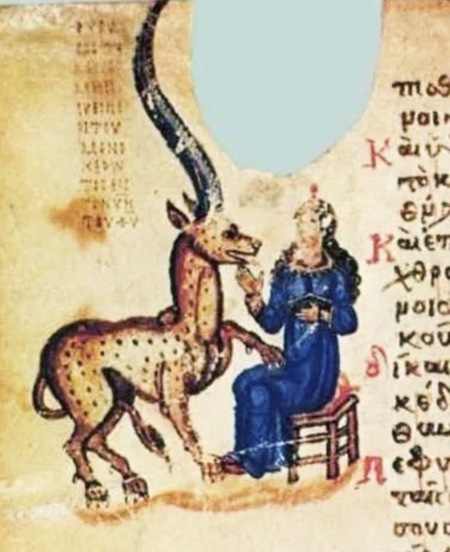
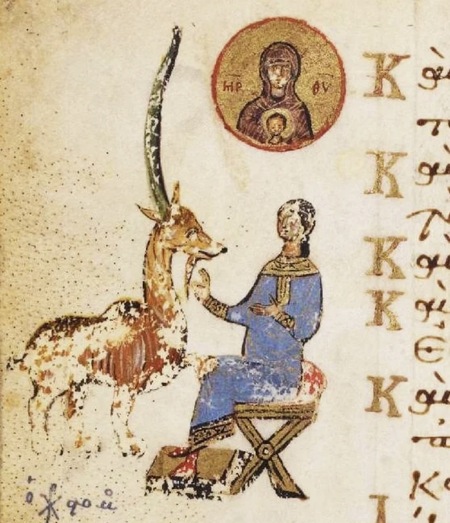
- The Virgin and the Unicorn—a symbol of Christ. Khludovskaya Psalter, 9th century. HIM No. 129d, fol. 93 r. Pub.: Shchepkina M. V. «Miniatures of the Khludovskaya Psalter.» Moscow: 19772. The Virgin and the Unicorn—a symbol of Christ. The Psalter of Theodore, 11th century. British Library, Add MS 19352, fol. 124 r.
To a medieval person, these lines were not perceived as a description of an unknown animal; rather, they opened a path to understanding ideological depth—that which transcends humanity can only bow to true purity.
The Church Fathers deepened this meaning. Ambrose of Milan asked: «Who is this unicorn if not the begotten Son of God?» The single horn symbolized the absolute unity of the Father and the Son. In other words, the unicorn appears as the indestructibility of the divine power, which chooses the path of humility, relying on feeling. Thus, patristics definitively established the Christological interpretation of the image.
- The Annunciation (Mythical Unicorn Hunt). 1489, Martin Schongauer’s circle. Pushkin Museum
2.2 In the 13th–15th centuries, this allegory expanded into a complete iconographic poem—a «mystical hunt.» The Virgin sits in a closed garden, a symbol of her purity. Archangel Gabriel blows a trumpet like a hunter leading hounds of virtues. The unicorn approaches and lowers its head to the knees of Mary. This is the moment of the Incarnation. The subsequent slaying of the beast by the hunters was perceived as a prefiguration of the Passions. Thus, whiteness, innocence, power, and voluntary sacrifice merged into a single image.
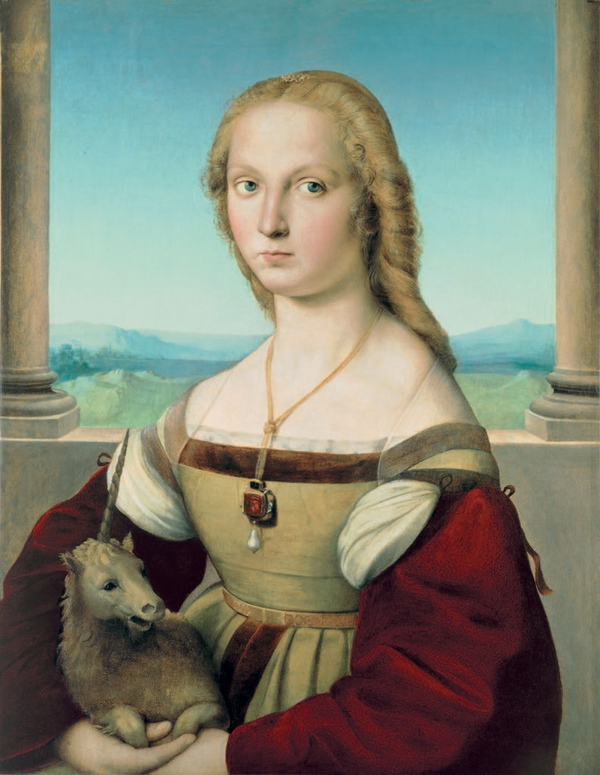
Raphael painted the Lady with the Unicorn at the very beginning of the Roman period, when Leonardo’s influence was still strongly felt: soft chiaroscuro, a calm posture, and a landscape fading into mist. The young woman looks directly at the viewer, and she holds the small unicorn as if it were not a symbol, but a living creature she has held close.
Here, what is important is exactly how the unicorn has become.
- «Lady with the Unicorn» (c. 1505–1506, Borghese Gallery, Rome)
In medieval tradition (from the «Physiologus» to tapestries depicting the «Lady with the Unicorn» and scenes of the mystical hunt), the beast was almost always large, powerful, and potentially dangerous.
For Raphael, the unicorn is reduced to the size of a small dog. It seems no longer to require taming, and the painting is neither a scene of capture nor an allegory of Incarnation. It is an attribute that the girl wears as naturally as a necklace or a ring. The medieval symbol passed through courtly culture and transformed into a sign of personal selectivity, rarity, and uniqueness.
The relief retains the medieval idea that only absolute purity can «sustain» a unicorn, but it changes the bearer and the tone—this theme can be observed quite frequently, which proves that the image was cemented primarily through sacred texts.
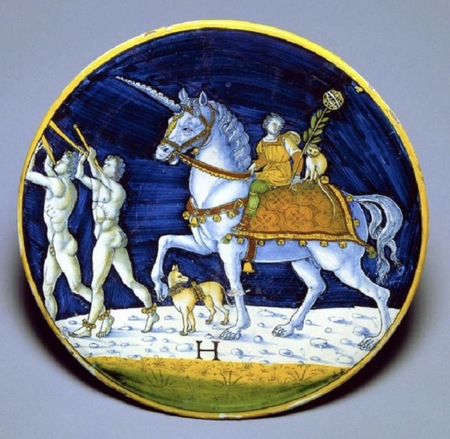
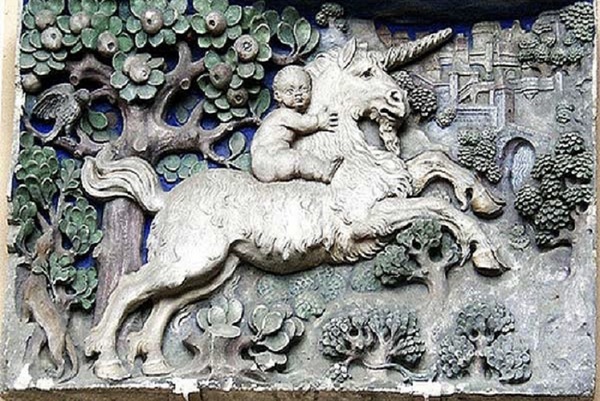
- Decorative maiolica on the wall of the «Liebieghaus» Museum in Frankfurt/M.5. Unicorn. Jacopo di Stefano Sciavone, art. pewter glaze, ceramics, maiolica. Italy, 1498. Fitzwilliam Museum.
4. On the left is a majolica plate
This is an Italian majolica from the first half of the 16th century. On a blue background, a white unicorn ceremoniously parades to the right. A female figure, dressed in garments, sits on it, holding a staff and a small bird. Two nude men carrying clubs and spears run behind, and a small dog is at the bottom. The letter «H» is displayed beneath the plate.
Here, there is a significant conceptual shift compared to classical medieval iconography. In the «mystical hunts» of the 13th–15th centuries (tapestries from the «Lady with the Unicorn» series, panels with the Virgin and the Unicorn, German altarpieces), the unicorn is always either bowing its head to the Virgin’s knees or already vanquished by hunters. It is the object of action—it is tamed, caught, or killed. This is an allegory of the Incarnation and the Passions.
In the Majolica, everything is inverted, as the Unicorn is not presented as an untamable beast, but as a triumphant mount. The woman sits atop it like a warhorse. The nude men in the background look more like a retinue or the vanquished than hunters from a «mystical hunt.» The dog, which often symbolized virtues or fidelity in medieval scenes, appears here merely as a scene accessory.
In fact, what we have before us is no longer a religious allegory, but a secular representation of power, authority, and victory. The unicorn retains its «wildness» and whiteness, but completely changes function: it transforms from a symbol of Christ into an almost heraldic image of might. This is a gesture characteristic of the Renaissance—a medieval symbol is cleansed of its theological baggage and integrated into the language of power representation.
5. The image on the right is a stone relief
The relief dates to the late 15th—early 16th century.
The unicorn is depicted in a sharp leap, with its mouth open and neck tensed. A small, nude child sits on it, gripping the beast’s mane with both hands. The background is filled with trees, foliage, and architectural fragments.
The child is not merely present—they are the only one capable of remaining atop a raging unicorn. Innocence is depicted in its most absolute, almost archaic form; it is not presented as the conscious chastity of an adult maiden, but as an inherent, sinless purity.
This difference is evident when compared to earlier artifacts. On tapestries titled «Ladies with a Unicorn» and on 15th-century altarpieces, the unicorn is calm, almost gentle, when touching the maiden. In this relief, however, it remains wild, dangerous, and full of unrestrained energy. The child is capable of coexisting with frenetic energy.
- Trellis «Sight.» Belgium. 15th century. Museum of Medieval Art, Cluny, Paris.
6. On the wallpaper titled «Sight» from the «Lady with the Unicorn» series, the unicorn no longer merely bows its head; it actually gazes at its reflection in the mirror held by the maiden. This gesture underscores recognition: the divine nature accepts the visible form. The creature’s white body, the red background, and the enclosed garden with an остролист (ornamental tree).