CONCEPT
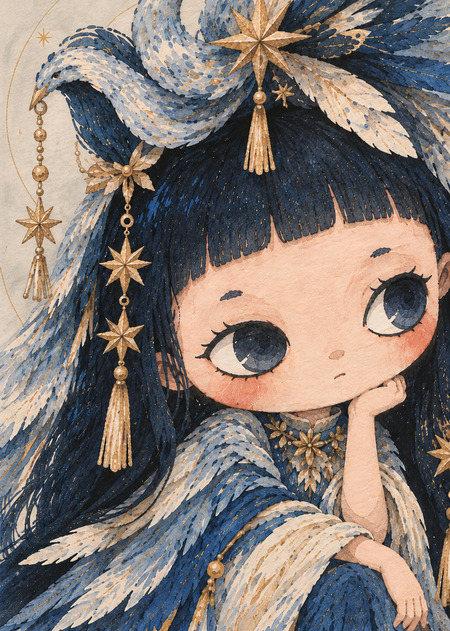
At the core of Maurice Maeterlinck’s fable, «The Blue Bird, ” lies the idea of seeking happiness and the ability to perceive the extraordinary within the familiar world. As Tiltil and Mitil embark on their journey, they discover the hidden lives of the surrounding objects and gradually realize that the most valuable things can be right next to them.This idea is transposed onto the urban landscape of Moscow. Every day, people pass by historic buildings without considering the events or people connected to these places. The project invites participants to look at the familiar city in a new light and uncover its hidden theatrical history.The characters from „The Blue Bird, ” created based on sketches from the 1908 Moscow Art Theatre production, appear at various points throughout Moscow. They become guides between the fable and the real city, helping the viewer see the history of plays, artists, and directors behind the usual facades.Just as Tiltil and Mitil set out to find the Blue Bird, participants on the city route search for small figurines, discovering unknown sides of familiar locations.The main idea is to demonstrate thatfor a true discovery, you don’t necessarily have to travel far: sometimes it is enough to look more closely at the city you live in.
TECHNICAL SECTION
The development of the figures was based on the historical sketches and stage costumes of the characters from the 1908 production of «The Blue Bird» at the Moscow Art Theatre. When creating the figures, it was crucial to preserve the original artistic concept, the characteristic silhouettes, the details of the costumes, and the recognizable features of each character, while adapting them to the modern aesthetic of collectible figures.
A total of 8 characters were developed: 7 figures for the main urban route and 1 reserve figure. All characters are rendered in a unified style, yet they differ in their costumes, poses, characterization, and individual details.
For each character, a color illustration sketch was created, defining their appearance, proportions, and color palette. Additionally, projections from multiple angles—front, back, and side—were developed to allow for a detailed examination of the figure’s construction, clothing elements, and accessories. Based on these materials, the character’s three-dimensional model and its sculptural form (mold) were worked out to maintain the nuances of the historical costumes when translating two-dimensional sketches into a three-dimensional form.
Thus, a set of visual materials was prepared for each character, reflecting the development sequence: from the historical prototype and concept sketch to the three-dimensional figure model.
*ChatGPT was used in the project development.
ROUTE
1. M. Gorky Moscow Art Theatre — Night
2. K. S. Stanislavsky House-Museum — Tiltil
3. A. P. Chekhov Moscow Art Theatre — Fire
4. MKHAT Artists' House — V. I. Nemirovich-Danchenko Apartment Museum — Mitil
5. K. S. Stanislavsky and V. I. Nemirovich-Danchenko Moscow Academic Musical Theatre — Soul of Light
6. State Theatre of Nations — Berilyun’s Fairy
7. Hermitage Garden — Blue Bird
Reserve Character: Tilo the Dog — is not assigned to a specific location.
Night
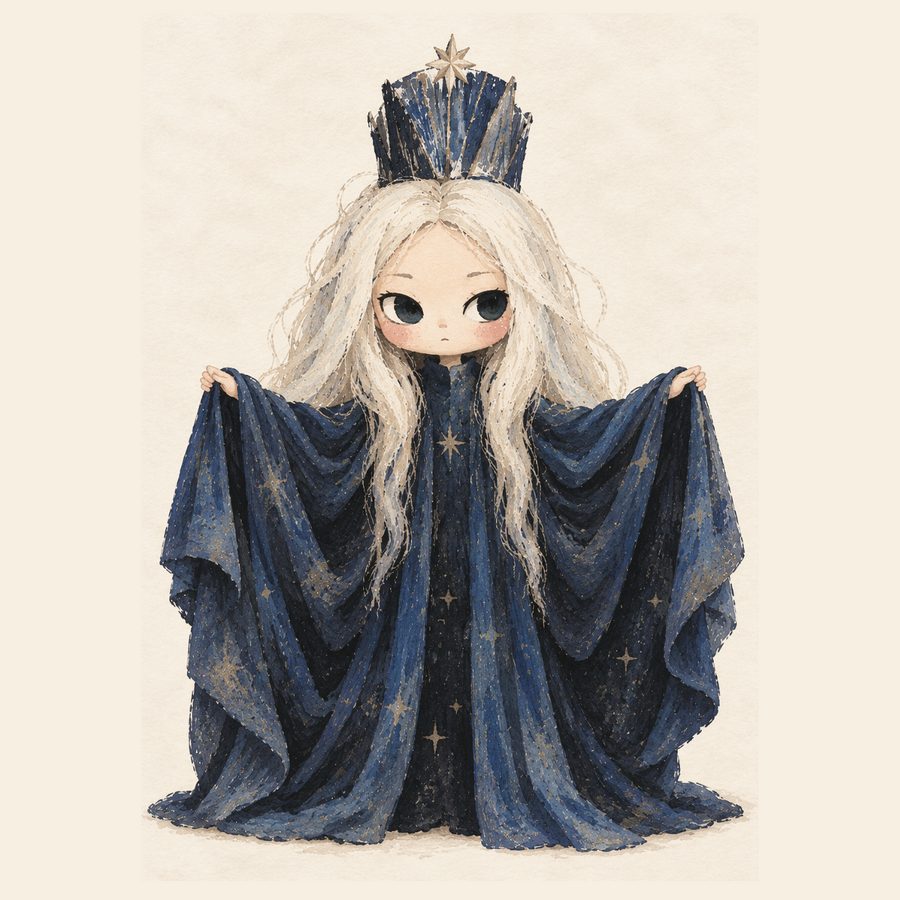

Original interpretation of the character based on a historical costume sketch
In Maurice Maeterlinck’s tale, Night serves as the guardian of secrets hidden behind the doors of her palace. She attempts to prevent Tiltiq from entering the unknown rooms where ghosts, illnesses, stars, and other invisible phenomena reside. This is why Night becomes the first character on the city tour: she greets the viewer at the MXAT named after M. Gorky and invites them to uncover the secrets of Moscow’s theatre. The theatre building, constructed in 1973 based on the design by architects Vladimir Kubasov, Anatoly Morgulis, and Vyacheslav Ulyashov, is distinguished by its massive, dark facade of brownish-red tuff. Its horizontal relief bands evoke the image of a stone theatrical curtain. This architectural feature forms the basis for the character’s connection to the location: Night’s wide blue cloak, inspired by the historical costume of the production «The Blue Bird» at the MXAT, echoes the folds of the facade. Just as Night conceals entire worlds behind the doors of her palace, the theatrical curtain separates daily life from what occurs on stage. The figurine with the open cloak is placed next to the building, becoming a symbolic start to the journey and inviting the viewer to look beyond this curtain to learn about the history of the Art Theatre.
Color character sketch: front, side, and back views
Character Sculptural Model: Angles and Element Detailing
Tilthill
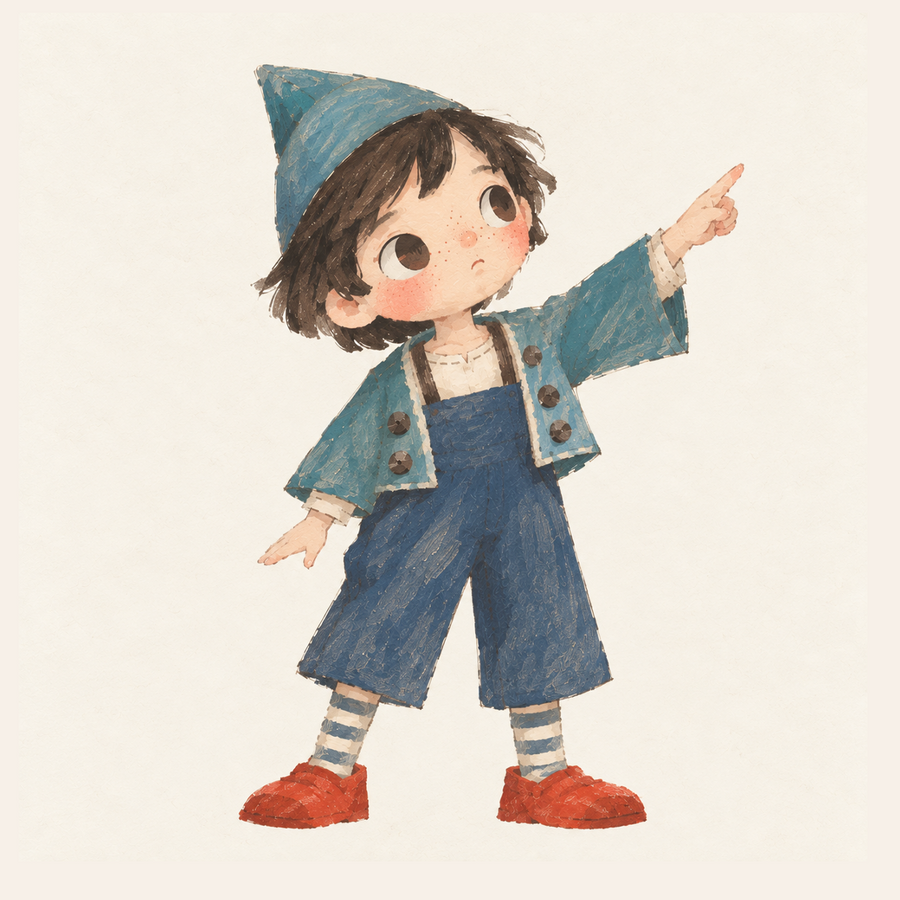
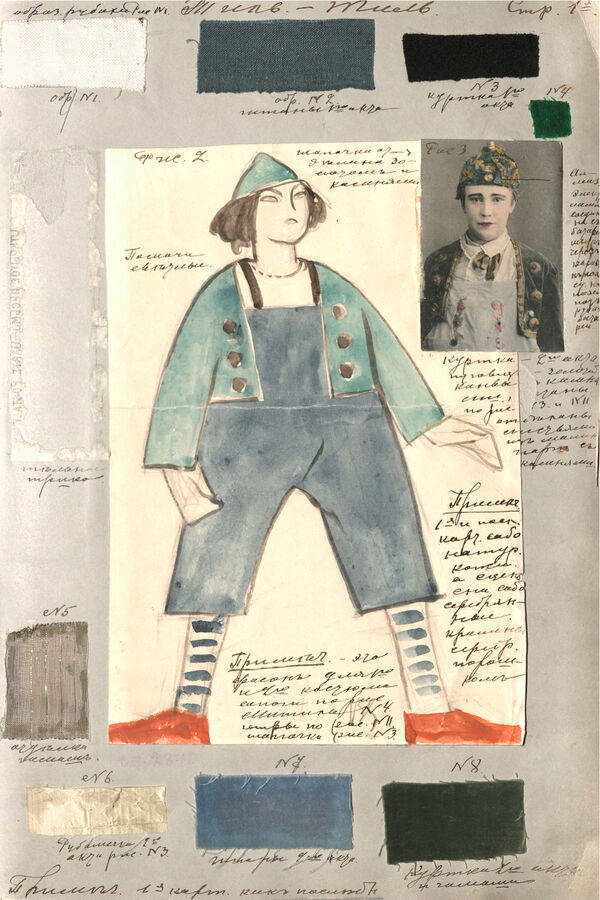
Original character interpretation based on a historical costume sketch
Tiltyl—the main character of Maurice Maeterling’s fable «The Blue Bird”—is a curious and brave boy who sets out to search for happiness and gradually learns to see the extraordinary within the ordinary world. His figure is located at the Konstantin Stanislavsky Museum-House on Leontyevsky Lane, where the great director lived and worked from 1921 to 1938. Stanislavsky himself was one of the directors of „The Blue Bird.“ Tiltyl’s connection to this location is built on a shared idea of exploration and discovery: the boy strives to understand the world around him, and Stanislavsky dedicated his life to finding new ways to reveal human emotions and characters on stage. The mansion was not only a home for the director but also a creative workshop—his Opera Studio was located here, classes and rehearsals took place, and the grand Onegin Hall was transformed into a theatrical space. Just like Tiltyl, who uncovers amazing worlds behind ordinary doors, visitors to the house can discover theater within a residential mansion. The figure’s design is inspired by the historical stage costume of the boy: the pointed cap, short jacket, and stockings maintain the hero’s recognizable appearance. Tiltyl’s raised hand directs the viewer’s gaze toward the building, inviting them to continue a journey through theatrical Moscow.
Character color sketch: front, side, and back views
Character Sculpture Model: Angles and Element Detailing
Fire
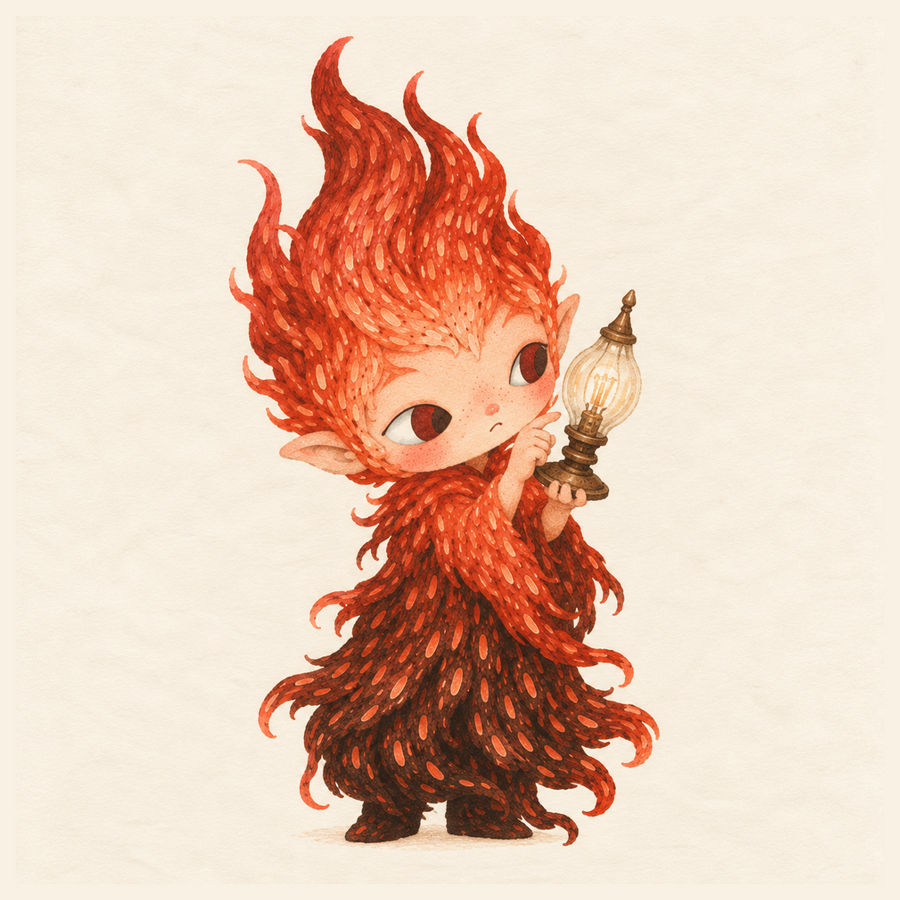
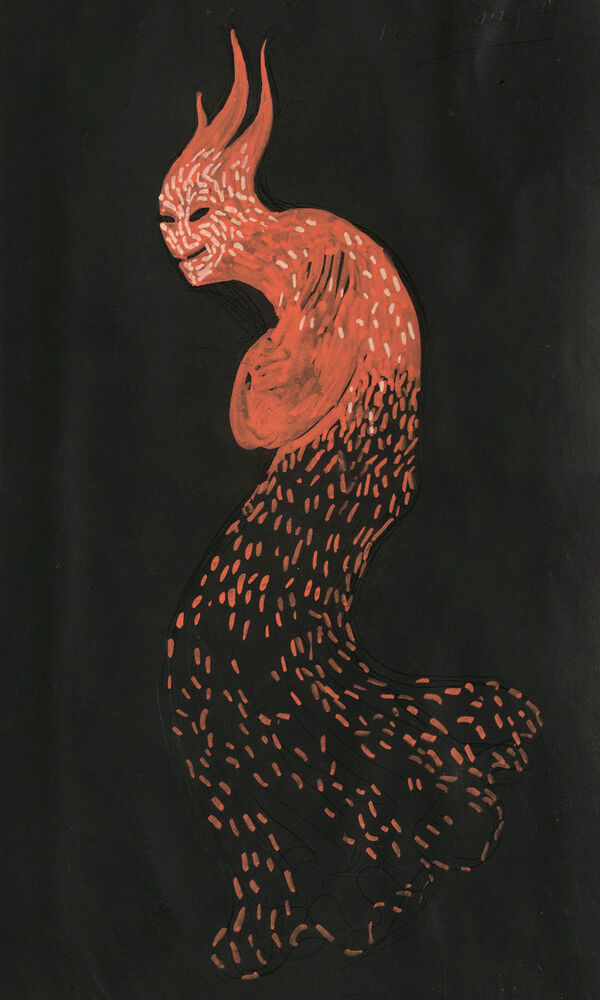
Original interpretation of a character based on a historical costume sketch
Fire—one of the animated characters in the fairy tale, embodying the energy, movement, and unpredictable power of the element. His figurine is located near the A. P. Chekhov Moscow Art Theatre on Kamergersky Lane, the site where the premiere of the famous production, «The Blue Bird, ” took place on September 30, 1908. The character’s connection to this location is revealed through the history of theatrical lighting. At the beginning of the 20th century, light became an important artistic tool, enabling directors to create fantastical spaces on stage, alter the atmosphere, and transform ordinary objects into magical imagery. For „The Blue Bird, ” lighting effects held particular significance because they helped show the audience the invisible world opening up to the main characters. Fire becomes a symbol of this technical and artistic transformation. His image is inspired by historical theatrical costumes featuring flames pointing upward, while the lightbulb in the figurine’s hand is a modern, original detail referencing stage lighting. Situated near the MXHT building, Fire serves as a reminder of how theater learned to transform light into an independent narrative medium and create genuine magic on stage.
Character color sketch: front, side, and back views
Character Sculpture Model: Perspectives and Element Detailing
Mytil
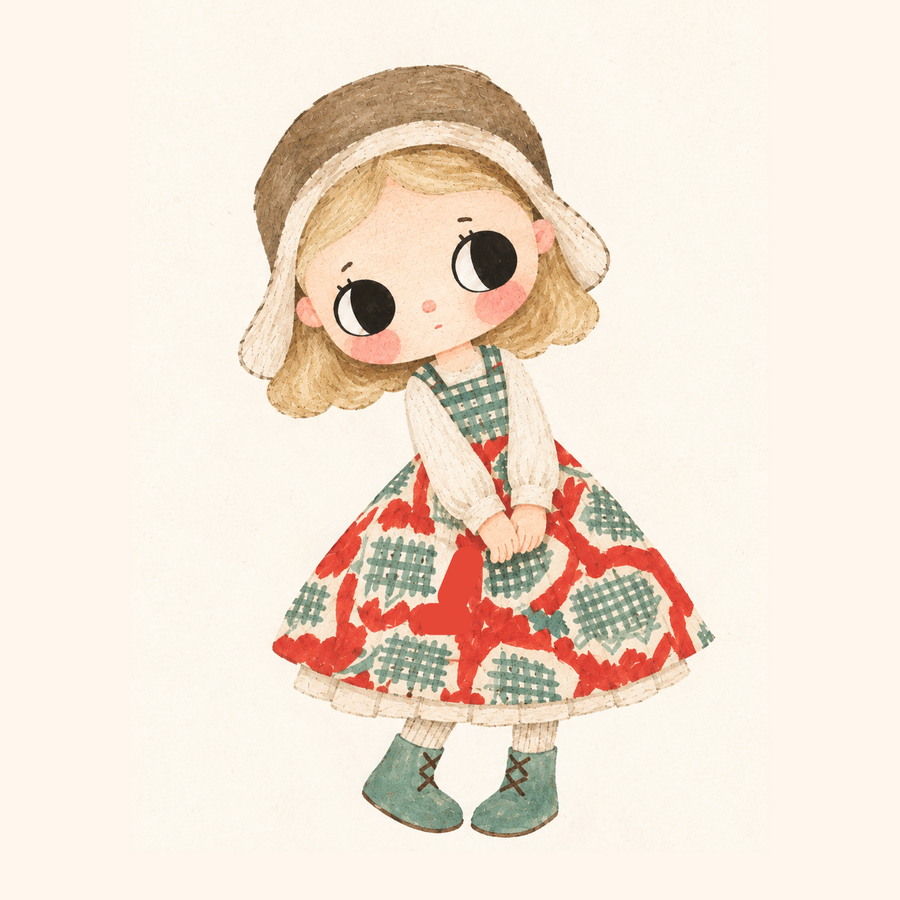
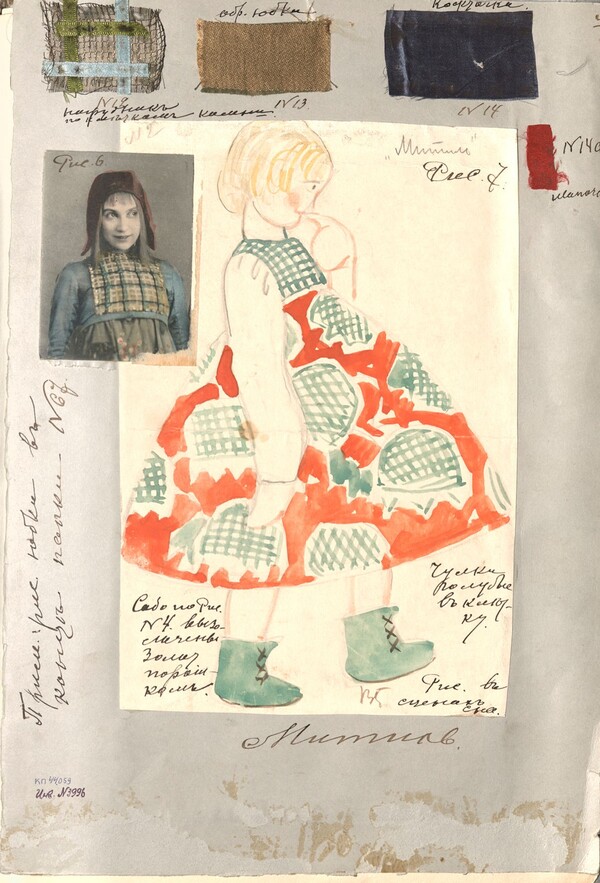
Original character interpretation based on a historical costume sketch
Mytil is Tilltil’s younger sister, who, along with her brother, journeys to search for the Blue Bird. Unlike the bold and curious Tilltil, she is more cautious, emotional, and particularly attached to home. Her figure is situated at the MHAT Artists' House on Glinishchevsky Lane, where renowned figures of the Artistic Theater resided. The character’s connection to this place is revealed through the themes of home, family, and daily life. In the Terlinga fairy tale, the children’s journey begins and ends in their native home, and true happiness turns out to be much closer than they imagined. The MHAT Artists' House also allows one to see theater beyond the stage—as a community of people connected not only by shared work but also by shared life. Here, theater history is preserved not in sets or performances, but in apartments, personal belongings, and the memories of the artists. Mytil becomes a symbol of this domestic, human side of theater. Her figure, modeled after a historical stage costume featuring a cap, corset, and wide skirt, resembles a small girl amidst a big city. Positioned next to the residential building, she draws passersby’s attention to the fact that the history of the Artistic Theater unfolded not only on stage but also in the daily lives of its creators.
Character color sketch: front, side, and back views
Sculptural character model: perspectives and element detailing
Spirit of Light
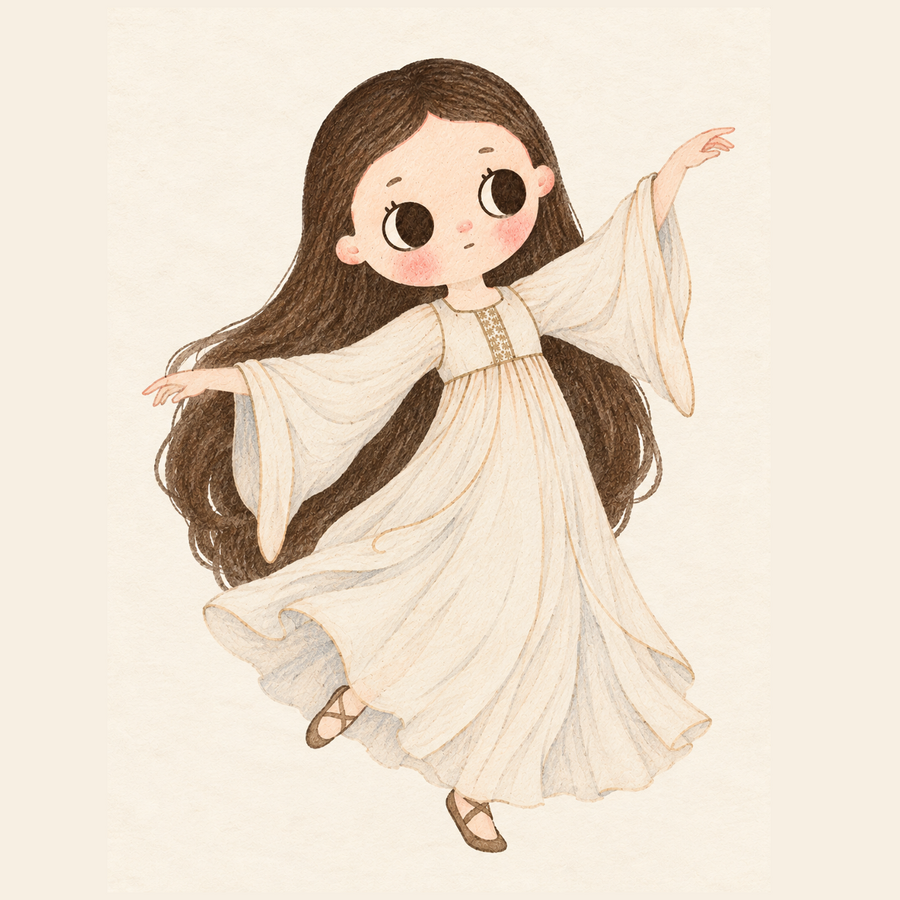
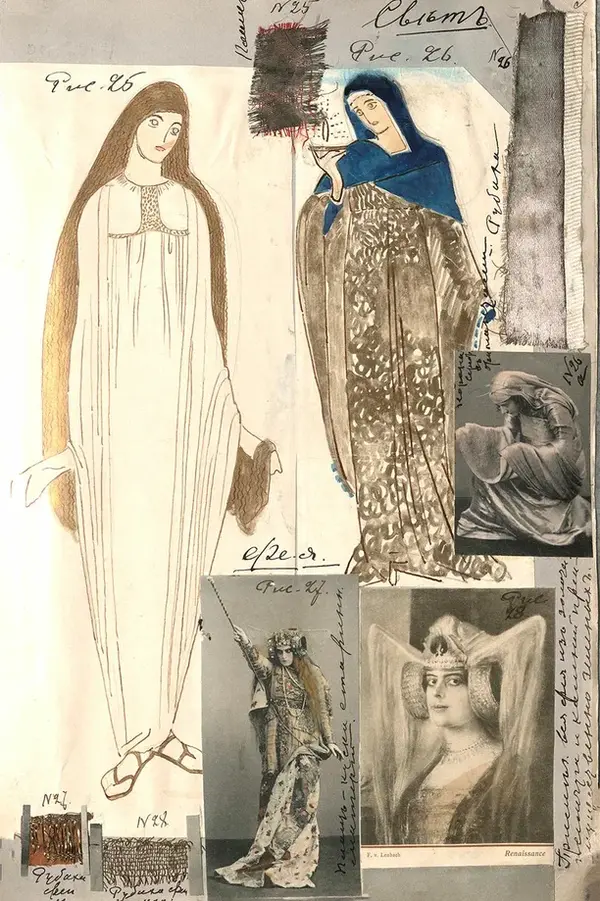
Author’s interpretation of a character based on a historical costume sketch
Soul of Light is one of the main magical characters in the fairy tale. She accompanies Tiltyl and Mitil on their journey, helping them overcome obstacles and uncover the hidden essence of the world around them. Her figure is located near the Stanislavsky and Nemirovich-Danchenko Music Theatre on Bolshaya Dmitrovka. The character’s connection to this place is revealed through music, dance, and stage movement. Soul of Light guides the fairy tale’s heroes, and her image is characterized by lightness, fluidity, and expressive plasticity. These qualities resonate with ballet, which holds an important place in the theatre’s repertoire. The history of the institution itself is tied to the creative pursuits of the two founders of the Moscow Art Theatre—Konstantin Stanislavsky and Vladimir Nemirovich-Danchenko—who sought to modernize the principles of musical performance. The figure is inspired by the historical stage image of Soul of Light: a long, flowing gown, expressive sleeves, and a raised arm create a sense of dance movement. Situated near the music theatre, it unites two branches of theatrical art—drama and ballet—and serves as a reminder of Stanislavsky’s and Nemirovich-Danchenko’s aspiration to make stage action alive and emotionally expressive.
Character Color Sketch: Front, Side, and Back Views