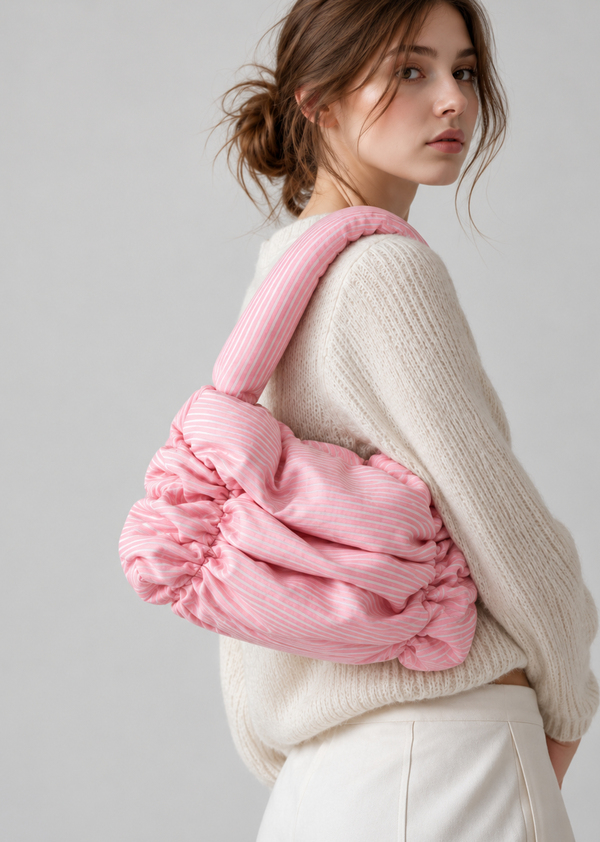
TRACE–PUFFED — a volumetric textile bag project developed within the «Factory» program. It is a continuation of the TRACE diploma project—a brand of designer bags founded on the reinterpretation of materials, their textures, and their transformative potential.
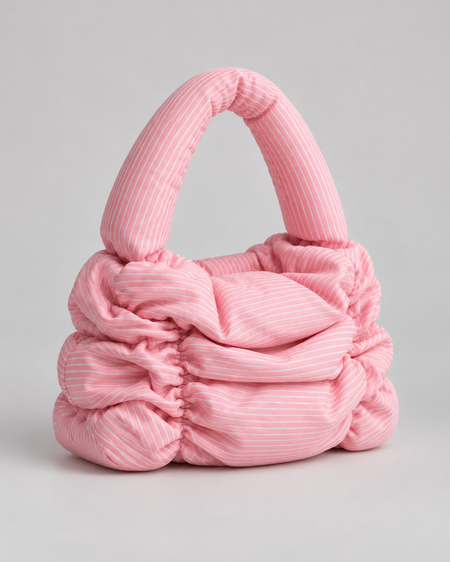
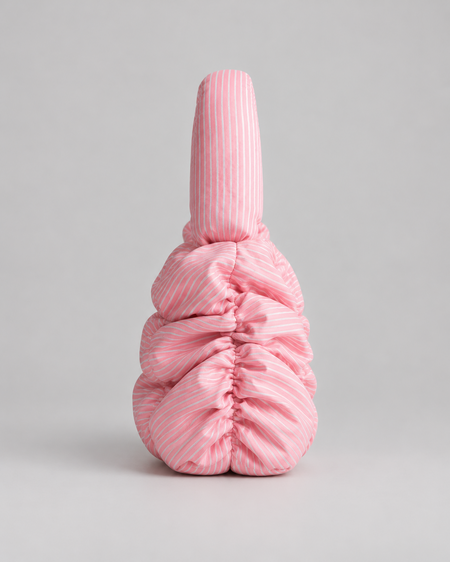
For the «Factory,» the PUFFED direction was chosen, which centers on working with soft volume, quilting, and changing the fabric’s shape. The bag’s main feature is its pronounced texture, created by large, soft sections that resemble small cushions. The project examines not only the appearance of the item but also its construction, material selection, pattern development, manufacturing technology, and the potential for future small-batch production. The goal of the project is to design a functional bag with an expressive textile texture while preserving the visual principles of the TRACE brand and adapting the construction for potential mass production.
Idea and Concept
The core concept of the project is to demonstrate how simple sewing techniques can transform ordinary fabric into an expressive, designer piece. Instead of rigid geometry, the design utilizes soft, pliable form, which is created through gathering, pleating, and internal volume. Horizontal elements define the bag’s characteristic silhouette, while side gathers emphasize the material’s multi-layered quality. This allows the fabric to become the primary decorative element of the item, negating the need for additional prints or complex hardware. The bag successfully balances everyday functionality with an unconventional aesthetic, maintaining softness, lightness, and ease of use.
Connection to the TRACE Thesis Project
TRACE — a brand of handcrafted bags centered on upcycling and the transformation of textile materials. One of the brand’s core principles is preserving the visible marks of the material’s treatment: seams, folds, gathers, and joins. The PUFFED model develops this idea through the use of volumetric pleating. The bag’s surface is formed directly during the sewing process, and the decorative effect is the result of the structural design.
For the «Factory» project, commercially purchased fabric with uniform characteristics across the entire surface is used. This allows for precise testing of the construction, pleat placement, and assembly technology. In the future, the model can be adapted for the reuse of textile materials, which will allow the core concept of the TRACE diploma brand to be maintained.
Form Generation
The design is based on a soft, rectangular body with rounded corners and several horizontal volumetric tiers. The top fabric gathers along the side seams, creating large, soft folds across the surface. The central part of each tier remains looser, allowing the volume to spread across the width of the piece. The folds are stacked one above the other, creating a sense of layering. Their size and depth are balanced so that the bag appears voluminous without losing its core silhouette. A wide, soft, arched handle serves as an additional element. In contrast to the body, it is executed in a nearly smooth form, without pronounced gathering. This combination allows for a balance between the complex texture of the body and the calmer shape of the handle.
Appearance
The bag features a rounded silhouette with a pronounced textile volume. Three main horizontal tiers are arranged on the front and back surfaces, formed through pleating and side construction. The seams remain visible, highlighting the handcrafted nature of the material work.The handle is made from the same fabric as the body. Thanks to its soft stuffing, it achieves a rounded, slightly puffed shape while maintaining a comfortable thickness. Metallic elements are not used as standalone decoration. The primary visual focus is on the texture of the fabric and the unusual form-making.
Color Palette
For the model, a soft pink color with a thin white stripe was chosen. This combination complements the TRACE brand’s pastel palette and highlights the garment’s gentle nature. The striped pattern plays an important role in how the form is perceived. As the fabric folds, the lines change direction, curve, and create additional visual depth. Unlike a solid-colored material, the stripe helps to better emphasize the details of the construction and the surface variations of the fabric. In the future, the model could be released in other shades from the TRACE signature palette while maintaining the overall structure and shaping principle.
Materials and Hardware
A commercially available pink and white striped fabric is used for constructing the bag. A preference is given to cotton or blended fabric of medium density that drapes well, holds pleats, and maintains its shape after sewing. A lining fabric in light pink or a neutral shade is provided for the interior. The soft volume of the body is maintained by internal padding materials and synthetic stuffing. At the same time, the stuffing must not make the folds too stiff or impede the natural movement of the fabric.
A separate layer of soft filling is used for the pen, allowing for the formation of a rounded shape without additional decorative assemblies. The design includes a hidden zipper closure that does not compromise the bag’s appearance. Where metal components are necessary, corrosion-resistant 316L stainless steel is preferred. Materials are selected based on cost, wear resistance, ease of processing, and the feasibility of reordering for small production runs.
Construction and Dimensions
The bag’s structure consists of an outer shell, an inner base, lining, a soft handle, and supplementary hardware to reinforce the connections. The outer shell components feature an increased volume of fabric, which is necessary for creating horizontal folds. The assemblies are predominantly placed on the sides. This arrangement allows for the formation of three soft tiers while maintaining a more open central surface. The inner base helps support the item’s silhouette and prevents excessive stretching of the shell. The handle is constructed separately and attached to reinforced sections on the top of the bag.
Preliminary dimensions of the finished product:
Width — approximately 38 cm.
Body height — approximately 25 cm.
Depth — approximately 10 cm.
Pattern Drafting
A preliminary pattern set has been developed for the model, including parts for the outer shell, internal base, lining, handles, and reinforcement elements. Particular attention is paid to the ratio between the exterior components and the internal base. Additional fabric length is required to create soft drapes. The patterns indicate assembly lines, joining points, seam allowances, and control marks. The handle is made from a separate component, designed to accommodate stuffing and achieve a smooth, arched shape. The patterns are prepared at a 1:1 scale and can be used to create the first prototype. After checking the fit and the volume of the assemblies, the patterns are adjusted for subsequent production.
Manufacturing Technology
The manufacturing process begins with material preparation and cutting the components according to the developed patterns. Assembly lines are marked on the exterior body parts. The fabric is gathered along the side sections, after which three main horizontal tiers are formed. The prepared parts are then attached to an internal foundation that helps maintain the garment’s shape.
The handle is manufactured separately. The fabric pieces are joined, soft filling is inserted, the handle is then turned right-side out, acquiring its rounded shape. Reinforced seams are provided for handle attachment, designed to withstand daily use. Next, a concealed zipper is installed, a lining is constructed, and it is connected to the main body.
In the final stage, the interior seams are treated, the symmetry of the assemblies, the strength of the fastenings, and the overall appearance of the product are inspected.
Functionality and Features
The bag is designed for everyday use and is intended to hold personal items such as a phone, wallet, cosmetics, keys, and other small objects. The wide, soft handle allows for comfortable shoulder carrying, and the lack of a rigid frame helps the item lie naturally against the body.
The main feature of this model is the combination of a highly expressive decorative surface and a relatively simple technical foundation.
The exterior look is formed primarily through construction and pleating, rather than through additional ornamentation. This allows the design integrity to be maintained and makes the construction suitable for manufacturing in small batches.
Production
The project is designed for small-scale production in a sewing workshop or a textile accessory manufacturing setting. Key operations include cutting, shaping assemblies, joining body parts, manufacturing the handle, installing the zipper, and finishing the lining. Specialized metal tooling or the creation of a rigid frame is not required for production. The main challenge lies in neatly distributing the fabric when creating pleats. To maintain a consistent aesthetic across the finished items, it is necessary to control the placement of the assemblies and the volume of each tier. Before launching a production run, a prototype must be created to verify the design and refine the sewing technology if necessary.