Media Concept
A Telegram channel dedicated to film through the lens of visual art. Here, we will analyze interesting shots from movies, discuss color, composition, light, and detail, share cinematic discoveries, and offer creative assignments to subscribers. A dedicated focus is the promotion of a drawing film club, where members meet, sketch movie scenes, and discuss them.
Six-Month Thematic Plan
First Month — Project IntroductionThe goal for the first month is to introduce the audience to the channel’s concept and demonstrate that cinema can be perceived not only through plot but also through visual language.— Introduction to the creator and the channel’s concept
— Why do some shots resonate more strongly than an entire film?
— Analyzing a striking frame from a well-known movie.
— A curated selection of films with interesting color palettes
— First simple assignment: choose a favorite frame and try drawing it
— Surveying subscribers about their favorite films and directors
Month Two—The Visual Language of FilmThis month, the focus will be on how imagery is constructed in cinema and how it impacts our emotions.— How color helps convey the mood of a scene.
— Why lighting in a film might be more important than dialogue.
— Frame composition: where is the director guiding the viewer’s eye?
— How interior design and props reveal character.
— Analyzing the visual style of a single director.
— A creative assignment based on one of the analyzed frames.
Third Month — Cinema as ArtThe monthly goal is to explore the connection between film and painting, photography, illustration, and design.— Films inspired by painting
— How artists' paintings transform into cinematic scenes
— A character’s costume as part of their narrative
— Unique visual solutions in auteur cinema
— A film collection for those who love aesthetics and beautiful imagery
— Submitting original drawings based on films
Month Four — Drawing FilmAt this stage, the channel becomes more interactive: subscribers not only read posts but also try working with frames themselves.— How to choose a frame that is interesting to draw
— How to convey the mood of a scene using color
— What is more important when sketching a frame: accuracy or impression?
— Several ways to interpret the same scene
— A short weekly challenge on drawing frames
— First publications of subscriber work and discussion of results
The Fifth Month: Introducing the Drawing Film ClubThe main goal for this month is to introduce the offline format and engage people who want to draw and discuss cinema with others.— How the idea for the drawing film club came about
— How the meeting takes place: from film selection to drawing discussion
— A selection of shots for a future meeting
— An introduction to the film that will be discussed in the club
— Photos and participant impressions after the meeting
— Announcement of the next event and an invitation to followers
Sixth Month—Community DevelopmentThe final month of the first thematic cycle is dedicated to participants, feedback, and project development.— The most interesting drawings from the past months
— A collection of favorite photos from subscribers
— Discussion of the film chosen by the audience
— A collaborative creative challenge
— Summary of the first meetings of the drawing film club
— A survey on what topics and formats the audience would like to see next
Content Samples
1.
Hello! 👁
This channel is for those who, after watching a great film, go hunting for stills on Pinterest, rewatch a single scene five times, or suddenly feel the urge to draw a character that flashed across the screen for three seconds.
Here, we will analyze beautiful and strange frames, discuss color, light, composition, and all the little details that make cinema truly cinematic.
But without stuffy lectures or an exam on Tarkovsky, I promise. Although, we will talk about Tarkovsky too.
I also want to start a drawing film club: we’ll meet up, select frames, draw, and discuss films in person.
In short, if you sometimes want to pause a movie and say, «GOODNESS, HOW BEAUTIFUL”—you’ve found the right place.
To start, tell me: what film would you choose to forget so you could watch it again? 🎬
2.
Wes Anderson and his passion for centering everything 💗
If you’ve seen «The Grand Budapest Hotel, ” you probably noticed that characters, doors, windows, and even small objects are often positioned as if the shot were assembled on a ruler.
This is called a symmetrical composition. It makes the image orderly, almost artificial—as if we are not looking at the real world, but at a meticulously constructed model.
And the interesting thing is that it’s not just aesthetically pleasing. This visual neatness helps create the film’s own world, where everything is slightly fantastical, theatrical, and unreal.
🎨 Try it yourself: mentally draw a vertical line through any of Anderson’s shots. How many objects appear on either side of it?
Now for the question: do you like this perfect symmetry, or are you more drawn to shots where everything is a bit chaotic?
3.
Format: Survey + ImagesLet’s test something out: if your favorite movie were a color, what would it be? 🎨Some films have such instantly recognizable palettes that a single frame can sometimes tell you what the movie is all about.For example, Amelie features rich reds and greens, The Matrix has its signature green hues, and Wong Kar-wai’s In the Mood for Love employs deep reds, dark greens, and warm golden tones.The color palette is more than just decoration. It helps establish a mood and unify individual scenes into a cohesive visual world.Now, choose your cinematic mood:❤️ Red — passion, tension, melodrama💙 Blue — melancholy and solitude💚 Green — strangeness and anxiety💛 Yellow — warmth, nostalgia, summer
4.
Format: voiceover, 60–90 secondsScript for recording:«Basically, there are movies that look like you’re remembering something that never actually happened. For me, 'In the Mood for Love' is exactly that.Notice the repeating hallways, the narrow spaces, the reflections, the way the characters are constantly behind doors or seem separated from us by a wall.And the camera—it doesn’t always show everything straight and open. Sometimes it feels like we are peeking at the characters from a distance.Ultimately, the visual style doesn’t just tell the story of two people; it creates a feeling of memory—beautiful, slightly painful, and incomplete.In film theory, we can talk about visual motifs and the subjectivity of the narrative, but if we keep it simple, the film doesn’t let us get completely close to the characters. And that’s why we want to keep watching.I wonder if you also ever get the feeling that some films are more like a dream or a memory than a regular story?»
5.
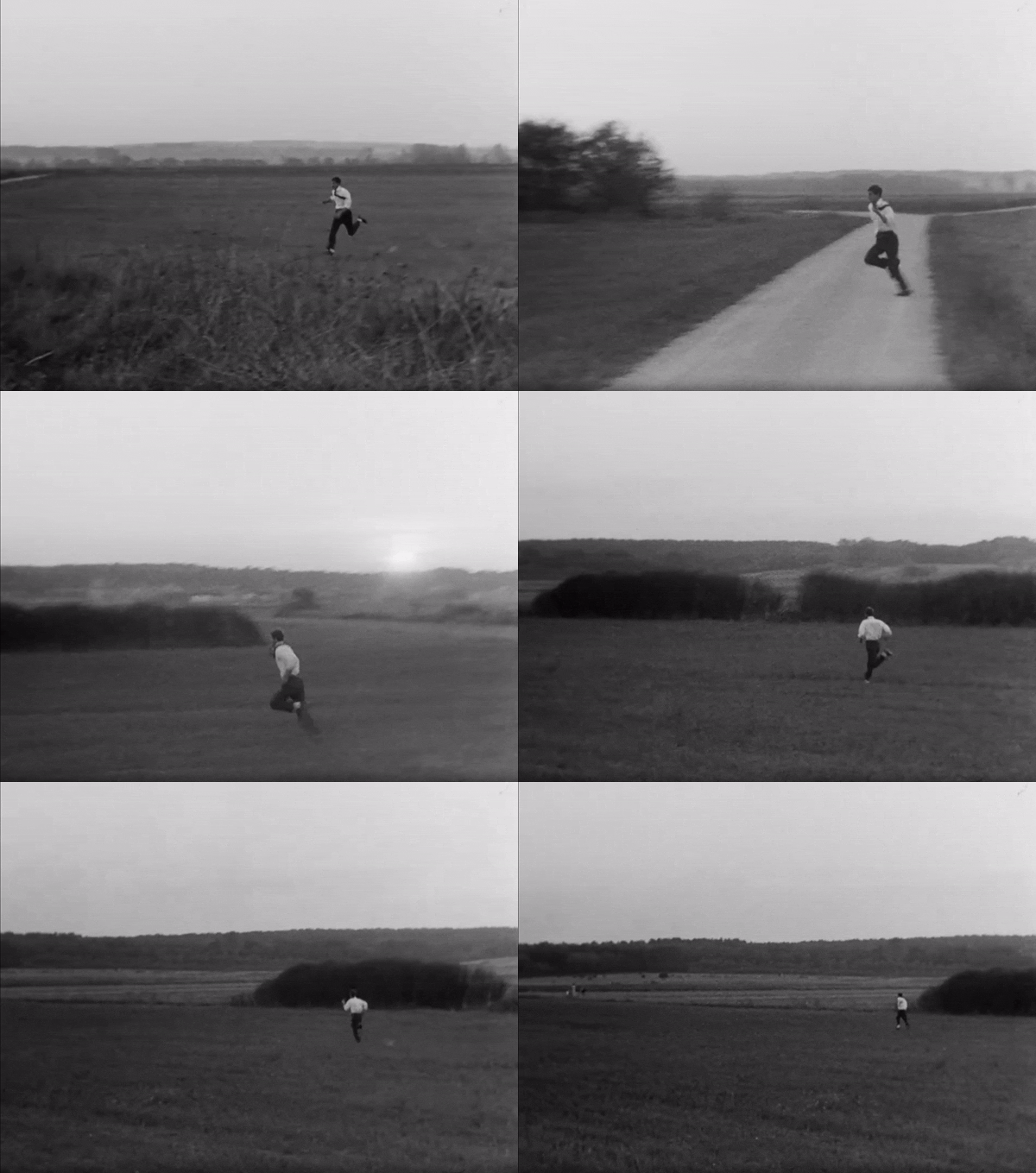
Why is the character so small when the frame is so large?When a character occupies a tiny portion of the frame, surrounded by vast empty space, it is often no accident.A director might use this technique to emphasize loneliness, vulnerability, or the feeling that the world is too large for the hero.Visually, this is achieved through scale and negative space—the areas of the frame not occupied by the primary subjects.What’s interesting is that if you zoom the camera in close to the face, the scene’s meaning can shift dramatically. We begin to read the individual’s emotion rather than their relationship with their environment.📌 Mini-experiment: take any shot featuring a person in a large space and crop it so that only the character remains. What sense has disappeared?Sometimes, a frame tells a story precisely by what it omits.
6.
Format: Meme or GIF
Me: Tonight I’m going to watch one movie and then go to sleep.
Also, at 3:17 AM, I’m searching for who was in charge of the camera work, why the lighting is like that in the third scene, and where to buy a sketchbook, because I ABSOLUTELY NEED TO DRAW THIS RIGHT NOW.
And then I spend another half hour choosing between 17 nearly identical frames.
Does movie-watching sometimes turn into a tiny investigation for you too? 🕵️
7.
Format: photo + short challengeSketch a frame in 10 minutes. No perfectionism🎨 Mini-challenge for todayWe choose a frame from a movie and sketch it in 10 minutes. Yes, only ten.
You don’t need to polish every detail, select the perfect brush, or redraw everything seven times. Try to capture just three things:
— the overall composition; — the largest areas of light and shadow; — the mood of the scene.
You can draw by hand, on a tablet, with a pencil on a coffee receipt—it doesn’t matter.
The goal here is not to prove that you can draw. It’s just about looking at a familiar image a little more closely.
If you try it—drop your results in the comments. I’m very interested to see how differently we will perceive the same frame 👀
8.
One Shot—Three Ways to Render It
Format: Vertical Video, 20–30 Seconds
Video Script:
0–5 seconds — Source image
On-screen text: «How would you draw this shot?»
Add to Favorites
5–12 seconds — Option #1
Line sketch: Focusing only on the basic forms and composition.
12–20 seconds — Option #2
Color interpretation: Conveying mood through the palette.
20–30 seconds — Option #3
Abstract version: Retaining only the emotional impact.
Text
One shot, three interpretations.
And none of them have to be «correct.»
When drawing for film, we can copy the image, study its composition, or simply try to convey only what we felt.Which option would you choose—1, 2, or 3?
9.
What if we stopped drawing alone?
Format: Process photo + invitation
Text
I have a feeling that sometimes drawing together is much more interesting than sitting with a sketchbook by yourself.
Especially when you have a shared reference, but everyone creates something unique. One person focuses on the lighting, another on the character’s face, and a third might end up drawing the background because that’s what somehow captured their attention.
That’s why I want to develop a drawing film club—meetings where we choose a film, sketch favorite scenes, and discuss what each person saw in them.
This isn’t a drawing lesson or a film studies exam. It’s more of an opportunity to spend time with people who are also interested in cinema and visual art.
And yes, you don’t need to come with a perfect drawing. You can come with absolutely no experience—the main thing is curiosity.
**What would you be more interested in at such a meeting: drawing more or discussing the film more? **