
TEAMUP. Find your collaborators.
Project Summary:
A platform where students from various universities gather teams for case competitions, hackathons, and creative projects.
The Problem: Students find it difficult to find a team with whom they can see a project through to completion.
The Solution: Matching individuals based on skills, goals, and availability, supplemented by a short trial assignment.
Format: Web service (with a Telegram bot later).

Original size 1536x1024
01. The Problem: Ideas Exist, But No Teams
Imagine this: a second-year student can create excellent presentations and wants to participate in a case competition. She has no contacts among potential participants. She posts in the group chat, «Looking for a team, ” and within an hour, her message is buried under dozens of others. Many students face this challenge. The Changellenge Cup Russia 2026 had over 5,000 registrations from more than 350 universities. However, the organizers themselves advise participants to look for members through their personal networks, social media, and case clubs. While they offer an automated matching service, they warn that such teams often dissolve. For the HSE Data Science Hack, those without a team are encouraged to find people on-site or in a general chat. The core issue: joining a team is possible, but finding a team you can actually collaborate with often comes down to luck.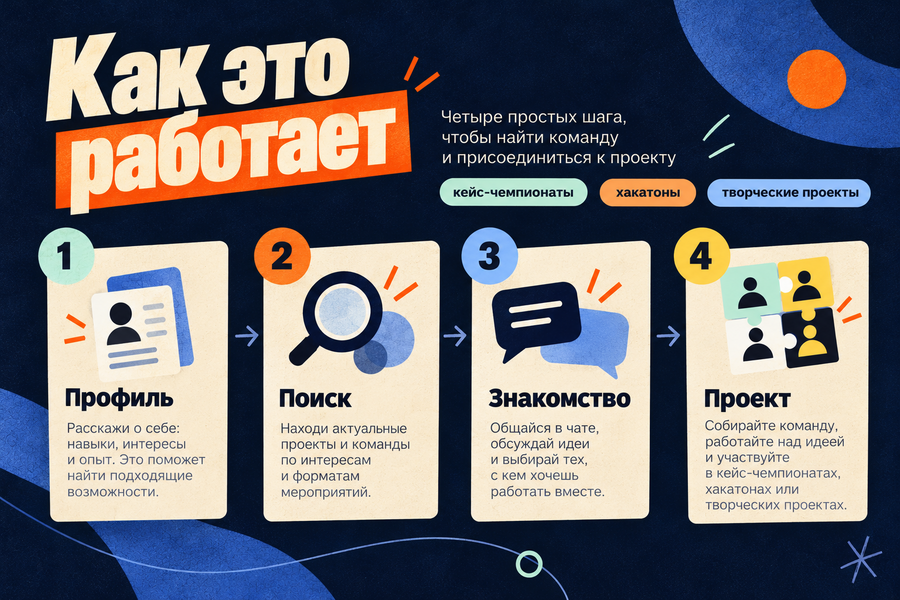
Original size 1536x1024
02. Why This Matters
Skills are only half the equation. The other half is how much time a person is willing to dedicate to the project and what they hope to gain from it. One person might be willing to work every evening, while another might only manage a couple of hours per week. This often becomes clear once the project has started. Validation from similar fields: According to Y Combinator, among users of their co-founder matching service, 79% consider how much time a partner is willing to commit to the project, and 74% prioritize shared interests. This is data from startup founders, not students, but the underlying logic remains the same. A 2026 hackathon study found that changes in team composition were the most frequent barrier to continuing work (26.15% of mentions).Original size 1536x1024
03. Solution: TEAMUP
TEAMUP helps students see not only what a person is skilled at, but also whether you are a good fit for each other. To achieve this, we present four things: Skills: what a person knows how to do. Interests: what kinds of tasks they enjoy. Goal: whether they want to win or try a new format. Time: how many hours per week they are willing to dedicate to the project. Before forming a team, you can complete a short, optional task: sketch out a solution structure together in 15 minutes. This helps determine if you are comfortable working together, even before the project starts. The choice remains with the individual—the service does not assign people automatically; rather, it helps compare options.Original size 1536x1024
04. Format: From Profile to Team
A web service featuring user profiles, competition cards, participant search, and team applications. We will later integrate a Telegram bot so that notifications arrive where students already communicate.
Create a profile → Find people → Connect and complete the task → Start a project.
For whom: Students in Years 1–4 who participate in case competitions, hackathons, and projects not only in IT but also in design, media, and content. We are launching with students from Moscow universities.
Original size 1536x1024