01
Musical Source
Jonathan Hostad was born on July 18, 1996, into a family of Swedish intellectuals—the renowned poet and translator Christopher Leandör and the diplomat Elsa Hostad. In the late 1990s, his mother was involved in human rights advocacy in Belarus, meaning Jonathan spent the first three years of his life in Minsk. Later, the family moved to Stockholm, where the future artist spent his childhood. However, sixteen-year-old Leandör felt drawn away from the contemplative nature of Scandinavian culture—straight into the boiling pot of American hip-hop, whose aesthetic reeked of money, drugs, and the cult of success—as a contrast to Swedish dullness.
02
Cultural Conflict
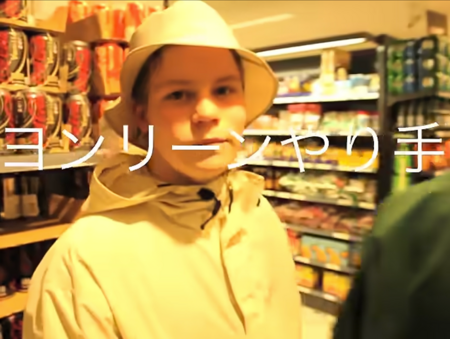
Because of the mismatch between his desires and reality in his creative work, one could find a strange duality. On one hand, the lyrics of early tracks by Yuntan resembled a collection of clichés drawn from the work of his contemporary peers like A$AP Rocky and Chief Keef. On the other hand, for the voice of a white teen who didn’t grow up in the New York ghetto, such gritty lines sound so unconvincing that one had to emphasize the absurdity and surrealism of their context. Leandyr delivers his lyrics in an arrogant, weary voice over slow, airy beats, as if distancing himself from his own speech and mixing tales of consuming iced tea with deliberate rap—which is comical in itself. Like his meme clips, in one of which Yuntan, wearing a ridiculous panama hat, attempts to mimic the dance of the cult underground rapper Lil B with shy movements.
03
Image in Music Videos
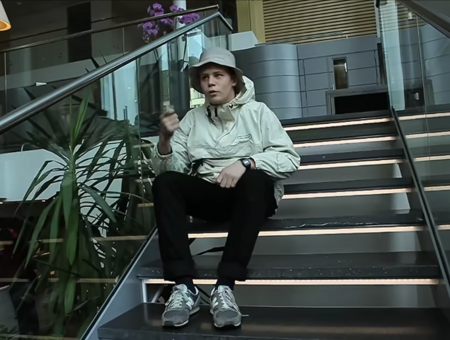
Throughout his career, Jonathan remained a focal point for fashion enthusiasts due to his striking appearance and his casual embrace of the most unconventional and even campy looks. In the mid-2010s, a subculture of sad boys emerged—young men who celebrated melancholy, dressed in streetwear, and, crucially, wore panamas. It was largely thanks to Jonathan that this aesthetic became commonplace among the fashionable (and melancholic) teens of an entire generation.
Boylife in the EU
The art direction of the work is entirely based on the artist’s childhood drawings, and the imagery is truly psychedelic: the characters in the music video—Jonathan’s friends and colleagues—wander through a closed room in a black and yellow cage—one (Yung Sherman) wears a furry balaclava with Garfield featured on the front, the other (Bladee) wears a pink blouse with a corset, has giant white claws instead of a left hand, and holds a vintage lady’s umbrella in his right hand.
Babyface Maniacs
In the clip, the protagonist moves through a harsh, almost desolate landscape, and the arrows striking his body transform his figure into something resembling a sculpture. The visual language merges the industrial environment, a cold blue palette, a near-mythological narrative, and artificially created effects. Director Leo directly connected the image to the myth of the hero who falls yet continues moving forward, and to the iconography of Saint Sebastian.
Forever Young
In the music video for the single «Forever, ” Yung has Jonathan bury another. The first—slightly disheveled, covered in blond stubble, and dressed in a simple leather biker jacket—and the second—clad in royal attire and wearing a crooked crown. Later, the first holds a parade of costumes, as if denying the audience any fixed sense of his own identity. Jonathan Leander is a spectrum ranging from a metrosexual dandy to a vulnerable guy in sweats.