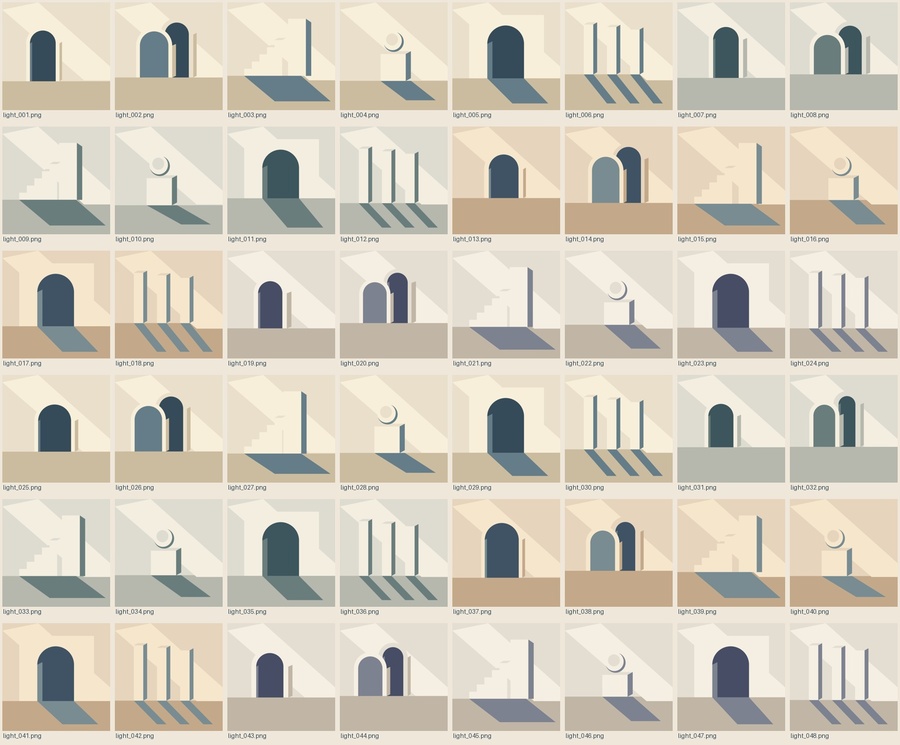
Light Through FormArchitectural sketches exploring how light alters the perception of simple volumes. A learning experiment in fine-tuning Stable Diffusion using the LoRA method.CONCEPTThe project is fundamentally based on the relationship between filled and empty space: arches and openings, walls and niches, stairs and cast shadows. Simple geometry allows us to observe how warm, illuminated planes and cool shadows create a sense of depth.Instead of detailed architectural visualization, the language of the flat study has been chosen: light plaster, muted blue-gray shadows, a calm perspective, and the absence of people, decor, or typography. The training objective is to apply this system of relationships across a series of different spatial motifs.INITIAL DATASETForty-eight original algorithmic drawings of 512×512 have been prepared for this project. Six motifs are included: a freestanding arch, two arches, a wall staircase, a sphere on a pedestal, an arched niche, and the rhythm of three columns. Color combinations, arch proportions, horizon height, and the placement of individual elements vary across these types. Each type is accompanied by its own text description.The drawings were generated using the make_dataset.py script, developed with the aid of ChatGPT. No external photographs, artists’ works, or materials from other portfolios were used. These are specifically prepared algorithmic source materials, not hand-drawn illustrations or the output of a pre-trained model.This selection allows for the comparison of style transfer across several motifs. Its limitations include a small volume and compositional similarity within each type.
LEARNING PROCESS
The base model is Stable Diffusion 1.5. Fine-tuning was performed using LoRA rank 8, without separate text encoder training. Each prompt utilizes the marker «lghtform style» and a description of the specific motif.
Training was conducted in Google Colab on an NVIDIA T4. Parameters: 48 images at 512×512 resolution, 400 optimizer steps, batch size 1, gradient accumulation 2, effective batch size 2, learning rate 0.0001, seed 73, fp16, gradient checkpointing. This equates to approximately 800 image presentations, including repetitions, or 16.7 passes through the dataset.
The log confirms the completion of 400/400 steps; the final weights are saved as pytorch_lora_weights.safetensors. The process took about seven minutes, not including environment setup and loading the base model. The official script train_text_to_image_lora.py from Diffusers version 0.35.1 was utilized.
Following training, pairs are created for six scenarios: the original model and the same model with the LoRA connected. In every pair, the text prompt, seed, resolution, 30 DDIM steps, and guidance scale of 7.0 are identical. This comparison demonstrates the effect of the adapter under fixed conditions.
A separate validation set was not used. The training loss alone does not prove generation quality—the results are evaluated based on the images and the control pairs.
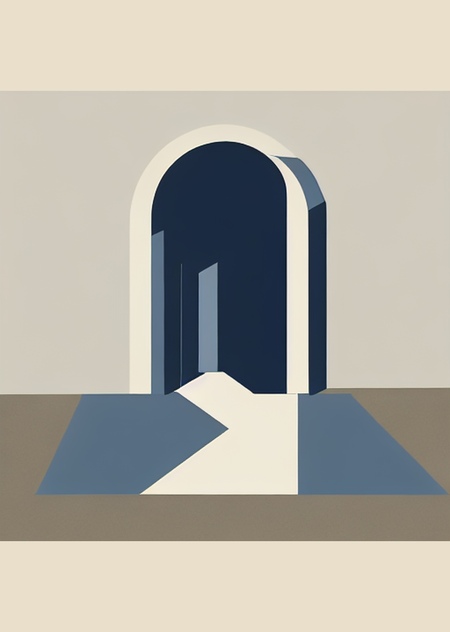
FINAL SERIESSix pieces are presented on the page above, arranged from left to right, top to bottom.01. Aperture and Light Path. A large, bright arch frames a dark blue opening. Interior verticals and the light path complicate the space. The motif of entry is preserved, but the juxtaposition of volumes reads as abstract graphic design.02. Intersection of Arches. Two unequal arches and a rectangular opening create several layers of depth. Diagonals connect the background with long shadows. Some volume boundaries are ambiguous.03. Staircase. The steps are clearly discernible; a light flight intersects a blue plane. A diagonal leads the eye toward the upper aperture. The gaps and bases require structural refinement—this is an artistic study.04. Sphere on a Pedestal. The requested sphere has transformed into an almost flat blue disk featuring a circular, bright area. The pedestal and shadow are retained, but the spherical volume is weakly conveyed. The planar style proved stronger than the object description.05. Niche Scale. A large, bluish-gray arch is juxtaposed with a small, bright opening. Instead of a deep niche, an almost independent colored plane emerges. The negative space enhances the feeling of stillness.06. Columns. Light verticals with dark side planes create a rhythm. Instead of three columns, the model features more supports—the requested number was not adhered to. The color and the alternation of light and shadow maintain the series' unity.
COMPARISON AND FINDINGSIn the three pairs above on the left, the base model is shown; on the right, the LoRA model is shown: the arch, the sphere, and the columns. Within each pair, the prompt, negative prompt, seed, and parameters are identical. Generation settings: 512×512, DDIM, 30 steps, guidance scale 7, seeds 210–215. After a frame was rejected, pairs 4–6 were recalculated using a refined negative prompt via an automatic filter. The filter was left enabled, and the seeds were maintained; the exact parameters are in prompts.json.For the arch, the photographic texture of the wall and floor is replaced with flat colors and large shadows. The base model conveys the spherical volume more convincingly, whereas the LoRA transforms it into a graphic disk. The cylindrical columns become faceted verticals. While the style transfer is noticeable, the precise form and object count are not guaranteed.The palette and presentation are consistent. However, the sample set is small, and variations within the types are close; independent testing for memorization and generalization was not conducted. The next stage will involve more angles, forms, and lighting conditions, along with individual captions and separate validation. No manual retouching was applied to the final works; the collage and cover fields serve only for presentation.GENERATIVE MODEL APPLICATION DESCRIPTIONChatGPT was used for conceptualization, coding algorithmic drawings, experiment setup, and text: https://chatgpt.com/. The final series was generated using Stable Diffusion 1.5, specifically fine-tuned with the LoRA method: https://huggingface.co/stable-diffusion-v1-5/stable-diffusion-v1-5. Source files and results are presented separately.CODE AND MATERIALSThe executed notebook, weights, journal, 48 source files, prompts, and all control pairs are available here: https://drive.google.com/drive/folders/1ISKDafw5iPHtwIFMF2OqI-biQcjNiun4Files: Свет_сквозь_форму_обучение.ipynb and Свет_сквозь_форму_полный_комплект.zip. Colab: https://colab.research.google.com/drive/1A3EofG9NrGujEhfkfKP2jhw5Vg7TJHvu. You can also use the public shared folder to download the code.