SUBTEXT
Future Media Themes
Segment: Film, visual culture, and visual storytelling.
Narrow Topic: The invisible visual narrative in film: how composition, color, light, space, costume, and shot details tell a story without words.
Format: Scene and shot analysis, short videos with visual analysis, compilations of visual techniques, and discussions.
Why this topic: High-quality materials on visual storytelling are often in English and scattered across various film disciplines. It is difficult for the viewer to grasp the hidden meaning behind visual choices, and for a beginner to apply them in practice. «SUBTEXT» unites this knowledge, demonstrating on specific scenes how visual techniques work to advance the narrative.
Media Goal
Problem: Information regarding visual storytelling is scattered, and many high-quality materials are in English. Audiences struggle to grasp the subtle meanings within an image, and emerging professionals find it difficult to systematize their knowledge and apply it in practice.
Project Goal:To create a media platform that:— Regularly publishes analyses of scenes and shots, demonstrating how composition, color, light, space, costume, and other elements contribute to the narrative.— Synthesizes knowledge from various visual disciplines and explains their interconnectedness using specific examples from cinema.— Assists students and emerging professionals in discovering visual techniques and applying them to their own film, CGI, and design projects.— Fosters a community of individuals interested in visual storytelling, where they can discuss films, share observations, find references, and exchange experiences.
Competitors and their analysis
Services and Methods Used
Yandex Wordstat — for analyzing the frequency and phrasing of queries related to visual storytelling: «visual language of film, ” „shot analysis, ” „visual storytelling, ” „composition in film, ” „color in film, ” „cinematography.“LiveDune — for analyzing competitor social media: publication frequency, audience engagement, content formats, and subscriber reaction.YouTube — for searching and analyzing video channels on film analysis, visual storytelling, cinematography, and scene breakdown. We examine video formats, themes, duration, presentation, and audience reaction.Manual keyword search on Telegram and VK.
Competition Criteria
Thematic scope and analytical depth—ranging from a general film overview to a detailed breakdown of visual choices.Format—video essays, short-form videos, text analyses, collections, and interactive content.Content adaptation for platforms—duplicating or repurposing materials for different venues.Visual style—working with film clips, graphics, typography, motion design, and other visual techniques.Tone of Voice—academic, expert, entertaining, or conversational presentation.Engagement and community tools—comments, discussions, reactions, polls, feedback, and other means of interaction.
Direct Competitors
»…and Action!» — Visual Language Analysis of Cinema
— Deep dives into films, editing, color, composition, and cinematography.
— Strengths: In-depth authorial analysis, specific scene studies, Russian language.
— Weaknesses: Lack of a systematic knowledge base, inconsistent content schedule.«LANGUAGE OF CINEMA» — Director’s Analysis
— Analysis of scenes, directing techniques, visual devices, and cinematic language.
— Strengths: Practical focus, detailed scene breakdowns.
— Weaknesses: Broad focus; visual storytelling is not the sole subject.KinoPoisk Video Essays — Film Analysis
— Video essays covering films, scenes, editing, color, composition, and other techniques.
— Strengths: Large audience, high production value, topical diversity.
— Weaknesses: Visual narrative is just one aspect; lacks deep specialization.
Indirect Competitors
«Seance» — a magazine about cinema and cinematic culture
— Critiques, essays, and materials on the history and language of film.
— Strengths: expertise, deep analysis, unique authorial voice.
— Weaknesses: more challenging for beginners, lacks a distinct focus on the practical application of visual techniques.Arzamas — an educational media platform focused on culture
— Lectures and materials on art, film history, and visual culture.
— Strengths: high-quality educational presentation, structure, strong visual style.
— Weaknesses: broad range of topics; cinema is only one focus area.Moskino — an educational project about film
— Lectures, materials, and analyses dedicated to cinema, directing, and the history of cinematography.
— Strengths: practical orientation, connection to the professional film industry.
— Weaknesses: wide scope of subjects, lacks narrow specialization specifically in visual storytelling.
Potential Competitors
StudioBinder — educational media focusing on film production.
— Deep dives into directing, cinematography, and visual storytelling.
— Risk: the release of Russian-language content may attract SUBTEXT’s audience.MUBI Notebook — a journal dedicated to cinema and visual culture.
— Essays and analysis on film direction and aesthetics.
— Risk: competes for the attention of audiences interested in deep film analysis.BFI — a British film institute and educational platform.
— Publishes materials on film history, direction, and visual language.
— Risk: if Russian-language educational content develops, it could enter the same niche.
Conclusions
What to borrow:
— From «…and Action!» — an in-depth analysis of specific film scenes and visual language. — From «THE LANGUAGE OF CINEMA» — practical focus and analysis of visual techniques. — From Kinopoisk Video Essays — variety of formats and high-quality visual presentation. — From Arzamas — a structured educational approach.
How to stand out:
— A narrow focus specifically on visual storytelling, rather than general film analysis. — Connecting film, design, CGI, and other visual disciplines using specific examples. — Practical application: each analysis helps apply techniques in your own projects. — A free knowledge base plus a community for discussions, reference sharing, and feedback.
Distribution Channel
Target Audience
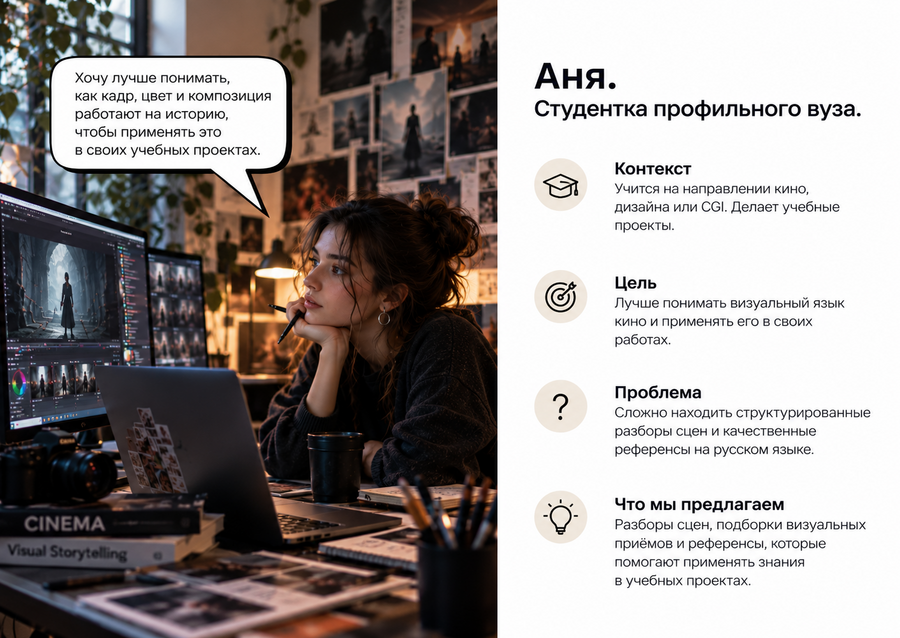
Film, Design, CGI, and Visual Arts Students.
— enrolled in a specialized university, seeking visual references, and aiming to better understand the visual language of cinema for academic projects.Aspiring Professionals in Film, CGI, and Design.
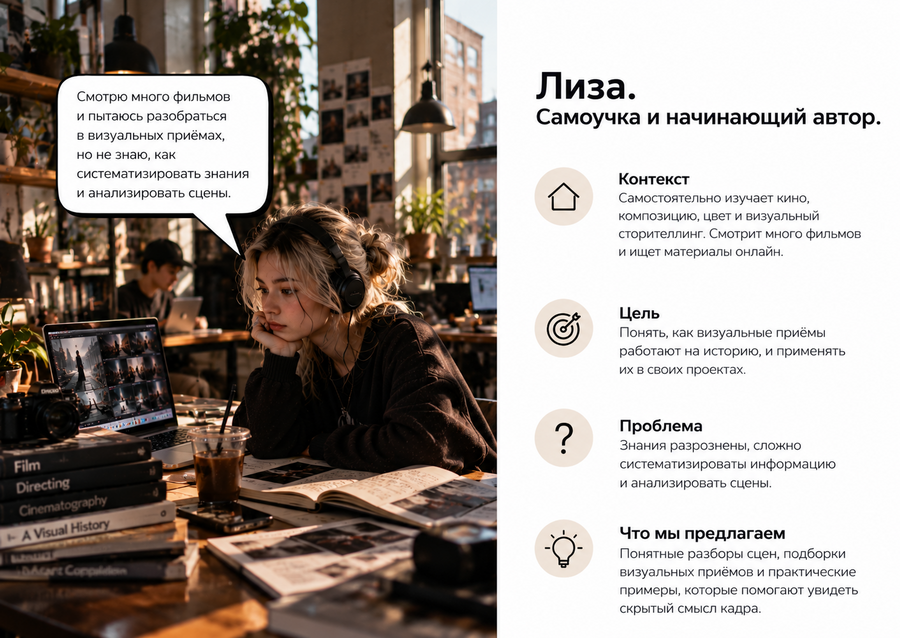
— already producing their own projects, but looking to develop visual literacy and apply professional visual techniques in practice.Self-Learners and Emerging Creators Studying Visual Storytelling.
— studying film, composition, color, or visual storytelling on their own, but lacking a framework to systematize knowledge and analyze scenes.Film Enthusiasts and Individuals Interested in Visual Culture.
— watching a great deal of film, noticing visual details, but desiring a deeper understanding of why a specific shot evokes certain emotions and how a director tells a story through imagery.