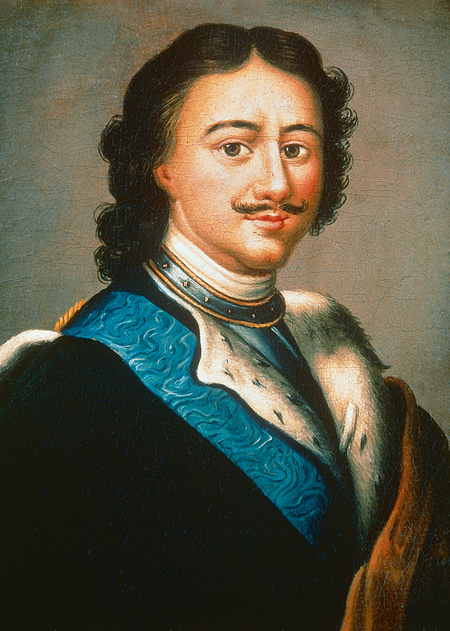
From the stern visages of ancient Rus frescoes to the bold flight of the avant-garde—art has been both a mirror and an active participant in the great transformations of Russian history. This timeline will guide us through the centuries, illustrating how the Baptism, yoke, reforms, and revolutions were reflected in architecture, iconography, literature, and painting. We will see not merely a chronology of events, but a dialogue between power, society, and the artistic genius that shaped the visage of Russia in stone, word, and color.
Древняя Русь
The Calling of the Varangians
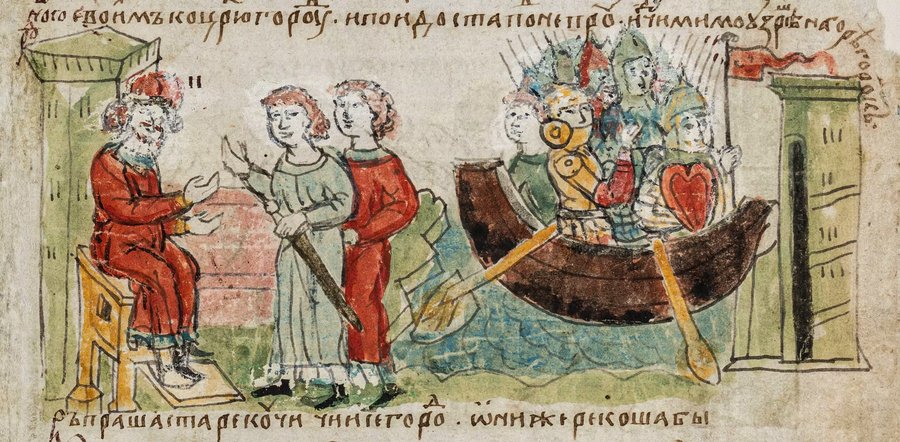
Miniature from the Radziwill Chronicle. Rurik allows Askold and Dir to go on a campaign to Tsargrad. 15th century. Fragment
According to the «Tale of Bygone Years, ” in 862, the tribes of the Ilmen Slavs, Krivichs, Chud, Meri, and Vesi, striving to end internal feuds, invited the Varangian Rurik, along with his brothers Sineus and Truvor, „from across the sea“ to become princes. This chronicle narrative, traditionally considered the starting point of Russian statehood, remains a subject of debate within historical scholarship regarding its factual authenticity and interpretation. The legendary Rurik settled, according to various versions, in Ladoga or Novgorod, which initiated the Rurikid dynasty that ruled Rus' for seven centuries.
Before the Christianization in 988, the art of the East Slavic tribes was predominantly applied and pagan. Its foundation was wooden architecture: the construction of fortified settlements, sanctuaries (shrines), and complex, multi-tiered dwellings. A striking manifestation of cult art was the creation of idols depicting the gods of the pantheon (for example, the stone idol of Perun, erected in Kyiv before the Baptism). Artistic crafts developed widely: the making of jewelry from silver and bronze, embroidery, and carving on bone and wood using solar symbols and zoomorphic ornaments. This artistic tradition, rooted deep in history, formed the foundation upon which Byzantine influences were later built.
X век
Baptism of Rus'
Miniature from the Radziwill Chronicle. Olga’s Conversation with Byzantine Emperor Constantine VII Porphyrogennetos. Olga’s Baptism in Tsargrad by the Tsar and Patriarch. 15th Century. Fragment
The tenth century became a period of centralization and the choice of a civilizational path for Kievan Rus'. Following the campaigns of Prince Oleg, who united the northern and southern centers under the rule of Kyiv, key figures included Princess Olga, the first to adopt Christianity in Constantinople, and her grandson Vladimir Svyatoslavich. It was Prince Vladimir, in 988, that according to the chronicles, initiated the mass baptism of the residents of Kyiv and subsequently of other lands, beginning a long process of Christianization. This strategic decision strengthened Rus’s international prestige, ensured its close ties with Byzantium, and laid the foundation for a new cultural development.
The adoption of Christianity spurred the rapid development of stone architecture and monumental art according to Byzantine canons. As early as 989, construction began on the first stone church, the Dormition of the Theotokos (Desyatinnaya), in Kyiv, lavishly decorated with marble, mosaics, and frescoes. The pinnacle of 11th-century art, rooted in the 10th century, was the magnificent St. Sophia Cathedral in Kyiv, symbolizing a new spiritual and state identity. Its architecture, featuring 13 domes and opulent interior ornamentation that included the famous mosaics «The Unbreakable Wall» and fresco paintings, demonstrated a synthesis of imperial Byzantine experience and local traditions. Applied arts developed concurrently: Kyiv and Constantinople masters created unique gold and silver items embellished with cloisonné enamel, niello, and filigree, which were used in church life and princely households, shaping the aesthetics of a new era.
Kyivan Rus'
St. Sophia Cathedral. The main Orthodox church of Veliky Novgorod. 1045–1050
Following the Baptism of Rus' in 988, Kievan Rus' reached the peak of its power under Princes Vladimir and Yaroslav the Wise (1019–1054), evolving into one of Europe’s major states. However, starting in the mid-11th century, a process of political fragmentation began—formally cemented by the Lyubech Council of Princes in 1097—which recognized the hereditary rights of individual dynasties to their respective lands. Despite the nominal primacy of the Prince of Kyiv, the state evolved into a confederation of independent principalities (Vladimir-Suzdal, Galician-Volhynian, and the Novgorod Republic, among others), which weakened it in the face of external threats. This culminated in the Mongol invasion of 1237–1240, which marked the end of the Kievan period of Russian history.
The art of Kievan Rus’, formed upon Byzantine canons, rapidly developed its unique characteristics. The epoch’s greatest achievement was the construction and ornamentation of the Sophia Cathedrals in Kyiv (1037–1040s) and Novgorod (1045–1050), where the Byzantine cross-domed system was enriched with multiple domes and massive fresco cycles. In the 12th century, during the period of fragmentation, vibrant regional schools emerged: the Vladimir-Suzdal school (white-stone carving on temples, such as the Church of the Intercession on the Nerl, 1165), the Novgorod school (austere monumentality and vivid frescoes, such as in the Church of the Savior on the Nereditsa, 1198), and the Galician school. Concurrently, icon painting, book miniature art («Ostromir Gospels, ” 1056–1057), and decorative arts (inlay enamel, filigree) developed. The Mongol invasion interrupted this flourishing, but the accumulated artistic traditions became the foundation for cultural revival in new centers.
XIII–XV века
Tatar-Mongol Yoke
The Wonder of George Slaying the Dragon. Late 15th century. Fragment.
The Tatar-Mongol yoke was established in Rus' following the devastating campaigns of Batu in 1237–1240 and a period of over 240 years of political and economic dependency of the Russian principalities on the Golden Horde. The yoke system involved issuing khan’s decrees granting the right to rule, regular tribute payments, as well as conscripting Russian troops for Horde campaigns. Northeastern Rus', including Novgorod, recognized the supreme authority of the khan, while the South-Western lands (the Galician-Volhynian Principality, and later Kyiv) entered the sphere of influence of the Grand Duchy of Lithuania. The process of liberation began after the Kulikovo Battle (1380) and concluded with the Battle of the Ugra in 1480, which marked the final collapse of the yoke and coincided with the formation of a unified Russian state with its capital in Moscow.
The Mongol invasion dealt a devastating blow to stone architecture, which largely ceased for half a century in most principalities. However, from the late 13th century, a slow revival began, occurring in isolation from Byzantium. This isolation encouraged a greater reliance on indigenous, pre-Mongol traditions and the formation of local artistic schools. In Novgorod and Pskov—regions less affected by raids—art developed continuously, characterized by the concise power of its forms (the Church of Fyodor Stratilat in Novgorod, 1360s). Starting in the 14th century, Moscow assumed the lead role in this cultural resurgence, home to distinguished masters such as the iconographer Theophan the Greek and his student Andrei Rublev, whose «Trinity» (c. 1411) became the pinnacle of the national spirit. Architectural styles of this era blended the traditions of the Vladimir-Suzdal white-stone architecture, the early Moscow school, and specific Western influences introduced via the Grand Duchy of Lithuania.
XVI век
Ivan the Terrible and the Russian Tsardom
Moscow. Cathedral of the Intercession of the Most Holy Theotokos on the Moat (St. Basil’s Cathedral). Built between 1555 and 1561.
The 16th century became an era of transformation for the Muscovite state into the centralized Tsardom of Russia. Following Ivan IV the Terrible’s coronation as Tsar in 1547—which symbolized the continuity of power from Byzantium and independence from the Horde—a period of large-scale reforms initiated by the «Chosen Council» began (including the creation of the Streltsy army, the Sudebnik of 1550, and the Zemsky Sobors). However, after 1560, the Tsar shifted toward harsh centralization through the oprichnina (1565–1572), which resulted in economic devastation and political crisis. Foreign policy saw major successes (the annexation of the Kazan and Astrakhan Khanates, and the beginning of Siberian exploration) but also a crushing defeat in the Livonian War (1558–1583), which exhausted the state’s resources.
Art of the era developed under the influence of two key factors: the emergence of a national consciousness following the fall of Byzantium and the increasing role of the state as the primary patron. A unique Russian tent-roof style was established in architecture, most vividly expressed in the Church of the Ascension in Kolomenskoye (1532) and St. Basil’s Cathedral on Red Square (1555–1561), built to commemorate the capture of Kazan. In monumental icon painting, the Dionysius school dominated, characterized by its refined drawing and luminous color palette (Ferapontov Monastery frescoes, 1502), while by the end of the century, the «Stroganov school» had formed, known for its miniature painting and profusion of gold. Applied arts and book printing (Ivan Fedorov’s first dated book, «The Apostle,» 1564) also reached a zenith, serving the needs of the royal court and the church. Overall, the art of the 16th century, which synthesized folk traditions and official ideology, became an important stage in establishing a national cultural identity.
XVII век
Turbulent Period
Miniature from a book on the election of the great sovereign, Tsar and Grand Prince Mikhail Feodorovich, the autocrat of all Russia. 1856
The seventeenth century began for Russia with a profound dynastic and state crisis—the Time of Troubles (1598–1613). Following the extinction of the Rurik dynasty, the country descended into civil war, foreign intervention, and a succession of pretenders. The peak of this crisis was the occupation of Moscow by a Polish garrison. The crisis was overcome thanks to the popular militia of Minin and Pozharsky, who liberated the capital in 1612. In 1613, the Zemsky Sobor elected Mikhail Fyodorovich Romanov as Tsar, who founded a new ruling dynasty.
The profound political and economic crisis at the beginning of the century led to a temporary decline in monumental construction and the arts. The activities of many art centers were interrupted. Following the ascension of Mikhail Romanov, a gradual recovery began. Architectural projects of the first half of the century were often restoration and preservation in nature, oriented toward 16th-century models. Stone construction resumed in Moscow (the Tent Church of Intercession in Rubtsov, 1626). In icon painting, this period saw an increased emphasis on graphic quality, more complex compositions, and the influence of Western European engravings; however, overall, the art of Mikhail Fedorovich’s era remained within the framework of traditional medieval aesthetics, laying the foundation for the flourishing of subsequent decades.
XVII век
The Rebellious Age
Stepan Timofeevich Razin. 1670
The seventeenth century entered Russian history as a «Rebellious Age, ” marked by a series of large-scale popular and social upheavals. After overcoming the Time of Troubles, the new Romanov dynasty faced the consequences of a profound crisis. Major uprisings were triggered by tax oppression (the Salt Riot of 1648, the Copper Riot of 1662), the serfdom of peasants (the Church Code of 1649), and religious schism (the Old Believer movement led by Metropolitan Avvakum). The climax was the crushed Cossack-peasant rebellion of Stepan Razin in 1670–1671. Although these demonstrations were suppressed, they forced the authorities to seek harsher forms of centralization and control.
Social tension and general instability found an indirect yet vivid reflection in art. In mid–late 20th-century architecture, in contrast to official austerity, the opulent, painterly style of «Russian Ornamentation» gained traction. It is characterized by complex composition, an abundance of decorative forms (kokoshniks, carved window frames, glazed tiles), and polychromy—features that can be interpreted as an aesthetic retreat from harsh reality into the realm of beauty. Prominent examples include the Trinity Church in Nikitniki (1630s–1650s) and the Rostov Kremlin (1670s–1680s). In icon painting during this period, there was a growing interest in realism; the first parsuny (portraits) appeared, and the work of Simon Ushakov («The Unmade Savior») demonstrates the pursuit of «likeness.» This century marked a period of painful yet fruitful transition from medieval canons to new forms, anticipating the radical Peterine reforms.
XVIII век
Peter I and the Russian Empire