Contents
[01] Concept [02] State and Cultural Symbolism [03] Propaganda Posters and Greetings Cards [04] Air Koryo [05] Design of Everyday Objects [06] Conclusion
[01] Concept
The Democratic People’s Republic of Korea (DPRK, or North Korea) is a state in northeastern Asia, occupying the northern part of the Korean Peninsula, with a population exceeding 26 million [2]. After World War II, the Korean Peninsula was divided into two zones of responsibility: the northern part came under the control of the USSR, and the southern part came under the control of the United States.
Since then, the DPRK has remained one of the world’s most closed nations—a state where control over information is not merely a political practice but a fundamental principle of the system. North Korea effectively operates as a dictatorship with strict censorship, where even the private lives of its citizens can be monitored by the state [2].
This is precisely why the visual culture of the DPRK is a unique case study and sparks considerable research interest. In conditions of isolation, design ceases to be a neutral carrier of information and develops in a manner distinct from the rest of the world. Due to stringent censorship and cultural isolation, works of foreign art and visual culture rarely reach North Korean society.
Consequently, designers' visual literacy is shaped under different conditions, and the functions of design significantly differ from those found in more liberal nations. Large factories and production facilities in North Korea belong to the state and are under its control, meaning the appearance of the products and packaging must align with ideological requirements. However, the necessity of state approval for design is not the sole characteristic of North Korea’s visual culture.
In the context of a planned economy, the number of design carriers—products, goods, posters, aircraft, and other objects—is limited, and consequently, the potential competition among manufacturers for consumer attention is significantly lower. Because of this, the aesthetic function of objects’ appearance often takes a secondary role [1; 4, pp. 32–36]. Furthermore, it is important for the government of North Korea to demonstrate its prestige not only to its citizens but also to the world community. Under such conditions, the visual language of North Korea transforms into a complex and multi-layered system.
This study will examine various design carriers in North Korea: from state symbolism to candy packaging. The objective of this research is to identify the distinctive features of North Korea’s visual language and to analyze the factors that influenced its formation.
The visual materials were selected based on their relevance to the study’s theme; the paper presents photographs of propaganda posters, postcards, packaging for everyday goods, and other design carriers from North Korea. The main criteria for selecting textual and informational sources were the reliability and factual accuracy of the presented information.
The research is structured around the analysis of different categories of design carriers. This approach allows for a more precise examination of the principles governing the visual language of North Korea.
What distinctive characteristics define North Korea’s visual language, and how did it develop?
This is the core research question. The study’s hypothesis is that North Korean design constitutes a deliberately stabilized system where both ideological and aesthetic functions are realized simultaneously through a specific set of stylistic devices and the use of cultural symbols.
[02] State and Cultural Symbolism
The flag and coat of arms of the Democratic People’s Republic of Korea (DPRK), displayed on the DPRK government building in Pyongyang.
The most logical starting point for studying North Korean visual code is by examining its graphic state symbols. The official state symbols of the Democratic People’s Republic of Korea are the flag, coat of arms, and national anthem. Before 1948, when the two Koreas emerged on the Korean Peninsula, the Taegeukgi («flag of the great principles») was used. This was a traditional symbol of pre-colonial Korea. Following the division of the Korean Peninsula into two sovereign states, the Taegeukgi became the flag of the Republic of Korea (South Korea). Therefore, when the DPRK was founded in 1948, the old flag was replaced with a new one featuring socialist symbols—this represents a fundamental break from the shared Korean visual tradition [2; 11].
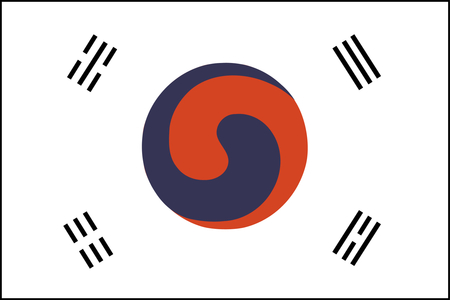
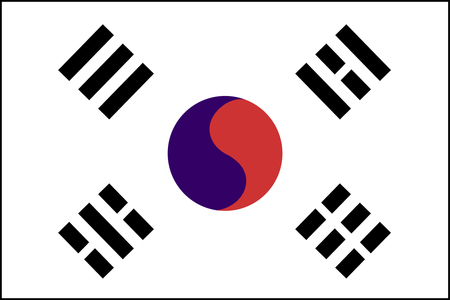
The «Taegeuk» symbol on the flag of the Korean Empire (1882–1910) and the flag of the Provisional Government of the Republic of Korea (1919–1945).
Current flag of North Korea.
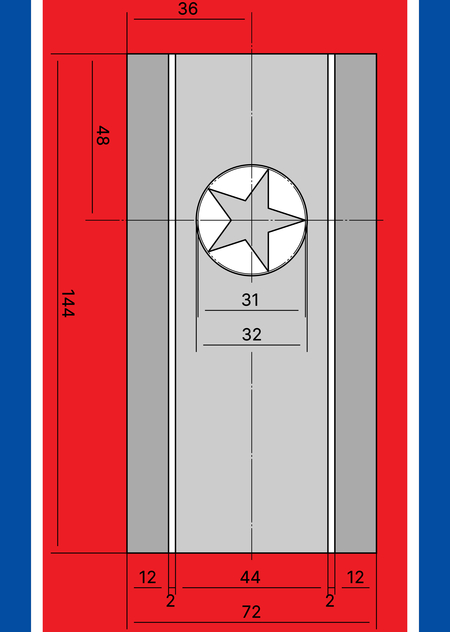
Flag structure and proportions.
The flag of the DPRK consists of a large red rectangle featuring a red five-pointed star within a white circle, and blue stripes with white borders at the top and bottom. The red star symbolizes the wise leadership of the Leader. The red rectangle represents patriotic enthusiasm, inheriting the anti-Japanese spirit; the white stripes signify the eternal prosperity of the Motherland; and the blue stripes represent the aspiration to fight alongside the revolutionary peoples of the world. [10; 16, pp. 34–40].
The flags of communist countries—the USSR, Vietnam, China, Cuba, Laos, and North Korea—share similarities in both color palette and symbolism.
It is important to note that the flag assigns significance not only to its geometric elements but also to the colors themselves. For example, red symbolizes «the patriotic spirit of anti-Japanese revolutionaries and the patriotic enthusiasm of the people»; blue signifies «unity with the revolutionary peoples of the entire world in the fight for independence and peace»; and white represents «the purity of the nation, diligence, and patriotic perseverance» [16, p. 34].
The Emblem of the DPRK and its Structure.
The emblem of the DPRK features a large hydroelectric power station at the foot of Mount Paektu—the sacred mountain of revolution—over which shines a five-pointed red star, framed by stalks of rice tied with a red ribbon inscribed with «Democratic People’s Republic of Korea» [10].
Changes to the coat of arms design.
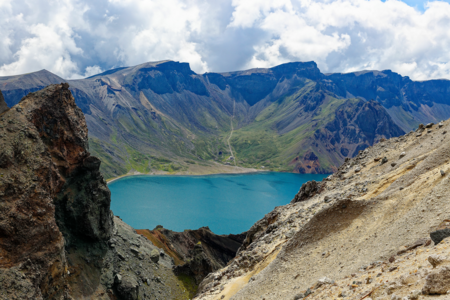
On the previously used emblem, five mountains were depicted beneath the red five-pointed star; however, in the emblem design after 1992, only the Paektusan mountain was retained (it is shown in the photo on the left), underscoring its significance as a cultural motif [6, pp. 46–48]. The presence of seemingly ordinary, everyday images—such as rice stalks and a hydroelectric power station—in one of the main state symbols can be interpreted as a deliberate state-level assertion of the value of the ordinary Korean worker. A distinctive feature of the DPRK’s symbolic system is the dedicated highlighting of national natural symbols—flowers, trees, birds, and even dog breeds.
Magnolia Sieboldii // Pine // Amur Jay // Phunsan Dog Breed
Although they are not officially designated state symbols or legally codified, these images are effectively granted the status of national symbols and are actively utilized within the state’s visual culture. This can be interpreted as a tool for shaping collective identity and reinforcing the perception of the nation’s grandeur and supreme authority. By embedding such imagery into the public consciousness, the state cultivates supplementary symbols of national unity and cultural exceptionalism.
[03] Propaganda Posters and Postcards
Posters depicting ordinary Koreans. 1960s–1970s // 1990s–2000s // 1966
Continuing the examination of daily life and the populace in North Korean visual culture, it is worth noting that most agitprop and propaganda posters, as well as other state visual materials, feature themes related to the daily lives, labor, and domestic routines of its citizens. The North Koreans themselves occupy a central role in these depictions.
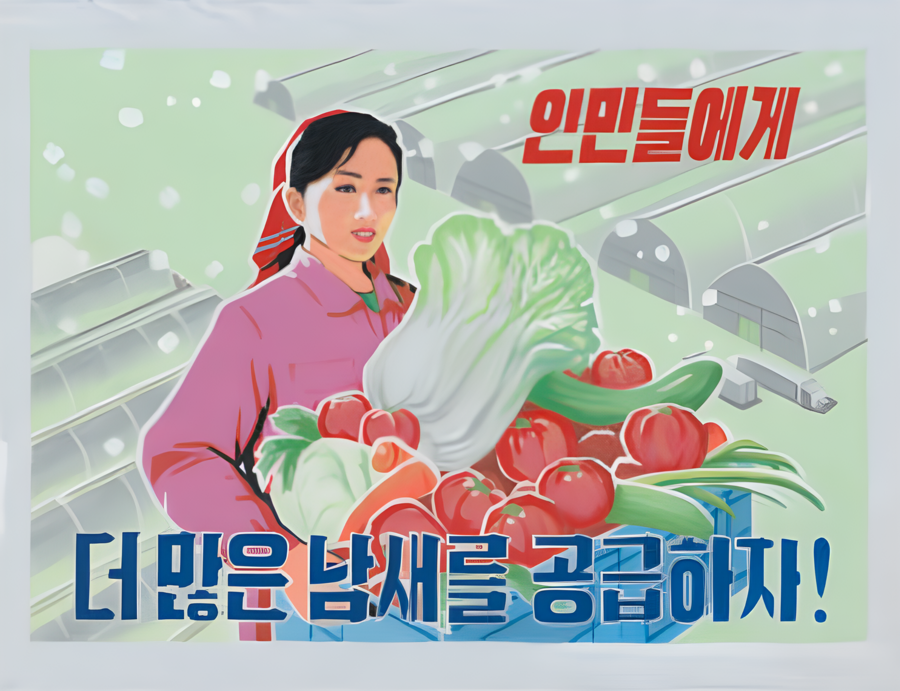
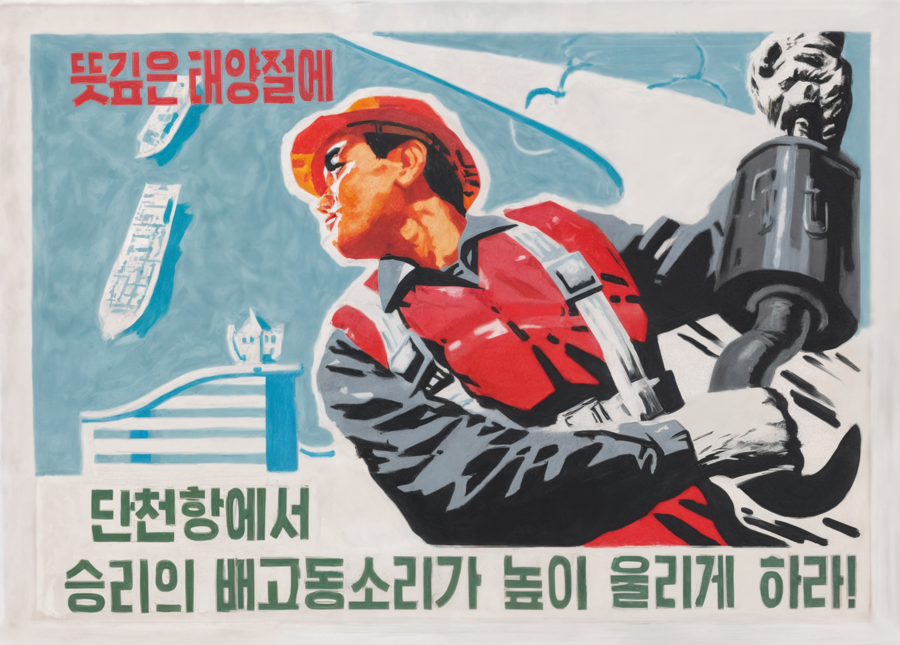
Posters featuring simple Korean subjects. 2000–2010.
When examining propaganda posters and postcards, the motif of highlighting specific symbols used to represent national values and sustain the public spirit of the citizenry remains noticeable. One such symbolic element is the hands. In some instances, they are depicted on posters in isolation; in others, the hands of the depicted Koreans play a vital compositional role, setting the dynamics and direction of the composition.
Poster, «Enemies are cunning and treacherous. Let us exhibit even greater revolutionary caution!» 1969
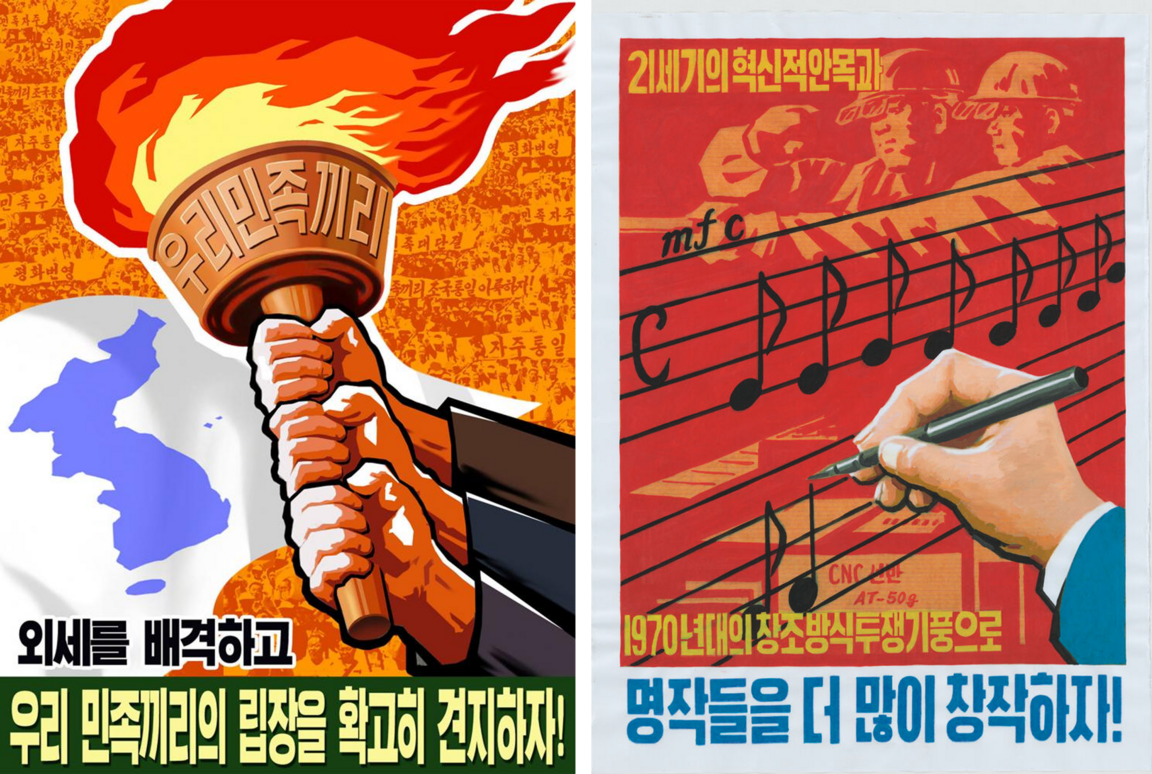
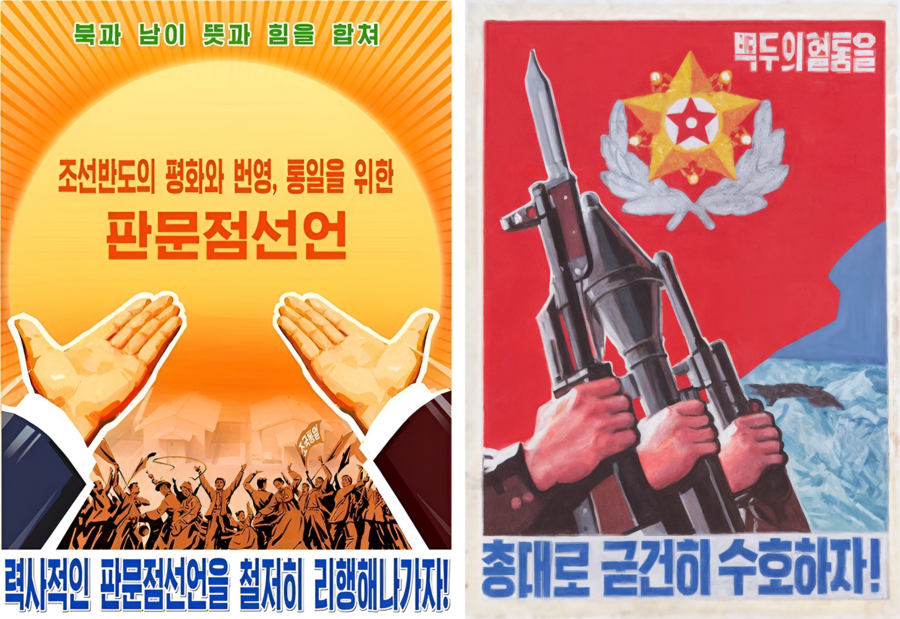
Posters on the protection and unity of Koreans, 2000–2010 // Posters on the importance of Korean diligence, early 2000s.