Topics
Concept
Domestic Mechanization: Utilitarian Forms and the Paradoxes of Early Advertising
Anatomy of Cleanliness: The Dyson Era and Ostentatious Engineering
Invisible Labor: The Robot and the Station
Conclusion — Bibliography — Image Sources
Concept
The evolution of home cleanliness—it is a story of the gradual transition from a utilitarian, bulky, and visually neutral appliance to an integrated element of modern living space.
The transformation of cleaning tools—from the massive cylindrical models of the mid-20th century to autonomous systems with base stations—reflects more than just engineering changes. It is tied to a rethinking of daily practices: concepts of routine labor, time allocation, and the role of technology in the home. As development progressed, not only the construction and materials changed, but also the usage scenarios dictated by the device’s form.
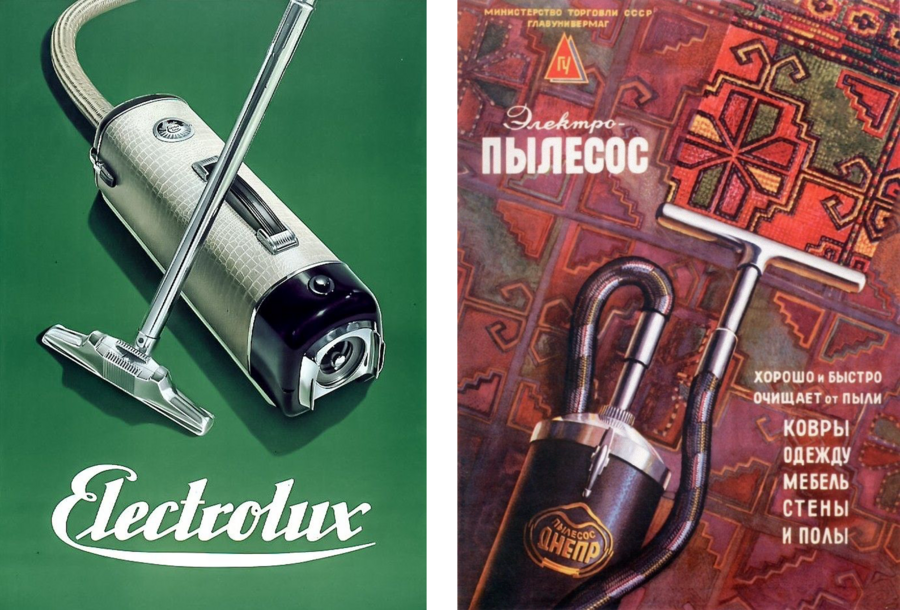
Electrolux, advertising poster for the Vacuum vacuum cleaner, 1955, Sweden | Electric vacuum cleaner, Soviet advertising poster «cleans well and quickly from dust, ” 1952
In its early stages, the vacuum cleaner was a purely utilitarian device. The form creation of the first European and Soviet models was dictated by technical limitations: powerful motors required massive casings made of metal or dense plastic, and usability was a secondary concern.
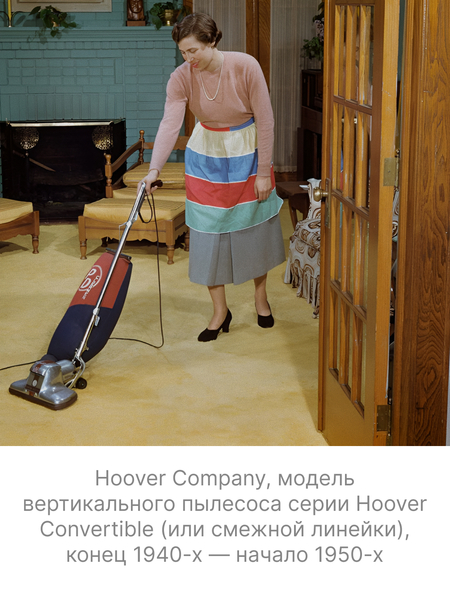
In the mid-twentieth century, advertising created the image of easy and quick cleaning; however, in reality, operation remained physically demanding. The user was tethered to a cord, had to maneuver a heavy unit, and interacted with the appliance directly throughout the entire process. The vacuum was brought out only when necessary and put away after use—its design did not imply a permanent presence in the living space.
Dyson, DC01 upright vacuum, 1993
The situation changed at the turn of the 20th and 21st centuries with the proliferation of the cyclonic system. At that time, the vacuum cleaner stopped being merely a box where everything happens inside. By removing the bags and adding transparent tanks, people finally saw where the dust was going. Now, the mechanism itself has become a design element. The outer casing no longer hides the internal workings—quite the opposite; it displays them.
Concurrently, the device’s layout changed. The shift toward more compact and subsequently wireless models redistributed weight and simplified operation. The vacuum became lighter, more mobile, and began being used in shorter, more frequent scenarios. This also influenced its placement within the interior: the device ceased to be an object that needed to be hidden and became acceptable for open display.
Dreame L10s Ultra Robot Vacuum, 2024
The current stage is characterized by automation. Robot vacuum cleaners have eliminated the need for direct human involvement in the cleaning process, transferring navigation and task execution to algorithms. Maintaining cleanliness has gradually become a continuous background process rather than a discrete action.
However, the key element of the system became less about the mobile component and more about the base station. It transformed from a simple charger into a multifunctional module that services the robot: it cleans the container, manages water, and stores consumables. Visually, these stations are designed as neutral volumes and are increasingly integrated into furniture or the architecture of the space.
Thus, the development of the vacuum cleaner can be viewed as a sequential shift in the role of technology: from a tool requiring constant human intervention to a system integrated into the daily environment that operates autonomously.
Mechanization of Daily Life: Utilitarian Form and the Paradoxes of Early Advertising
The introduction of the electric vacuum cleaner in the first half of the 20th century was a significant step in the mechanization of domestic labor. However, in its early stages, the appliance was purely utilitarian: its form was dictated solely by engineering constraints. The first models were direct adaptations of industrial mechanisms. Massive electric motors required robust metal casings, and the hoses and attachments resembled parts of factory machinery. Vacuum cleaners were heavy, loud, and required considerable physical effort.
Electrolux Lux I, 1919 | Mod V, vacuum cleaner advertisement poster, 1945
Early models clearly illustrate borrowings from industrial design. Metallic cylinders on rigid slides, bulky mounts, and external dust collectors made the instrument look visually heavy and alien to the domestic interior. Ergonomics was entirely subservient to the engine’s dimensions, not to human comfort.
Despite the bulkiness of actual devices, mid-20th-century advertising forged a completely different image. Manufacturers weren’t selling mere household appliances; they were selling the very idea of freedom from routine. This created a persistent paradox: on posters, the vacuum cleaner appeared as a magical helper in the hands of an elegant woman controlling it with effortless grace, while in reality, the user remained tethered to the noisy machine and the short cord.
Hoover, vacuum cleaner advertising posters, 1945–1946
The advertising campaigns of that era were built upon striking visual dissonance: the aggressive aesthetic of the mechanical apparatus contrasted with the distinctly light, almost festive image of the homemaker. Marketing sold the illusion of effortless labor, masking the fact that operating the machine required serious physical stamina.
Due to its utilitarian nature and visual crudeness, the vacuum cleaner has established a strict interaction scenario: «retrieve—use—store.» Being an aesthetic dissonance in the living room or bedroom, it was immediately put away in a dark closet or pantry after cleaning.
Raketa-7M, a Soviet domestic vacuum cleaner, 1970s
It is notable that when design attempted to move away from a purely industrial aesthetic in the 1960s and 1970s, it turned toward aerospace aesthetics. This trend was especially pronounced in Soviet models («Chaika, ” „Saturn, ” „Buran“), which adopted the streamlined forms of rockets, turbines, and planets.
Saturnas, household vacuum cleaner, 1967
The attempt at aestheticization through the prism of the Space Race was predominantly decorative. For instance, the shape of the «Saturn» vacuum cleaner referenced planetary rings, yet its aerodynamic casing had no influence on its functionality. The appliance remained a heavy object whose expressive form was paradoxically intended to be hidden from view for most of the time.
Regardless of the external design of the housing, the main architectural dominant of 20th-century vacuums remained the dust collector. Since society perceived dust as an absolute aesthetic and hygienic taboo, the machine’s fundamental task was reducing to its reliable isolation.
Hoover, convertible upright vacuum cleaner (Ranger series), 1960s–1970s
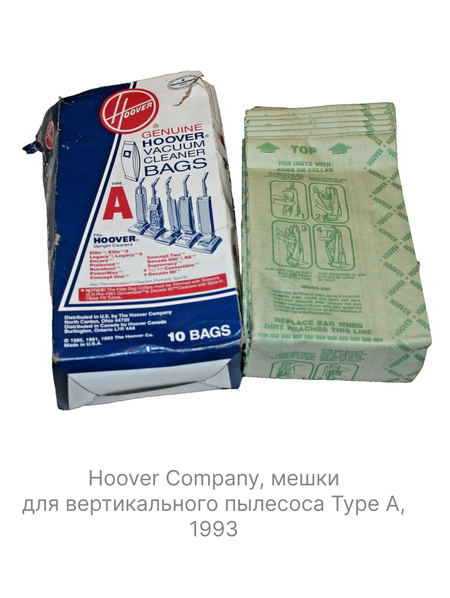
A classic vertical Hoover serves as a clear illustration of this pattern. Its massive, opaque fabric bag functioned as the physical and visual boundary between the clean space of the home and the accumulated dirt. The user had no control over the process—one could only gauge the reservoir’s fill level by changes in the motor’s sound or by how taut the fabric inflated with air.