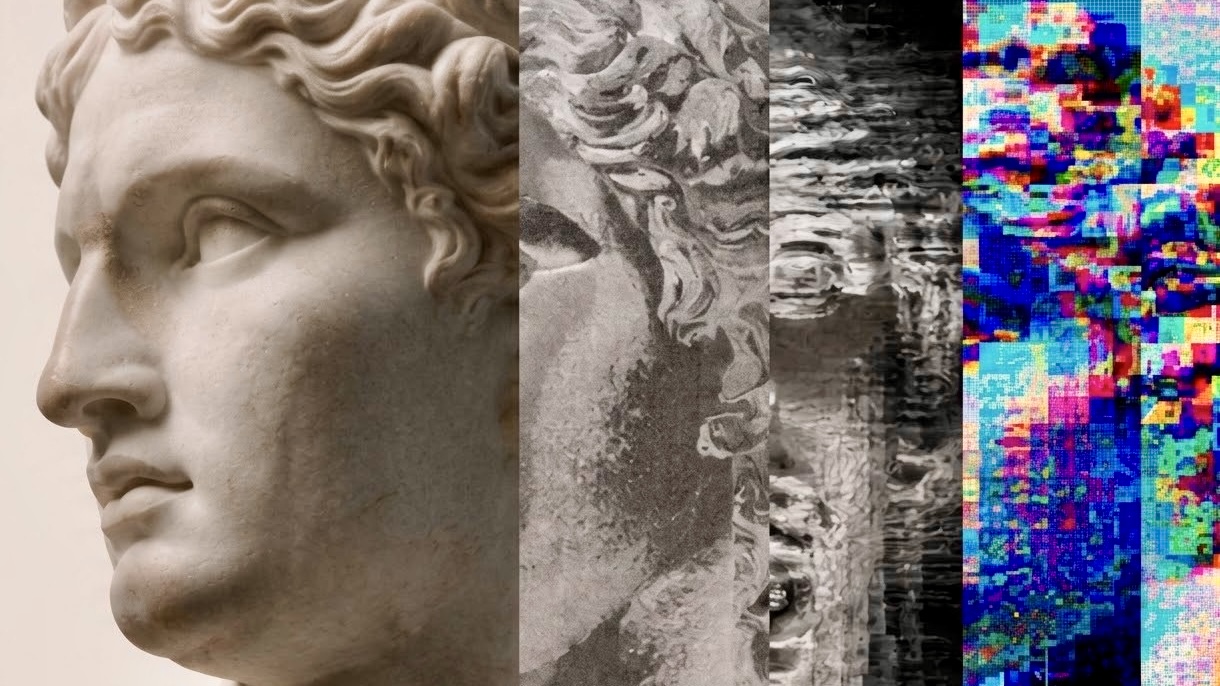
Media exploring how art is transforming in a world where images can be infinitely copied, modified, and reproduced.
Project Goal
— create media that explores the new relationship between the original and the copy.
SECOND ORIGINAL demonstrates that copying today is not merely a technical process, but an integral part of artistic culture.
Topic
Segment: contemporary art and digital culture.Narrow Topic: original, copy, and authorship in the digital age.Main Themes:
— AI-generated media
— digital reproductions
— memes and visual remixes
— NFTs and digital ownership
— virtual museums
— new forms of authorship
Main Question
— When does a copy become the new original?
SECOND ORIGINAL does not attempt to provide a single correct answer. The media examines specific works, technologies, and artistic practices, inviting the viewer to define for themselves the boundary between copying, interpreting, and creating something new.
Competitors
Direct Sources: — e-flux: contemporary art, criticism, theory, exhibitions, and institutions. — Artnet News: art world news, artists, exhibitions, museums, and the market. — Artforum: contemporary art, criticism, interviews, and cultural discourse.
Indirect Sources: — The Art Newspaper: art news and institutional agendas. — Hyperallergic: contemporary art through news, criticism, and cultural context. — Dezeen: design and visual culture as broader competitors for audience attention.
What competitors already have
Major art media primarily operate on the formula: «news $\to$ exhibition $\to$ artist $\to$ criticism $\to$ event.»
e-flux, for example, integrates journal articles, critical reviews, exhibition announcements, educational materials, and events.
Artnet News, on the other hand, covers the broad art world—from exhibitions and artists to museums and institutions.
SECOND ORIGINAL’s open territory: don’t tell what happened in art, but explore how its very concept has changed.
Content Model
«COPY» — histories of works that have been copied, reinterpreted, or reproduced.«MACHINE» — AI, algorithms, generation, and the question of authorship.«REMIX» — memes, appropriation, citation, and visual borrowing.«ORIGINAL?» — an analysis of specific cases through one central question: «is this still original?»
Formats
Vertical Videos: short visual breakdowns, carousels, image experiments.Video Hosting: podcasts, in-depth visual analyses.Telegram Channel: textual analyses, quick «news» updates.Website: long-form articles, research, and digital archives.Special Projects: AI experiments, interactive narratives, and visual comparisons of «original → copy → remix.»
Target Audience
THE CURIOUS VIEWER — interested in art, but doesn’t want to read dense academic texts.
JTBD: «Help me understand why this is even considered art.»
—
THE DIGITAL NATIVE — lives among memes, AI, and infinite visual copies.
JTBD: «Help me make sense of the images I see every day.»
—
THE CREATIVE — an artist, designer, or student.
JTBD: «Give me ideas and context for my own practice.»
—
THE ART STUDENT — already knows art history but is seeking modern context.
JTBD: «Connect what I’m studying with what’s happening now.»
Tone of Voice
Intelligent, visual, inquisitive
Not an academic journal and not a purely entertaining blog.Key attributes:
— concise phrasing.
— minimal terminology without explanation.
— emphasis on visual evidence.
USP
Art after the original — SECOND ORIGINAL examines art at the precise moment the original ceases to be the sole form of the work.Not just another art news media — it doesn’t simply report on art world events; it investigates the changing concept of art itself.«When does a copy become something new?» — this single question forms the foundation of the entire editorial system.
Positioning
SECOND ORIGINAL — a media platform dedicated to contemporary art that explores the life of a work after its original iteration.
From museum to meme, from reproduction to AI, from copy to new creation.