Navigation
- Concept
- Endless Desert Horizon
- Phantom Faces
- Hybridization
- Corporeality, Body Deformation
- Mannequin Figures
- Principle of Obscurity
- World of Illusions and Hallucinations
- Theme of Violence, Death, and Decay
- Conclusion
- Bibliography and Image Sources
Concept
Surrealism is a movement within global fine art that emerged in France during the 1920s. The term originates from «surréalisme, ” which the poet Guillaume Apollinaire used in the manifesto „The New Spirit, ” translating to „super-realism.“ The early works of artists reflected Sigmund Freud’s psychoanalytic theories concerning people’s unconscious desires and experiences. Masters strive to depict what is invisible to the human eye: fears, fantasies, hidden desires, and dreams.
André Breton, a French writer, is recognized as the founder of Surrealism. His 1924 work, „The Surrealist Manifeste, ” labels this new creative approach „pure psychic automatism.“ Breton viewed this movement as a method for liberating the human mind. While reality is visible to the naked eye and does not require extra effort for complete understanding, reaching the subconscious necessitates allowing a stream of thought without restricting it by any laws. Since achieving this in reality is difficult, artists began using the language of art to explain the inner mysteries of human nature.
Surrealism develops upon existing movements, such as Dadaism, Futurism, and Cubism. Like these movements, the described phenomenon rejects social norms, satirizes reality, and demonstrates three-dimensional imagery.
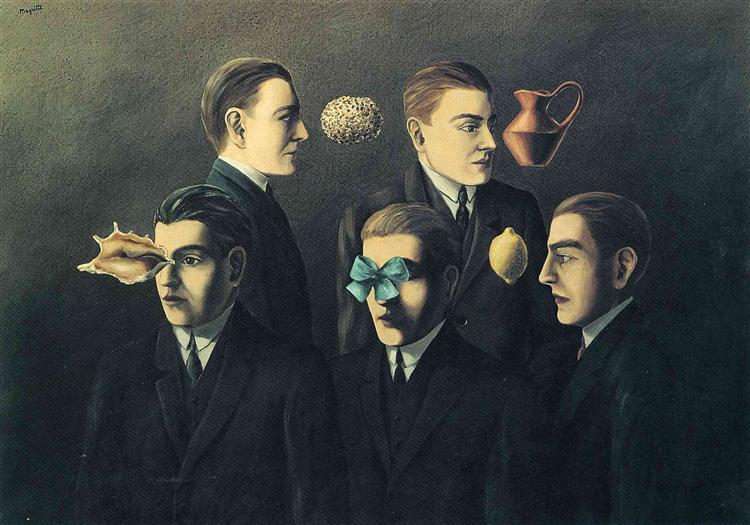
René Magritte, «The Familiar Objects, ” 1928
In my research, I observe how surrealism has transformed the perception of reality. This movement is expressed not only in painting, where any concept can be placed on canvas, but also in photography, which requires experimentation with various parameters to achieve the desired result. Existing early subjects in the artists' photographs lose their conventional meaning; photography ceases to document reality—it instead marks the surrounding illusions and the human subconscious. By comparing painting and photographic practices using the same criteria, I formulate the characteristics of surrealism and study the methods by which artists achieve the desired effect across different art forms.
The selection of material for the visual presentation is based on analogy. In my work, I conduct paired comparisons of 20th-century surrealist works that utilize different techniques to explore a single theme. Throughout the study, I answer the question: what are the primary hallmarks of surrealism in painting, and how are they manifested in 20th-century photographic art? My hypothesis asserts that despite the fundamental differences between the two art forms, the surrealist method distorts the documentary nature of frames using specific tools (photomontage, solarization, double exposure). This enables photography not only to imitate pictorial techniques but also to amplify the effect of altered consciousness and reality.
The boundless desert horizon
A surreal landscape often depicts a desert—it is infinite and devoid of life. The space recedes into the distance, withholding any secrets about what is presented in the foreground. The depicted locations are frequently stripped of the human spirit. These desolate spaces evoke discomfort in the viewer; there is a sense that something is being concealed, yet its mystery will remain unsolved.
Giorgio de Chirico, «Melancholy and the Mystery of the Street, ” 1914
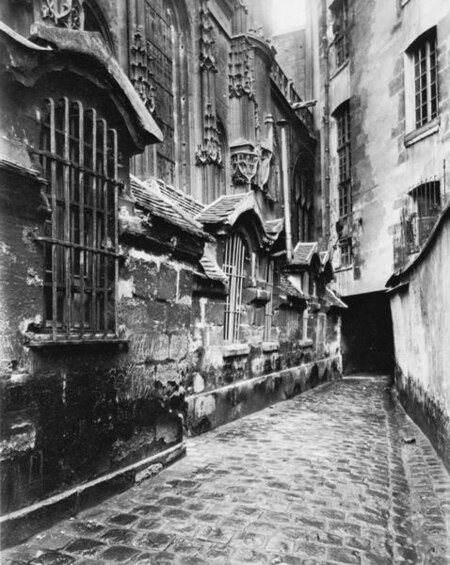
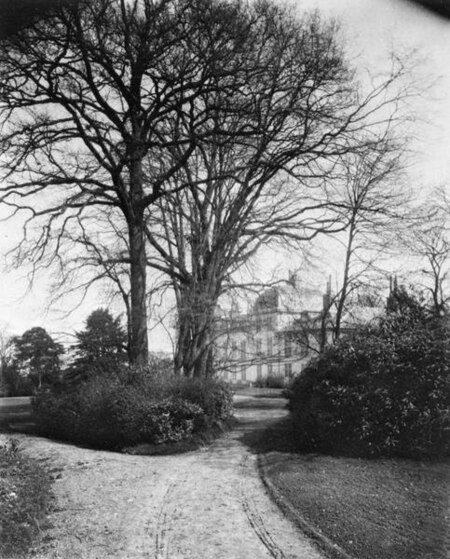
Eugène Atget, «Versailles,» 1900s
The space seems limitless. The perspective shoots off into the distance sharply; the horizon can be set extremely low or, conversely, raised incredibly high. The ground surface is flat and smooth, devoid of obvious protrusions or obstacles. The familiar laws of physics do not apply to Surrealist paintings.
The foreground might contain few objects, and they all obscure something. For example, Giorgio de Chirico’s painting depicts an open van, but the angle does not allow one to know if it is filled, or with what. The play with the viewer is built on the fact that the arising questions cannot be answered. There is a mystery in Surrealist works—it approaches revelation, but never reaches it.
René Magritte, «The Conditions of Human Existence, ” 1935
Martina Frank, «Morocco,» 1976
In the photograph, Martina Frank’s loungers abandon their conventional function; only their form matters. The fluid lines evoke waves, and the white color suggests seafoam. The repetition of identical shapes filling the space becomes a method of deconstructing real space and creating an imagined landscape.
In a work by René Magritte, the painting on canvas merges with the view of a vast body of water and ceases to exist independently. The objects stop being themselves and dissolve into a single entity with the background.
Phantom Figures
Surrealists manipulate objects in countless ways, devising various methods to present a mystery. One approach involves combining elements into a form resembling a human face. Surrealist photographers created phantoms using technical techniques, such as long exposure and the Sabattier effect (solarization).
Salvador Dalí, «The Appearance of a Face and a Vase on the Beach,» 1938
Philippe Halsman, «Dalí’s Skull, ” 1951
Phantom faces appear in the work of Salvador Dalí, creating the effect of an optical illusion. The paintings depict a landscape or still life in which portraits are hidden. The faces retain only hints of eyes or mouths, remaining spectral apparitions.
Salvador Dalí, «The Secret Conversation» (or «Mysterious Mouth Appears on My Nurse’s Back»), 1941
Raul Yubak, «Nebula,» 1939
The portraits gathered in the photographs look horrifying. In this case, the connecting elements are people, which heightens the viewer’s sense of dread, as the living person loses their soul and serves merely as a form for compositional unity. The faces appear multilayered, as if several ghosts have merged into one. The photograph alters our perception of familiar things and reveals the «optically subconscious of reality.»
Hybridization
Surrealists explore the human body by merging it with other elements. This approach blurs the boundaries between the living and the dead, the mechanical and the human.
Oscar Domínguez, «Electosexual Sewing Machine,» 1934–1935
Wanda Wulz, «Me + Cat, ” 1932
When a body integrates with mechanical parts, tools, or furniture, the human transforms into a functional apparatus—they execute designated tasks and are utilized strictly according to their design. The fusion of humans with animals emphasizes the instinctive aspect of the subconscious, revealing their animal nature.
Max Ernst, «The Wavering Woman,» 1923
Man Ray, «Violin Engrave, ” 1924
Through this technique, artists strip the individual of their status, transforming them into an object for use. Images are overlaid onto one another, one material becomes another, and the living and inanimate exchange their properties.