Categories
- Concept
- Rhythm
- Reverse Perspective
- Layering
- Light
- Symbolism
- Conclusion
Concept
The word «icon» originates from the Greek word, which translates from Russian as «image.» An icon is a pictorial representation of Jesus Christ, the Mother of God, saints, or biblical events, created for meditative worship. An icon serves as a conduit to the spiritual world for believers. As an archetype—that is, a primordial image—the icon permeated all spheres of Russian culture. The semantic, compositional, and color choices in icons—all of this found reflection in works from various artistic periods.
In the 20th century, the phenomenon of the icon began to be studied seriously. Thanks to the large-scale restoration of ancient Russian artistic monuments, artists gained access to ancient sacred images. The interest in the icon became the result of a synthesis of reactions to social upheavals, the search for national identity, and the attempt to understand humanity’s place in a complex, changing world.
St. Theodore Studite writes in his works that an icon is a work of art created according to the laws of divine, not earthly, beauty. It is in icons that the primordial beauty of the world can be perceived [11].
The iconographic canon—a collection of specific icon painting techniques used to construct the image—is designed to preserve the sacred essence of the icon. The canon codifies the doctrinal content of the image and serves to reveal Divine Revelation through the language of artistic means.
In this visual study, I analyze how the icon archetype influenced the work of 20th-century artists working in various styles. Each creator reinterprets the compositional and stylistic techniques of the icon in their own way, employing them to convey their worldview.
Rhythm
The integrity of the icon is created through its rhythmic expressiveness. Rhythm in icons arises from recurring forms, gestures, lines, or colors, the symmetrical arrangement of figures, the hierarchy of imagery, the directionality of lines or forms toward semantic centers, and the principle of similarity. It is precisely rhythm that connects the icon to the musicality and harmony of the liturgy.
«Iconographers rejected the classical rhythm as an image of movement. Instead, the iconographic rhythm enclosed the image within itself, lending it absolute staticity. This rhythmic stillness gave the icon that particular resonance—a resonance connected for humanity to the feeling of Eternity and Silence, and directly linked to the spiritual practices of contemplative prayer practiced by hesychasts» [3].
Natalia Goncharova, «Mother, ” 1910
In the painting by Natalia Goncharova, an avant-garde artist, a special reverence for the mother as a saint is revealed. At the center of the composition is a woman holding a child. Her figure is outlined with a luminous line, creating an iconographic effect of radiance and emphasizing the mother’s spirituality and holiness. The shape of the haystack echoes the woman’s figure, as if protecting her from the outside world. The haystack directs the viewer toward the biblical mount, the kingdom of love and light. Furthermore, the tree is not placed randomly directly above the mother’s head, as though growing from her figure. This rhythmic drawing underscores the power of maternal love. Thus, Natalia Goncharova explores the theme of motherhood, leading the viewer to the image of the Theotokos—the interceding mother.
Andrei Rublev, «The Entry into Jerusalem,» early 15th century / Natalya Goncharova, «Mother,» 1910
In Andrei Rublev’s icon, the contours of the mountain echo the silhouettes of the apostles following Christ, emphasizing the security of the students alongside their Teacher. Natalia Goncharova borrows not only the iconographic technique of compositional rhythm but also uses the technique of organizing the image against a large object in her painting. By using the yellow color of the haystack, the artist conveys the symbolic meaning of holiness and grace emanating from the mother.
Icon of the Nativity of Christ, 1410–1430 / Pavel Filonov, «Holy Family, ” 1914
In his quest for the perfect image—one that could encompass the beauty of the Universe and unify the entire world around it—Pavel Filonov, the creator of «analytical art, ” turns to the Biblical theme of the Nativity of Christ. In both the artist’s painting and the icon, the space and rhythm are structured around the central figure: the infant Christ. The figures of saints, animals, and plants—all are directed toward the semantic and geometric center of the artist’s canvas and the icon. This results in a cohesive composition.
«Filonov utilized iconographic ideas of the small growing into the large, complex flowering unity, the interplay of color and light, natural rhythm, and the connection between the micro- and macrocosm to imbue his paintings with an inner vitality» [3].
Kuzma Petrov-Vodkin, «The Death of the Commissar, ” 1939
The rhythm in Kuzma Petrov-Vodkin’s painting carries significant semantic weight. The posture of the wounded commissar mirrors the stance of the soldier in the background who is escorting the fighters. The commissar’s head is directed precisely toward the advancing soldiers. Thus, the artist reflects the idea that life does not end with death; it finds continuation in the fighters marching to battle, as well as in the soldier supporting the commissar—who gazes forward intently, as if beyond the canvas. It is no coincidence that rural expanses stretch out behind them, where a church can be seen among the houses.
Icon «Descent from the Cross,» late 16th century / Kuzma Petrov-Vodkin «Death of a Commissar,» 1939
You can also clearly trace the connection between Kuzma Petrov-Vodkin’s painting and the iconography of the descent from the cross. Christ’s pose is repeated in the artist’s work. Both pieces are structured around sacrificial death, but in the painting «The Death of the Commissar,» death is not a symbol of eternal salvation—it is depicted as a sacrifice for the revolution.
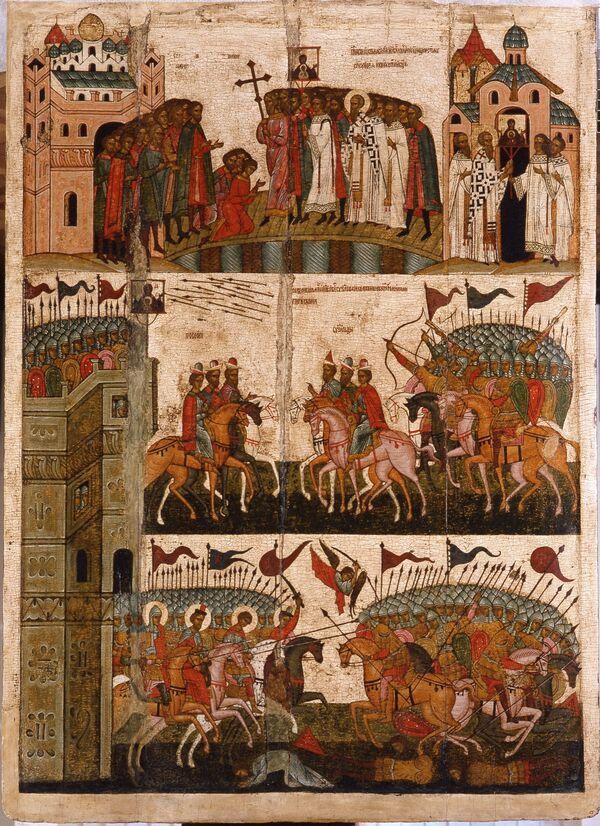
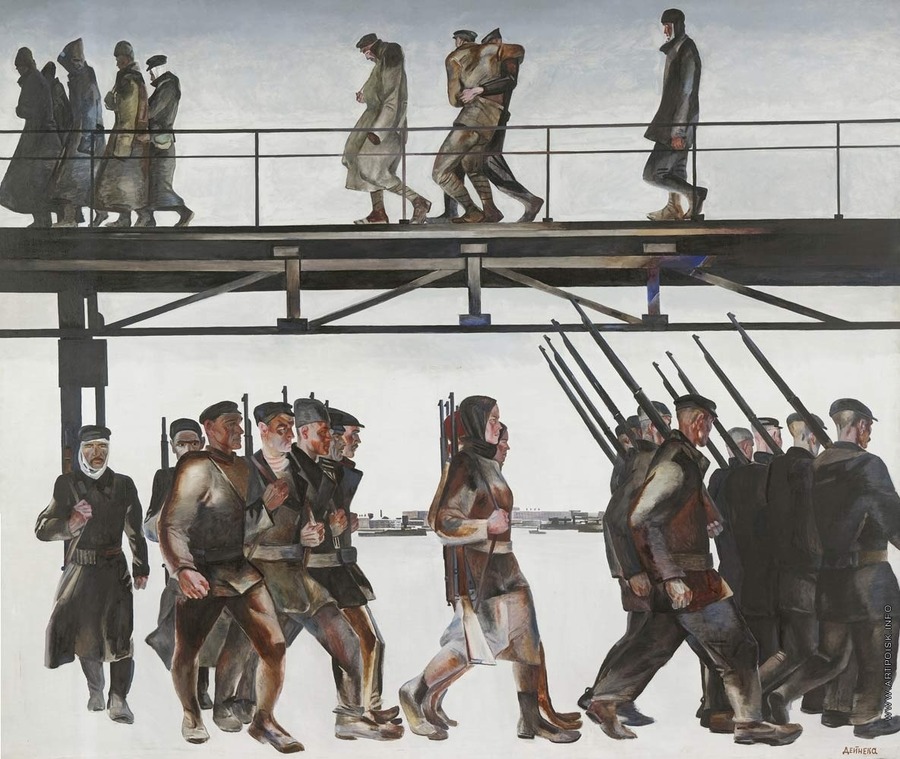
«Icon of the Battle of Novgorodians and Suzdalians, ” 15th century / Alexander Deineka, „Defense of Petrograd, ” 1928
Alexei Deineka, a Socialist Realism painter, and the icon painter employ the technique of hierarchical composition. Deineka contrasts the dynamism of new defenders with the emaciation of veterans. In the icon, a confrontation between the Novgorodian and Suzdalian forces is embodied. For this icon and Deineka’s painting, a cyclical rhythm is also characteristic. The technique of movement in the reverse direction closes the composition. The cyclical rhythm and clear silhouettes lend the canvases an epic and heroic character.
Reverse perspective
Andrei Rublev, «The Trinity, ” early 17th century.
Unlike European painting, icon painting employs the principle of reverse perspective. In linear perspective, parallel lines converge at a vanishing point on the horizon, which creates a sense of spatial depth. Reverse perspective, however, has its vanishing point seemingly inside the viewer—meaning that objects do not diminish as they recede, but rather increase in size. Consequently, the artist can depict objects on the icon from multiple angles simultaneously.
«Reverse perspective creates a unified symbolic space oriented toward the viewer, fulfilling the task of embodying supra-sensory sacred content within a visible form that lacks material concreteness» [8].
Mikhail Larionov, «Stroll in a Provincial Town, ” circa 1909
Mikhail Larionov creates a flat space by employing the iconographic principle of reverse perspective: buildings and a table expanding toward the background, and disproportionate human figures. All of this emphasizes the provinciality and irony of the scene. Reverse perspective reflects the artist’s desire to move away from convention and depict provincial life without idealization.
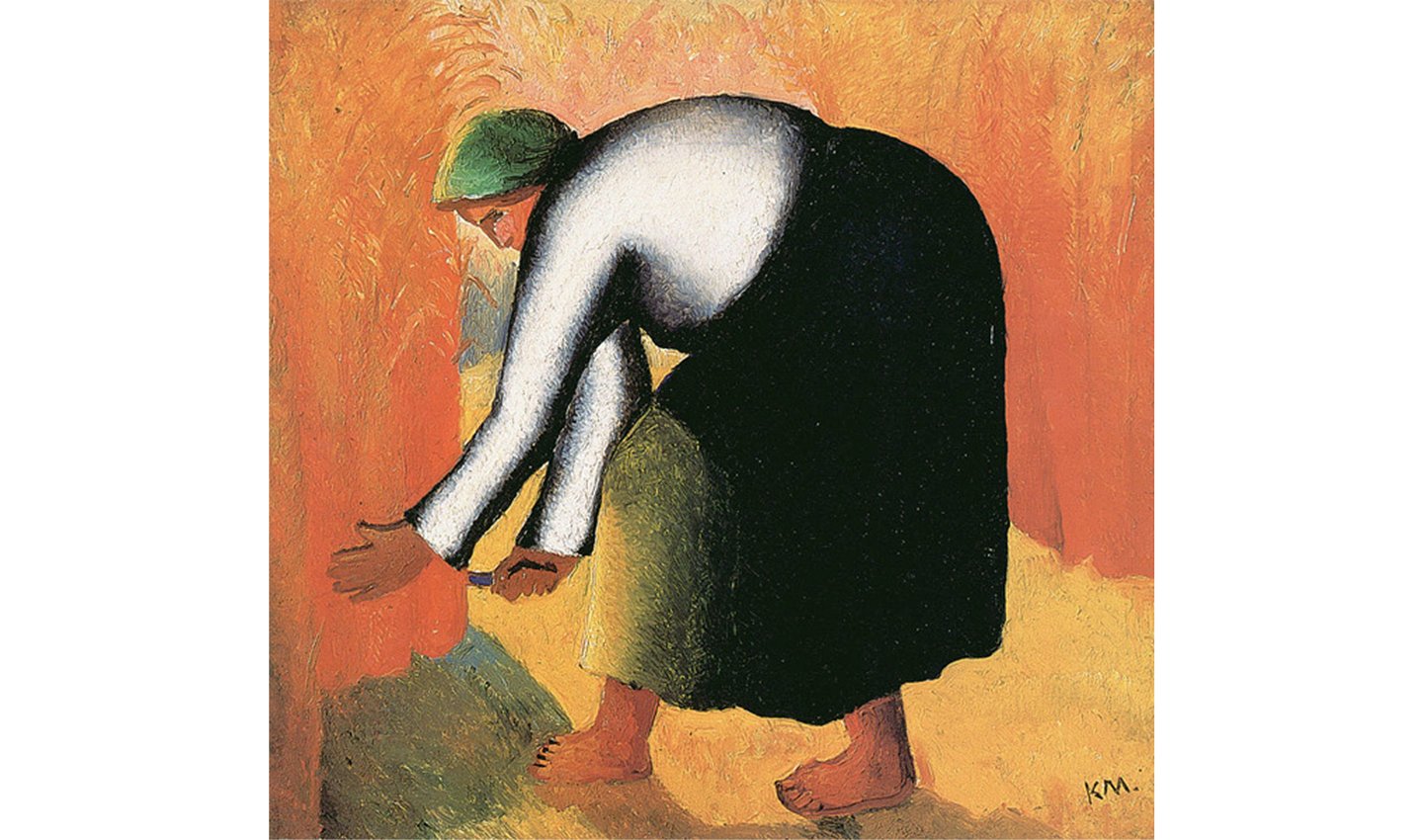
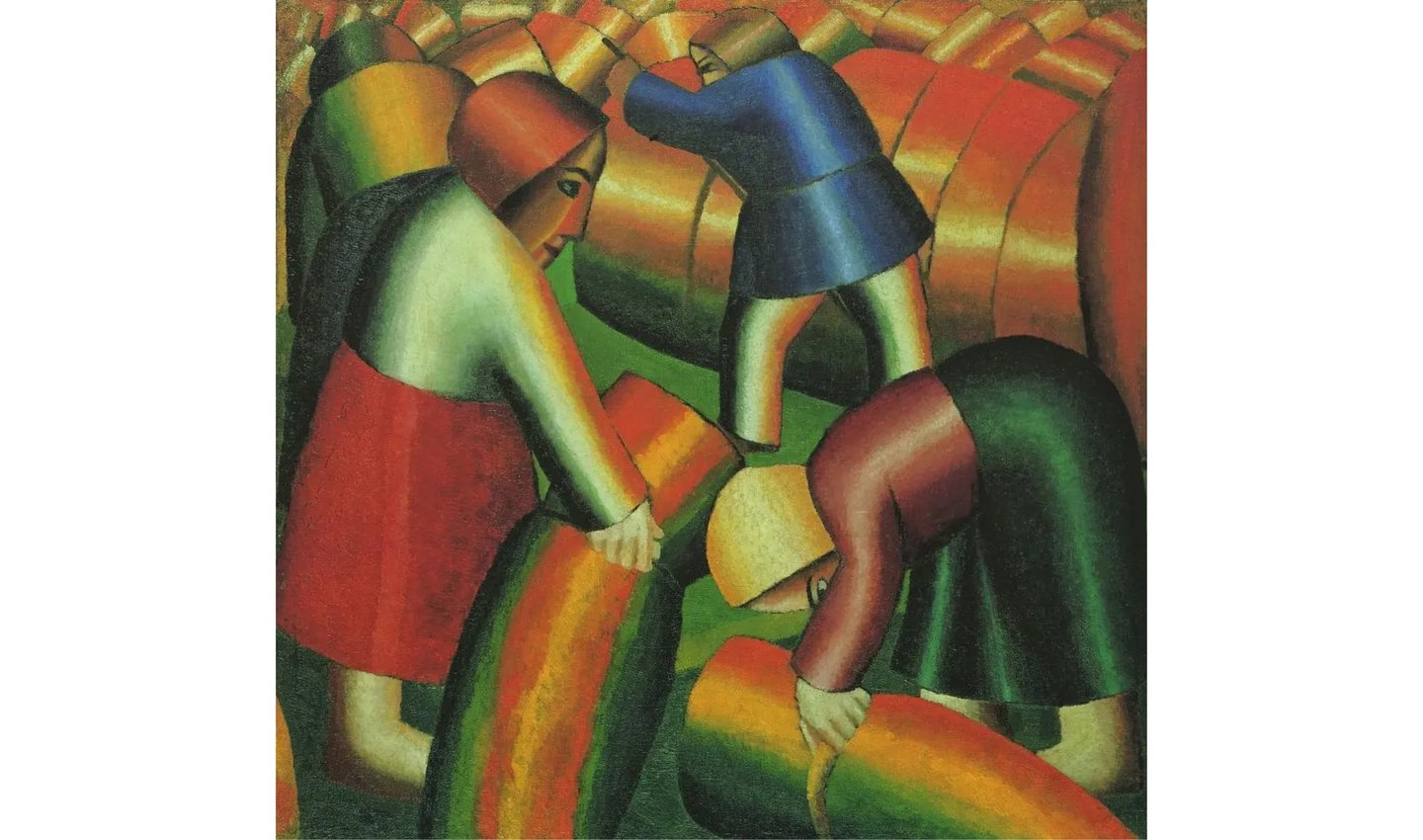
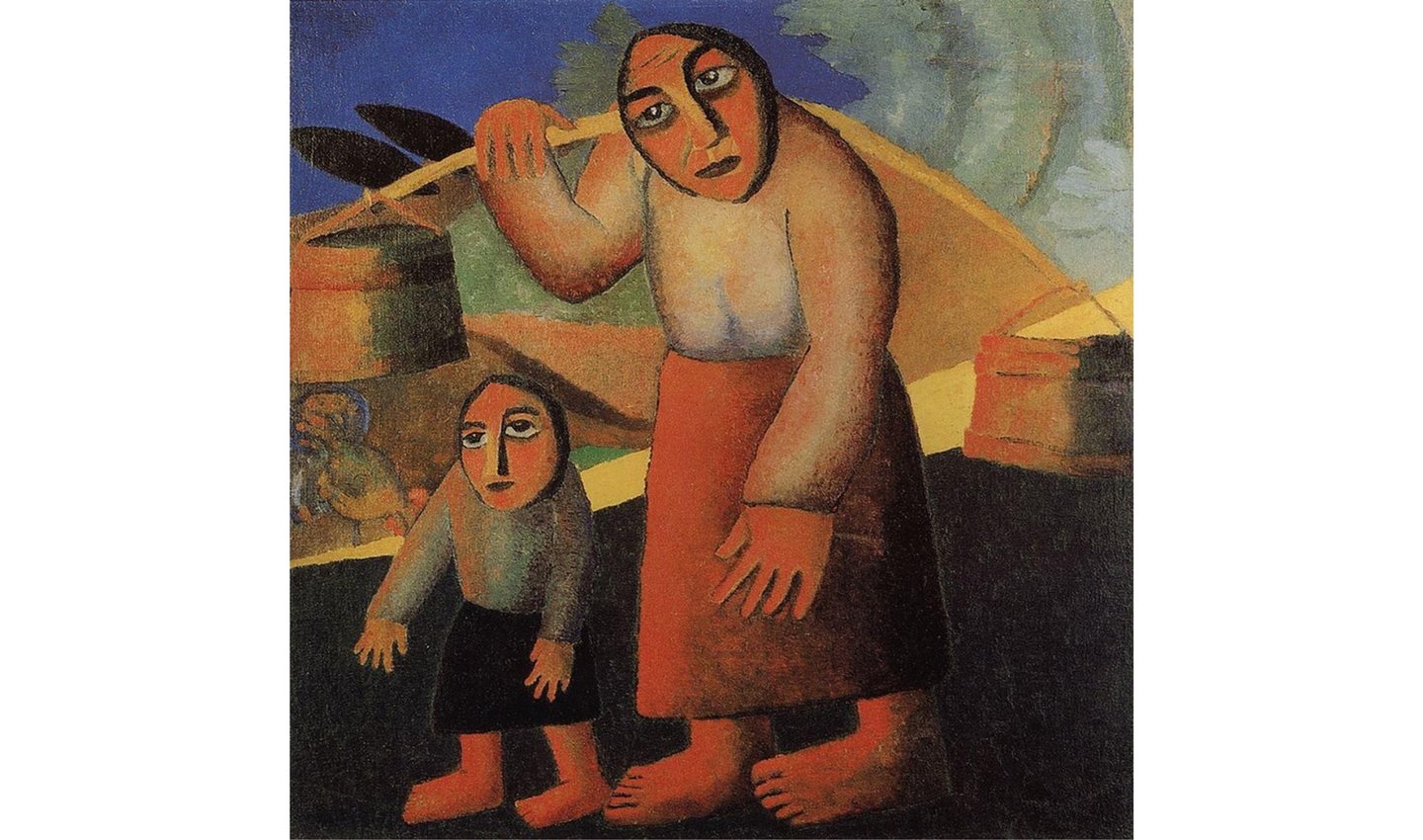
Kasimir Malevich «The Cleansing of Rye, ” 1912 / „Peasant Woman with Buckets and Child, ” 1912 / „The Reaper, ” 1929
Kazimir Malevich, in a series of paintings on the theme of peasantry executed in the style of cubofuturism and neo-primitivism, actively employs the technique of reverse perspective. His main objective is the reinterpretation of traditional art. By referencing the technique of Old Russian iconography, the artist emphasizes the «sacredness» of the peasant figures.