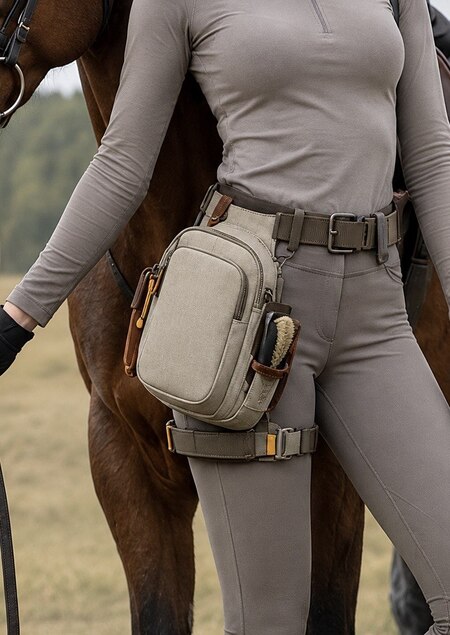
RIDER KIT — a compact bag for storing essential items during riding lessons. The design combines the main bag with a waist and hip fastening system and removable side modules for snacks and horse care, which can be repositioned to the most convenient side.
Problem and Function
During horseback riding lessons, riders need to carry personal belongings, treats for the horse, and grooming supplies. However, standard bags are not always convenient in a stable environment: they can restrict movement, interfere with exercises, and prevent quick access to necessary items. Using multiple separate accessories complicates organization and preparation for training.RIDER KIT — a modular accessory for storing and carrying essentials during horseback riding. The main body is designed for personal items, while the interchangeable side modules are for treats and horse grooming supplies. The modular design allows the user to customize the kit based on the usage scenario, consolidating necessary items into one compact accessory.
Concept
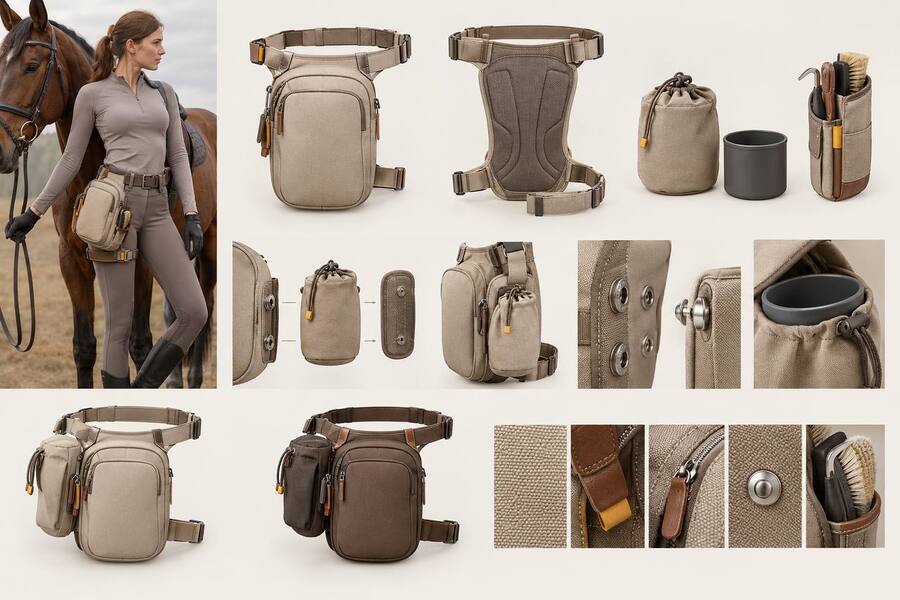
RIDER KIT — a modular accessory that combines storage for personal items, treats, and horse care supplies into one compact system. The anatomically contoured body is supplemented by removable side modules, which are secured using mechanical button fasteners. The strapping system ensures the accessory remains firmly attached to the body, and the interchangeable configuration allows it to be adapted to various stages of training—from preparing the horse and ground work to completing the session. The RIDER KIT helps organize necessary items and keep them immediately accessible, reducing the need for several separate accessories.
Structure and Dimensions
THE RIDER KIT comprises a semi-rigid, anatomically curved body and two detachable side modules: one for storing treats and one for horse care supplies. The main body is equipped with a primary waist belt and an additional thigh strap to stabilize its position while working on the ground.
Main body — 190 × 125 × 50 mm. The streamlined shape reduces protruding elements and ensures compact storage for personal belongings.
Side modules. Each module is designed for a specific category of items. Treat module — 100 × 125 × 45 mm is designed as a textile pouch with a cinchable top and a soft body. Care supply module — 110 × 125 × 45 mm is intended for the segregated storage of small tools and accessories.
Attachment system. Modules are mounted onto the body’s side slots using vertical guides. The securing mechanism includes an upper loading point, a lower mechanical stop, and an recessed upper fastener that prevents accidental removal. Button closures are used to secure individual components, but they must not be the sole retention mechanism for heavily loaded modules.
Strap system. The primary 38 mm wide waist belt secures the body around the waist. The additional 25 mm wide thigh strap limits accessory displacement during movement.
Materials
Main Body Outer Material: 600D Oxford ripstop polyester with a water-repellent finish. Internal Frame: 1–2 mm thick sheet polypropylene. Lining: Smooth-surfaced polyester, which facilitates cleaning of the interior space. Soft Components: 3–5 mm thick expanded polyethylene in areas requiring additional shape retention and protection for contents.
Snack Module Material: 600D Oxford dense polyester with an internal lining made of smooth, washable material. Fastening: Polyester drawstring with a stopper. Design: Soft walls and a cinchable top for quick access to contents.
Care Accessory Module Outer Material: 600D Oxford polyester. Internal Reinforcement: Thin sheet polypropylene in the walls and base. Internal Organization: Fabric pockets and elastic bands to hold small tools.
Strap System Main waist belt and auxiliary hip belt: Polyester webbing, approximately 38 mm and 25 mm wide, respectively. Contact Areas: Soft textile padding in areas contacting the body.
Module Attachment System Snap Closures: Stainless steel snaps.
Threads and Seams Sewing Thread: Durable polyester. Seam Reinforcement: Rivets in areas where belts, modules, and stressed components are attached. Hardware Attachment: Stitching with reinforcing patches.
Production Technology
Design and Prototyping Development of construction documentation, preparation of textile components, and 3D models of plastic parts. Verification of housing dimensions, module seating, and fastening mechanism geometry.
Housing Construction Cutting of the outer Oxford 600D fabric, lining, and reinforcing elements. Shaping the housing through sewing assembly, installing the inner frame made of sheet polypropylene and soft padding. Edge finishing and reinforcement of stressed seams.
Side Module Fabrication Cutting and sewing of two interchangeable modules. A drawstring with a fastener is installed on the snack module. The personal care module is additionally equipped with internal pockets and elastic holders. Form-defining inserts can be installed in the walls and base if necessary.
Plastic Part Manufacturing Fabrication of guides, bottom stops, and fixing elements from engineering plastic. 3D printing is an option for the prototype sample.
Strap System Production Cutting the polyester webbing, installation of adjustment hardware and buckles. Sewing the straps to the housing using reinforcing patches and multiple securing stitches in high-stress areas.
Modular Mounting Installation Assembly of guides, bottom stops, fixing elements, and corresponding button fasteners. Verification of housing and module compatibility, proper installation, and ease of repeated removal and securing.
Final Assembly and Quality Control Installation of all components, inspection of seams, hardware, and strap adjustments. Testing the modules for load retention during movement, checking ease of removal and installation, and resistance to dirt and repeated use.
Packaging Cleaning the product, packaging it with interchangeable modules and an instruction manual. Placing the accessory in transport packaging with protection for the plastic components against damage.
Estimate
Transportation and Security
The RIDER KIT packaging is designed as a compact box made of sturdy corrugated cardboard in a warm, sandy brown color palette that complements the product’s visual aesthetic. The internal cardboard insert secures the main body and two interchangeable modules, preventing shifting and contact with hardware during transport. Adjustable straps are neatly placed inside the box. This packaging is engineered to protect the product during shipping and storage.