Concept
Plastic can persist in the environment for hundreds of years, so its longevity can be leveraged as an advantage rather than a disadvantage.
RE — an eternal calendar crafted from recycled 3D printing scraps and plastic bottle caps. It is designed for long-term use. The product’s durability is ensured not only by the material’s properties but also by its construction: the calendar consists of cubes with numbers and blocks with month names that can be rearranged to form any date.
The calendar is not tied to a specific year and remains relevant over time.
Material Selection
The concept behind choosing recycled plastic is the idea of the material’s durability and the product’s lifespan. Plastic decomposes very slowly in the environment, so it is important to use it to create items designed for long-term use. The perpetual calendar gives the recycled material a practical function and a second life that can last for decades. The calendar does not lose its relevance with the arrival of a new year because the numbers can be combined to form any date, and the number of months always remains constant.
Two types of recycled plastic were selected for the calendar’s production: PLA (polylactic acid) from 3D printing waste and HDPE (high-density polyethylene, grade 2) from plastic bottle caps.
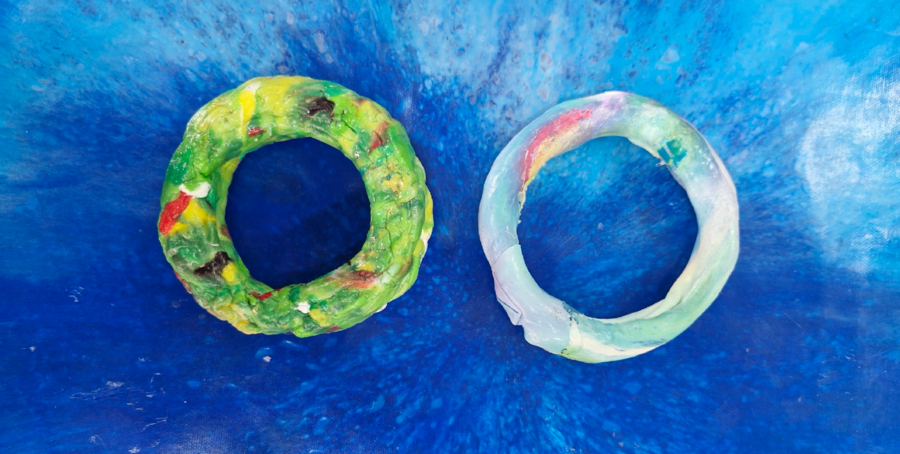
The difference in the smoothness of two types of plastic: HDPE and PLA
PLA was used to construct the frames of the cubes, rods, and the base because, during the working process, it solidified with a smooth surface, allowing for dense and stable components. Furthermore, it was convenient to mix after heating since it solidified slower than HDPE. For the numerals and month names, a mixture of PLA and HDPE was chosen to create a unique color combination and contrast with the calendar frame while maintaining the smoothness of the parts.
Artistic language
For the frames, it was important to achieve a predominantly solid color surface with subtle flecks of various colors, which emphasize the secondary nature of the plastic without disrupting the calendar’s overall aesthetic. By blending heated PLA in violet, turquoise, yellow, and white, we managed to achieve the desired azure hue. For the numerals and month names, we selected black HDPE infused with PLA. This combination creates a strong contrast with the azure frame, ensures clear legibility, and lends the details an unusual texture. The simple geometric forms of the cubes and bars highlight the minimalist design of the piece, and the smooth, pleasing-to-the-touch surface makes the daily act of changing the date a small, tactile ritual.
Production
The production process begins with selecting the plastic and desired hues, anticipating that they will be mixed under a hot press.
The next step involves shredding the selected pieces of plastic in a shredder and sifting them to remove small pieces of unwanted color.
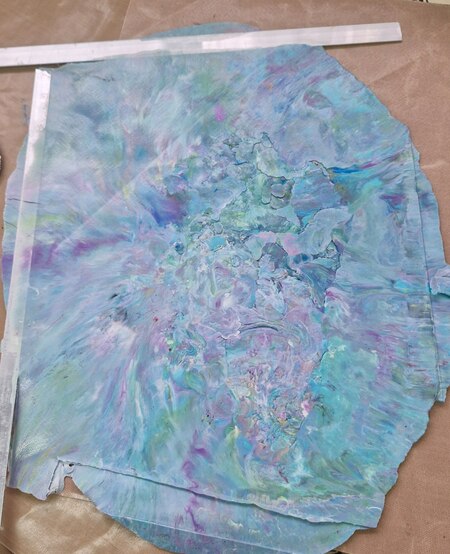
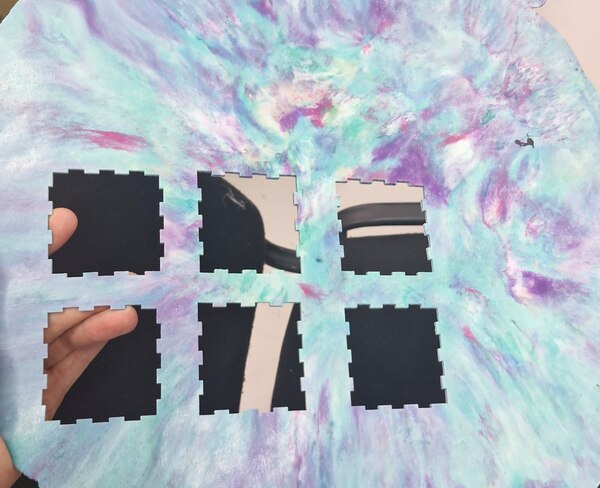
Sheets of recycled plastic before and after laser processing
After preparing the material, it is placed under a press heated to over 200 degrees. The plate molding process occurs in several stages:
- Initial heating
- Mixing color into the hot material
- Second heating with iron rods to create a uniform thickness of 2 mm.
Next, calendar components are laser-cut from plastic sheets using preliminary sketches created in Adobe Illustrator. The cut parts are assembled along their seams to verify the accuracy of the dimensions.
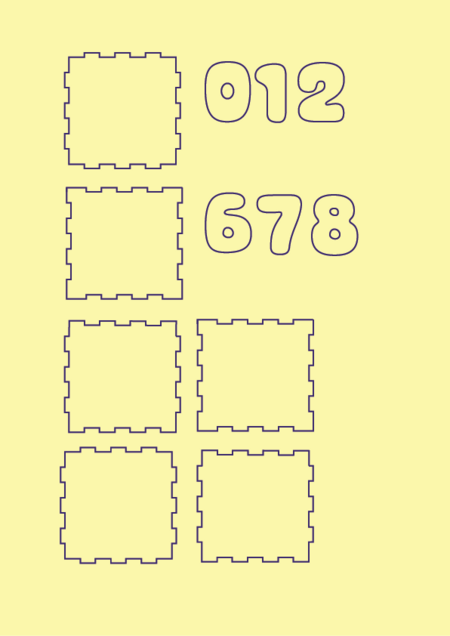
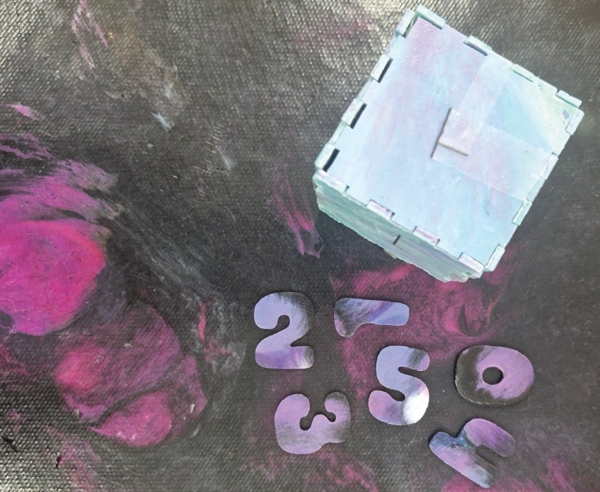
Element schematic for one cube; Elements after laser cutting
The final stage involves assembling all the pieces using a hot glue gun.
Target Audience
Office Workers and Freelancers
A perpetual calendar can become a pleasant tactile routine for them—a way to disengage from the digital environment, shift focus, and decompress after a demanding workday. Its smooth surface and the ability to rearrange elements, much like building blocks, evoke pleasant childhood associations, transforming the daily date change into a small moment of respite.
Baristas and Owners of Small Cafés
The calendar can be placed at the register or on the bar counter next to the service bell, complementing the arrangement of decorative tabletop items. Its unique texture and color combination can serve as an accent in the café's interior. Each day, staff can change the date independently, while visitors can notice the unusual object made from recycled plastic.
Production
The RE calendar is straightforward to produce and suitable for small-batch runs. Thanks to its simple construction, it can be sold disassembled, complete with a parts kit and glue. The buyer can assemble the calendar themselves, like a puzzle. This approach simplifies mass production by eliminating the need to glue components during the manufacturing stage. Alternatively, the calendar can be sold pre-assembled for those who prefer a ready-made product.
Even with the possibility of mass production, every single item will be unique. The plastic recycling process generates an inimitable pattern of colored flecks, so even calendars with the same shape will remain distinct and unique from one another.