Can you feel the chemistry of polymers with your hands—in a single gesture?
The Problem
Corporate merchandise often boils down to slapping a logo onto a finished item. These pieces quickly become disposable: they lack character and history, and people don’t want to wear them. Meanwhile, the polymer industry itself remains invisible to most people. We use plastic every day, but hardly anyone stops to consider how the material is structured internally or what its potential is. We asked ourselves: how can we create a beautiful and sophisticated object that showcases the unseen structure of the material?
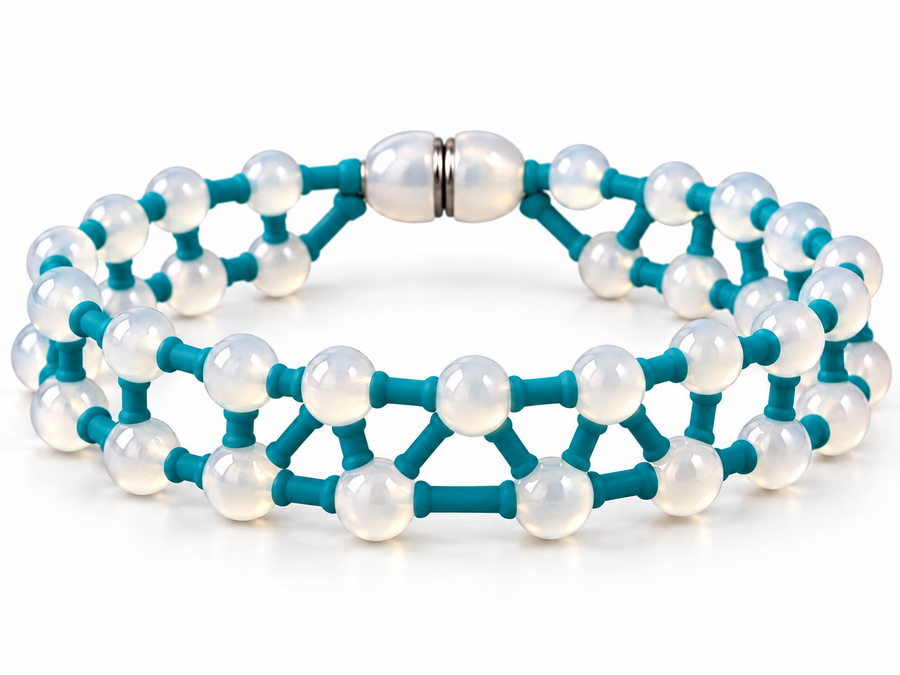
SShIVKA is a bracelet that mimics the structure of a spatial polymer and responds to the person wearing it. It clicks when fastened, changes color based on body heat, and glows in the dark. All of this works without batteries or electronics—solely through the material’s inherent properties.
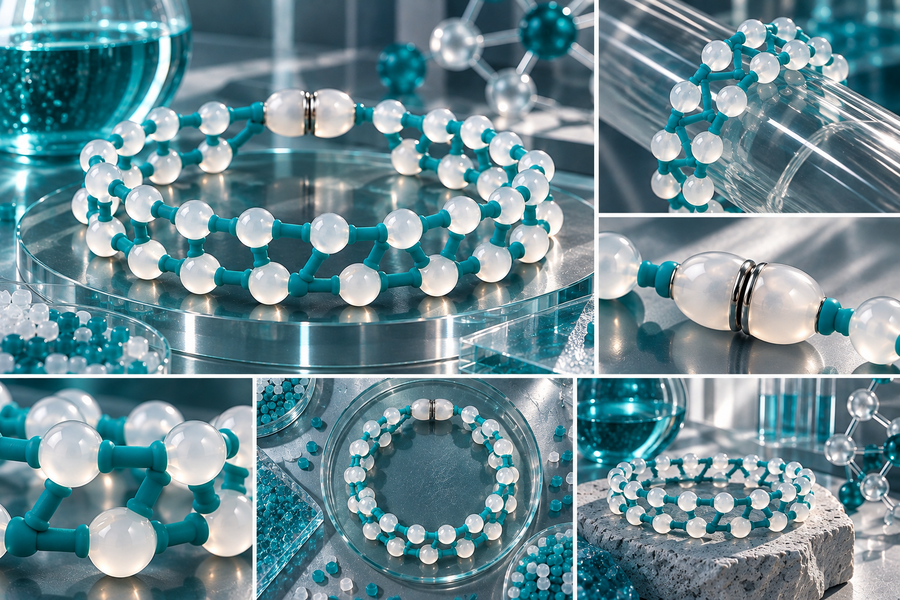
Why SHIVEKA?
In polymer chemistry, «cross-linking» is the process where individual molecular chains connect to each other via transverse bonds, transforming into a three-dimensional network. This is how ordinary rubber becomes vulcanized rubber—strong, elastic, and shape-retaining.
The name directly describes the principle of the object. In its open state, the bracelet is simply a chain. When a person fastens it, the structure closes and forms a cohesive network.
Each fastening is a small cross-linking reaction that the person initiates themselves. And, just like a real chemical reaction, it has a visible result: the material responds with sound, color, and light.
Concept
Two parallel rows of nodes are connected by transverse links, forming a spatial structure. Magnetic clasps are positioned at the ends of both rows. The nodes are slightly uneven, mimicking a real molecular model. Therefore, the bracelet reads as a fragment of a living material structure. The key point here is that the material is not the subject—it is the principle of operation. The bracelet stretches and conforms to the wrist precisely because the elastic links create a network. This is the same property that makes rubber rubber. Furthermore, the effects of color and luminescence are integral to the plastic itself, not applied on top.
Bonding Reactions: Three Effects
The main feature of the bracelet is that it responds to human action. Every effect is based on the properties of the polymer material and requires neither batteries nor charging.
The click is the circuit closing. Powerful magnets are hidden in the clasp. When the ends of the bracelet come close to each other, they are drawn together on their own and snap shut with a distinct click. This is the moment the circuit closes: the structure becomes whole.
Color — the reaction has started. A thermochromic pigment has been added to the knots in the plastic, which changes color based on temperature. For the first minute after fastening, the bracelet heats up from the skin, causing the knots to change color. A person literally sees the material «reacting» to them. When the bracelet is removed and cools down, the color returns, and the reaction can be repeated.
Tile with two images/GIF that changes color like a bracelet
Light—a grid in the darkness. A photoluminescent pigment has been added to the elastic fibers. During the day, the bracelet subtly charges from ambient light, and in the dark, the fibers begin to glow softly. The knots remain dark, and the molecular grid itself—a structure usually unseen—is revealed on the wrist.
image of a bracelet in the dark, only the network grid glows
Together, three effects transform a simple action into a small ritual: a click, warmth, a color change, and in the evening—a glowing structure on the hand.
How the HSE Art and Design School Works
The bracelet’s function can be described by a simple chain: chain $\rightarrow$ click $\rightarrow$ reaction $\rightarrow$ network
4 bracelet states in the diagram: chain (open, straight), snap (magnets engaged), reaction (heat changes color), network (connections glow)
The bracelet has three main states.
Chain. The bracelet is unclasped and lies as a straight band. This is a «linear polymer»: the structure is not yet closed.
Mesh. The bracelet is fastened around the wrist. The structure has closed into a loop, the elastic bonds are slightly stretched, and softly conform to the arm. The warmth of the skin triggers a color change.
Network. Since the clasps are universal, bracelets from different people can be connected. Two bracelets form a long chain, and several form a common network. Thus, the object transforms into a metaphor for human connections.
image, two hands clasped with two bracelets
Use Cases
In the everyday life of a SHIVKA student, this item is both a piece of jewelry with a story and a useful gadget. It can be wrapped around headphones or a charger and clipped to function as a cable organizer. The magnetic clasp attaches to a key ring, and the carabiner fits through a loop. Two connected bracelets work as a short strap for an ID badge or a water bottle. Plus, the glowing mesh makes it visible in the evening, at concerts, and in the dark.
For SIBUR, the bracelet functions in several formats:
HR and onboarding—a new employee receives a bracelet and is «integrated into the network» of the company; Events and hackathons—the «build the network» mechanic: participants connect their bracelets to each other, and the network lights up in the evening; Merchandise shop—a series of different colors offering collectibility; Gift sets and giveaways—the color and glowing effects look great in videos and social media.
Rewrite the above text and add images
Construction and Blueprints