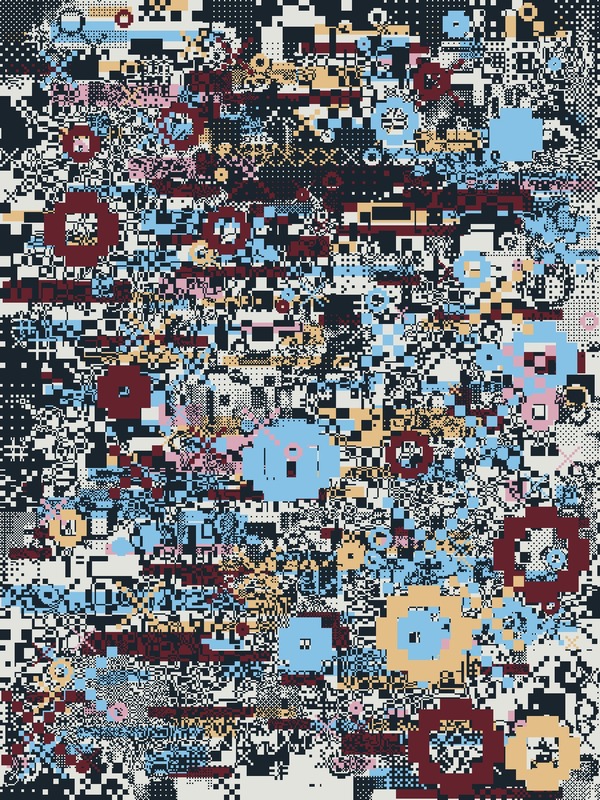
The virtual world exists as long as the flow of data continues. When the signal breaks, the space where we connect with others collapses into macroblocks, stripes, and noise. «Signal loss» documents this moment of rupture, embedding it into the fabric—the technology from which the computer arose: the 1804 Jacquard loom, controlled by punch cards. Through the interference, crosses and zeros emerge—OXO, one of the first computer games. The game continues, even as the world disappears.
In VR, there is the concept of presence—the feeling that you are truly in another place with other people around you. Presence relies on continuity: dozens of frames per second, low latency, and a stable connection. Lose just a few packets, and the illusion shatters. The world doesn’t vanish entirely; instead, it reveals its underlying structure: a compressed image breaks down into squares, which is what it was always composed of. The glitch is the only moment when digital space reveals its true materiality.The tapestry works directly with this matter. Its surface is composed of what is usually hidden: macroblocks from video codecs, stretched strips of dropped frames, and matrix dithering—a method of depicting half-tones using only two states: «signal present» and «signal absent.» The dithering scale ranges from 6 mm to 5 cm, as if the image is simultaneously breaking apart at different levels of resolution.The choice of weaving technique here is fundamental. In 1804, Joseph Marie Jacquard taught a loom to weave patterns using punch cards. Forty years later, Ada Lovelace wrote that Babbage’s analytical engine «weaves algebraic patterns just as the Jacquard loom weaves flowers and leaves.» The digital image is literally born from the fabric: the thread is the first pixel, the punch card is the first program. By translating the disintegrated virtual world onto the loom, the work completes this circle.Tic-tac-toe, visible through the noise, is a reference to OXO, one of the first computer games written in 1952 for EDSAC. It is the simplest form of interaction with another, and it can continue even over a broken connection. For a diploma focusing on social VR spaces, this is the central question: what remains of an encounter when the world in which it took place disappears?
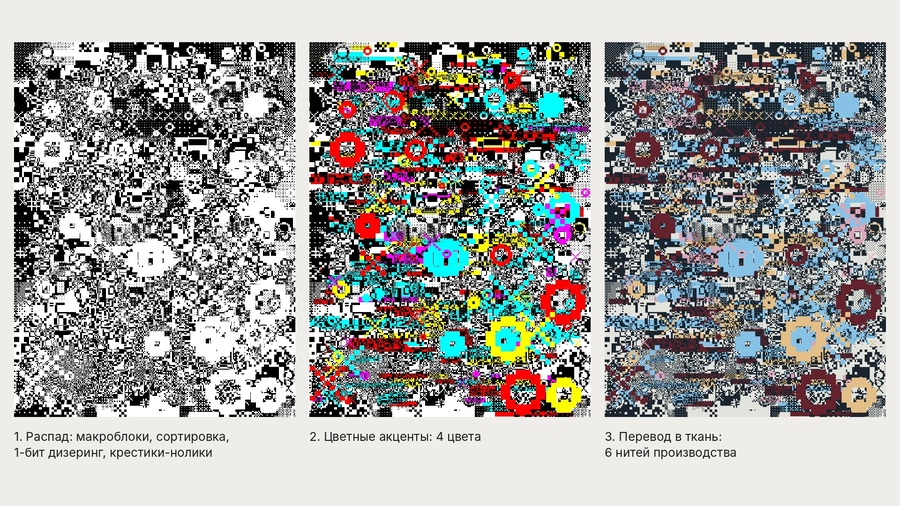
Process
The image is algorithmically constructed, mimicking the manner in which a video stream disintegrates. Initially, the field is fractured into macroblocks and shuffled; bands stretch, and pixels are sorted by brightness. Subsequently, it is reduced to multi-scale 1-bit dithering, over which crosshatch patterns are overlaid, and finally, four color accents are added.
Threads
Six screen colors have been translated into six production threads: graphite, milky, sky-blue, burgundy, beige, and pink. The vibrant digital spectrum is softened, becoming textile: the signal passes through the material and transforms. The smallest detail is around 6 mm, ensuring the pattern maintains sharpness during weaving.