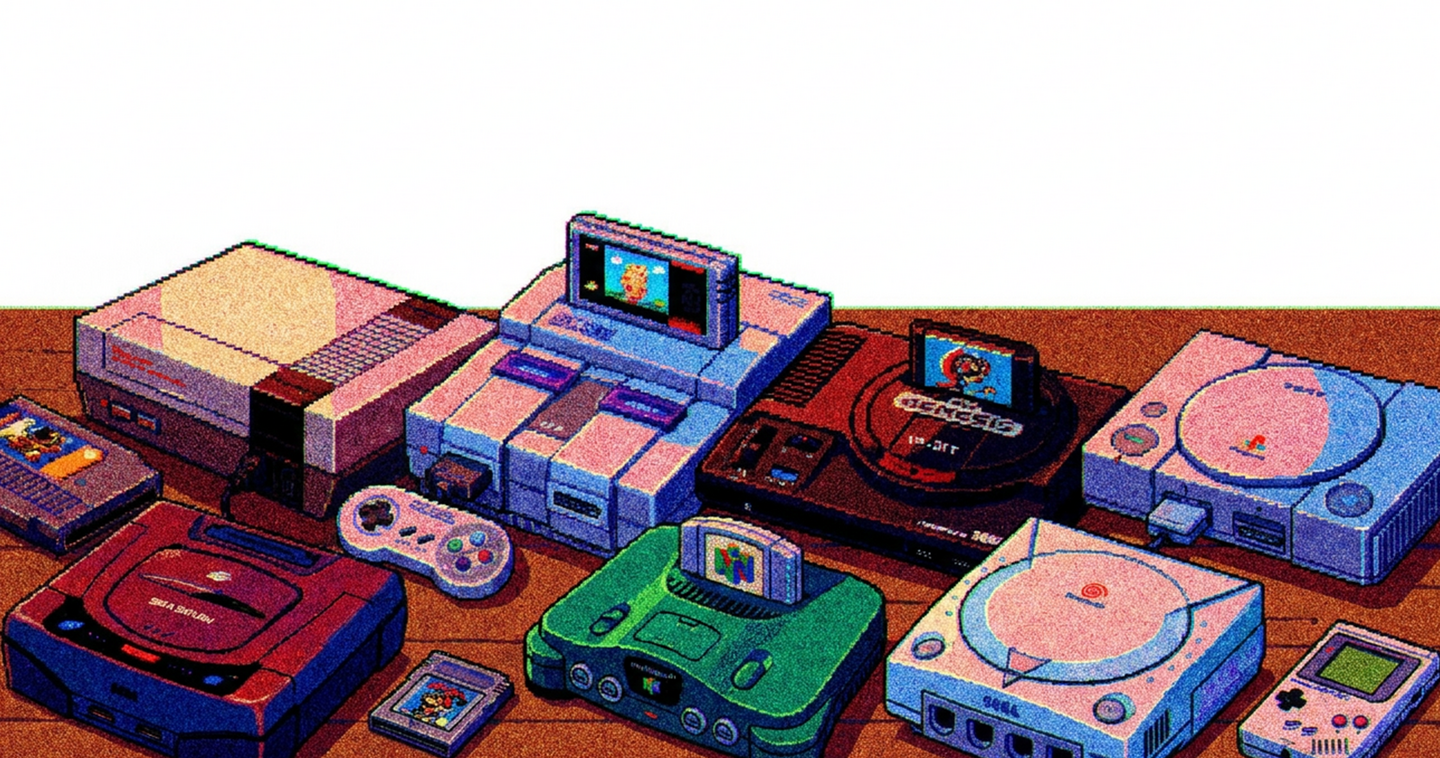
[PROJECT CONCEPT]
Pixel Archive — a documentary media project dedicated to the history of console retro gaming and the iconic video games that shaped the industry.
Lately, many gamers have been returning to retro games more and more often, reminiscing about their childhood and their first experiences with consoles connected to bulky old televisions.
But why is this happening? Why, in a modern world with its graphic capabilities, do people choose eight-bit pixelated worlds, collect old hardware, attend themed clubs, and buy outdated cartridges?
Media Pixel Archive explores this phenomenon, uncovering what lies behind the feeling of nostalgia, and helps you learn more about the history of consoles and the gaming industry.
[MEDIA OBJECTIVE]
The history of video game consoles constitutes a vast expanse of information, making it easy to become lost within. Throughout the history of retro gaming, many significant events have shaped the future of the entire industry. For someone diving into this material for the first time, it can be challenging to find their footing, extract the core ideas, and avoid getting overwhelmed by the sheer volume of models, studios, and notable figures.
The media’s goal is to create an accessible educational space through which someone discovering console gaming can learn more about the history of retro gaming, understand how trends developed, and learn about the formation of the industry.
[THEME]
Pixel Archive focuses on the niche segment of console gaming, emphasizing the retro attributes of the era—from 1972 through the 2000s.The media focus includes retro consoles, from Atari to PlayStation; video games that influenced the gaming industry; and iconic phenomena such as Dendy and the 90s gaming arcades.Focusing specifically on consoles and console video games, and examining a particular time period, allows for a focused depth of cultural background, enabling engagement with specific nostalgia for the past—a nostalgia expressed through returning to old formats and gaming practices. This approach makes it possible to build content around specific platforms, games, and events.
[COMPETITORS]
SELECTION AND ANALYSIS CRITERIA
— Positioning — what informational need the media addresses and how it defines itself.— Audience Focus — who the project’s target audience is and why they are interested in the field.— Content Format — how the content is structured and what types it includes.— Project’s Tone of Voice — the style of information delivery: whether the media sticks to dry facts or emphasizes emotion/engagement.
DIRECT COMPETITORS
Media services and projects that build content around the history of retro video games and consoles
DF Mag
An electronic and print retro magazine published by the DF (Dendy Forever) community since 2013. It features thematic articles on the history of video games, retro consoles (including Dendy and Sega), homebrew development, hardware, and the gaming industry. The project is aimed at passionate enthusiasts of retro games and consoles—those nostalgic for the 8- and 16-bit era. The media’s tone is varied and heavily depends on the author of the specific article, but it is usually a lively, emotional, and sometimes subjective style.Retroarcadia
A personal, non-commercial blog. It is a popular project dedicated to the history of console video games from the 1970s to the present day. It publishes deep and detailed reviews from the perspective of someone who witnessed the arrival of the video game era and its evolution. The content is educational material and detailed analyses/research that describe the past in a dynamic and straightforward manner, immersing the reader in retro nostalgia. The project’s target audience is the author himself and people like him—those who played video games starting in the 1970s. The project’s tone is very personal and reflective, which is captured in the slogan: «The games that made us. All the way back to the 1970s.»Console Patrol
An independent retro gaming publisher in Russia, specializing in producing themed magazines and selling rare copies of cartridges and consoles. Social media and the website feature news about new releases, launches, and shipments, host auctions, and publish review articles dedicated to cartridge video games. The project’s target audience is likely adults from the 90s who miss their past childhood, and collectors willing to purchase physical items, whether retro magazines or consoles. The project’s tone is warm and highly nostalgic—personal, yet serious.
All three projects, one way or another, center on a profound sense of nostalgia; they invite the reader into a distinct dialogue, creating a space where one can and should share personal experiences.
INDIRECT COMPETITORS
Media covering old computer video games. Their content emphasizes retro aesthetics or a feeling of nostalgia, but the information is not related to consoles.
Igramania
An honest and unbiased media outlet covering gaming, cinema, and technology, regularly publishing news, reviews, and previews of video games. The project’s target audience is contemporary gamers who actively follow industry innovations and seek expert opinions on the portal. The project’s tone is conversational, informal, and emotional, which makes the material accessible and attracts a young audience.Stop Game
A popular website dedicated to video games, news, and related events. The platform releases video reviews and news, discusses new releases, compiles rankings, and provides recommendation lists. The target audience is also modern gamers looking for expert opinions and in-depth analysis of news and new titles. The project’s tone is expressive and vibrant; its material is unafraid to be emotional and occasionally subjective.Old-Games RU
A non-commercial archive site for classic computer games. The project’s catalog features most retro masterpieces, rarities, and simply interesting titles from past years; it also publishes internal archive news, podcasts, articles, and discussions. The project’s target audience is true enthusiasts—people who don’t just feel nostalgic, but who intentionally preserve and study old video games. They are interested in game preservation, technical adaptation, and cultural heritage. The project’s tone is expert, technical, and pragmatic, geared toward deep research and historical preservation.
These media outlets address a closely related topic and fulfill a similar information need; they are focused on establishing a deep connection with the target audience—the core and, in a sense, the driving force of the project. The platforms gather and catalog in-depth analytical content related to video games, allowing readers to interact with it independently.
POTENTIAL COMPETITORS
Large platforms where diverse content from various authors is published—including content about new video games, or personal blogs through which authors broadcast their multi-faceted expertise to a wide audience.
Potential competitors for this project include media outlets that publish podcasts, reviews, and streams about the latest in the gaming industry. They address a similar informational and emotional need, but through different resources. The target audience for these media seeks expert and emotional—even if biased—opinions that they can rely on and trust.
[DISTRIBUTION CHANNELS]
VK / Telegram — project introduction, topic briefing, and audience engagement The high speed of content consumption and the ability to work with multiple publication formats allow for direct contact with the audience and the tracking of general trends and points of interest. Content can be designed as cards, mini-articles, regular columns, and interactive features, gradually introducing the reader to the subject matter.Blog on DTF and Dzen — material repository The main body of information for the project is published on these platforms because they are best adapted for the long-form article format. This format also allows for reaching a wide audience and organically publishing long, content-rich articles and analyses.Podcast Platforms — in-depth, focused immersion in the topic Narrowly focused content dedicated to a specific theme is published on these platforms. The format can include personal monologues, interviews with notable figures or specialists, and interactive segments, such as answering reader questions. It is suitable for those who wish to dive deeply into the subject and learn as much as possible.
[TARGET AUDIENCE]
The target audience for this project includes individuals interested in immersing themselves in the history of console systems and video games, but who lack the sufficient time or resources to independently find reliable and engaging information.
Segments:1. Nostalgic Millennials
Individuals who grew up in the 80s and 90s and witnessed the dawn of the console and video game era.Desire to return to childhood:
They seek ways to recreate the atmosphere of their youth and pass it on to the next generations.2. Young Explorers
Young gamers, students in creative fields, and video game enthusiasts.Desire to learn as much as possible:
These individuals want to dive deeper into the industry—to learn about its evolution and the journey video games took to become what they are today.3. Collector-Researchers
Active gamers who play games as adults, often individuals with a technical or IT background.Desire to understand the technical mechanics:
They collect original cartridges and consoles, study the types of operating and gaming systems and their distinctions, and aim to systematize their knowledge within a community of like-minded enthusiasts.4. Curious Gamers
They frequently play modern games but sometimes feel the urge to try something older to test themselves, understand what makes the older content appealing, or simply gauge their skills.Desire to know why the past felt «better»:
They are not collectors, but they are definitely interested. They don’t seek deep immersion but periodically pay attention to classic video game remakes to learn a bit more about their history.

Dima, 35, Moscow, IT Specialist
He grew up on Dendy and Sega Mega Drive, and now buys retro consoles on Avito to play the games he couldn’t afford as a child.
He frequents retro clubs to play on various consoles and connect in person with fellow enthusiasts.Media Value: Practical guides (how to connect a console to a modern TV), nostalgic articles, and collection appraisals.Motivation: Emotional connection to his childhood.Barriers: In the modern world, it is too difficult to find high-quality and engaging, timely content about retro consoles, and it is hard to find like-minded people or a community for interaction.

Vika, 18, St. Petersburg, Designer, Roleplayer
She grew up on video games, playing them with her father. Her interest in retro aesthetics stemmed from his stories about pixel art and music. She actively follows the gaming industry and reads academic literature on game studies.Media Value: An explanation of «why retro consoles are cool» without condescension, visual aesthetics, and accessible formats.
Motivation: Seeking authentic experiences and escapism from the «digital noise.»
Barriers: Lack of time—she is willing to consume only fast, yet expert, content.