Concept
Industrialization radically transformed not only the social structure of society but also the way the environment was perceived. The machine and its noise gradually became an integral part of daily life, transforming into a new aesthetic experience. While in the early 20th century technology was associated with progress, by the second half of the century, attitudes toward mechanization became more contradictory. Artists increasingly approached the image of the machine not as a triumph of science and technology, but as a symbol of alienation and crisis. This transformation is particularly evident in art that engages with sound, movement, and mechanical systems. The noise of motors, the rhythm, and the vibration of mechanisms become an independent artistic statement, rather than a mere tool.
Traditional research focuses either on the acoustic properties of works or on the technological aspects of sound art practices. Much less frequently is the mechanical sound and industrial aesthetic examined as a cultural phenomenon of the 20th and 21st centuries. Yet, it is precisely through the artistic reinterpretation of the machine that we can trace the evolution of perceptions of technological progress in shaping modern perception.
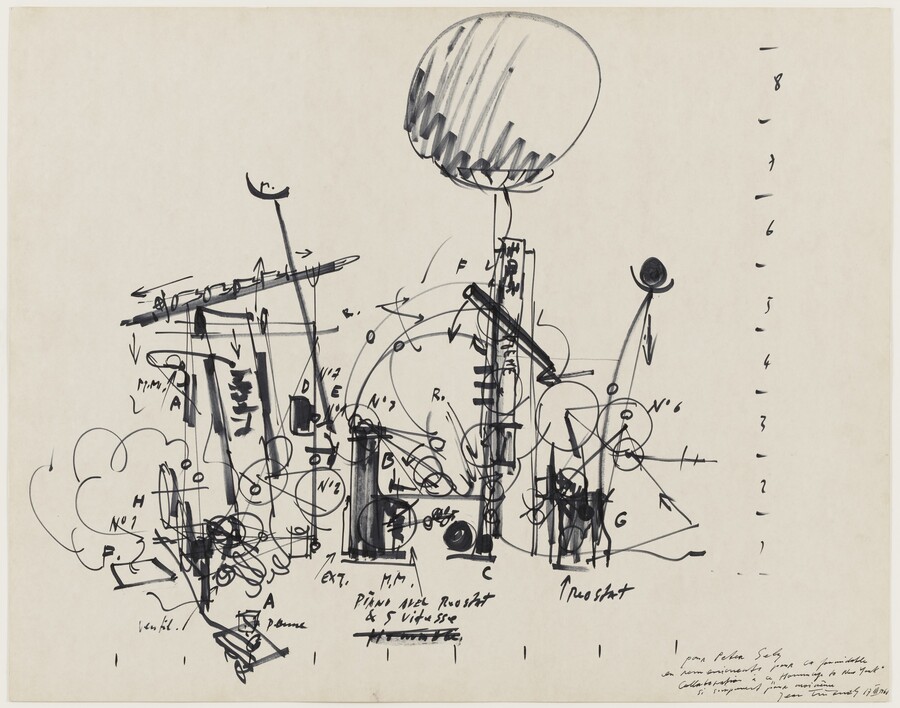
Jean Tangley. Sketch for «Paying Respects to New York» (1960)
As part of this research, we will examine the transition from the early futurists' optimism to a critical reflection on mechanization in postwar art, and subsequently to post-industrial and contemporary practices. While the machine symbolized speed and energy for Futurism, in later works, the system takes on characteristics of absurdity, chaos, and self-destruction.
The material selection principle is based on practices where mechanical noise becomes a central element of artistic expression. The research will draw upon the theories of Luigi Russolo, the works of Jean Tinguely, and contemporary installations by Zimoun, Dmitriy Morozov (: vtol:), and Jane Tingle.
The structure of the study involves dividing the material into three main blocks. The first block focuses on the aestheticization of industrial noise and the machine in early modernism and Futurism. The second block examines the crisis of mechanization in postwar kinetic art. The third block concentrates on 21st-century sound practices, where technology gains autonomy and a contemplative nature.
The principle for selecting textual sources is based on scholarship in sound art, media archaeology, and contemporary art. The research incorporates the works of J. Attali, K. Cox, as well as J. Pigott, which examine electromechanical systems and kinetic sound installations.
I. Industrialization and the Cult of Technological Progress
Artistic practices of the early 20th century began to strive toward representing the energy and rapid pace of the industrial world. Concurrently, the acoustic space of the city was changing. The sounds of engines, factories, transportation, and mechanical devices began to be perceived as a new form of sensory experience. It was during this period that the idea formed—that modernity possesses its own soundscape, fundamentally distinct from the pre-industrial environment. This new perception of industrial noise manifested in Italian Futurism, whose proponents viewed the machine as the central image of modernity. For the Futurists, technology opened up the possibility of creating an entirely new art based on speed, energy, and rhythm. It is within this context that the idea of aestheticizing noise as an artistic material emerged.
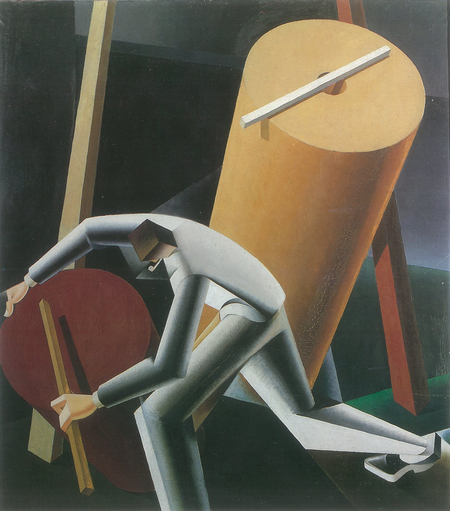
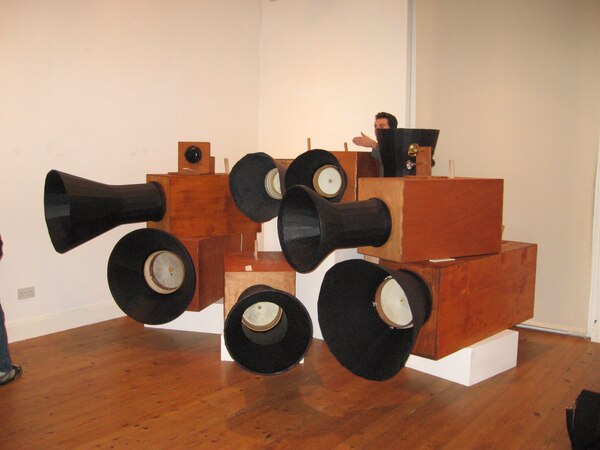
Ivo Pannaggi. Characters (1925). Pietro Verardo. Reconstruction of Luigi Russolo’s «Intonarumori» (2002–2009)
Luigi Russolo becomes a central figure in shaping the aesthetics of industrial noise. In 1913, he published the manifesto «The Art of Noises,» which became one of the key texts of the early sound avant-garde. Russolo argued that the traditional musical system could no longer adequately reflect the reality of industrial society.
«Let us pass through the modern city, weakening our sight and sharpening our hearing, and we will discern the streams of liquids and gases in metal pipes, the murmur of sounds—primal, breathing, and pulsating—the click of valves, the movement of pistons, the roar of mechanical saws, the clatter of trams on rails, the snaps of whips, the flapping of flags, and the rustle of curtains.» Luigi Russolo
«Intonarumori» Score by Luigi Russolo
Rossellini’s key project is the «Intonarumori» of 1913—mechanical instruments designed to reproduce industrial sounds. These devices mimicked the hum of motors, the clatter of machinery, vibrations, and the noise of the urban environment. The distinctive feature of the «Intonarumori» is that mechanical sound was considered an independent artistic statement for the first time. Rossellini did not seek to hide the sound’s origin—on the contrary, he emphasized its mechanical nature. The machine here becomes simultaneously a source of sound, a visual image, and a symbol of the new age.
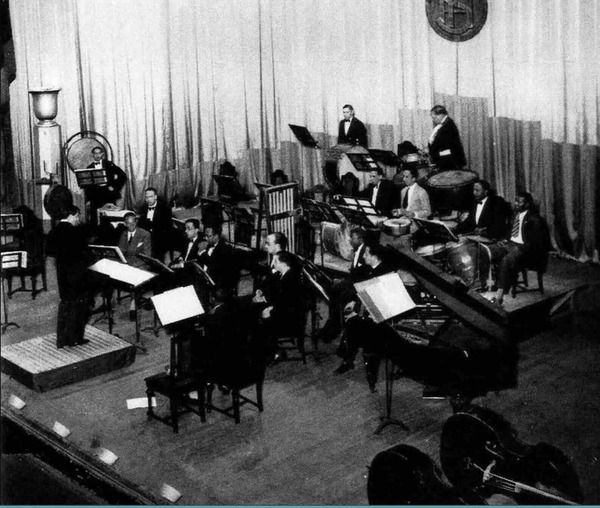
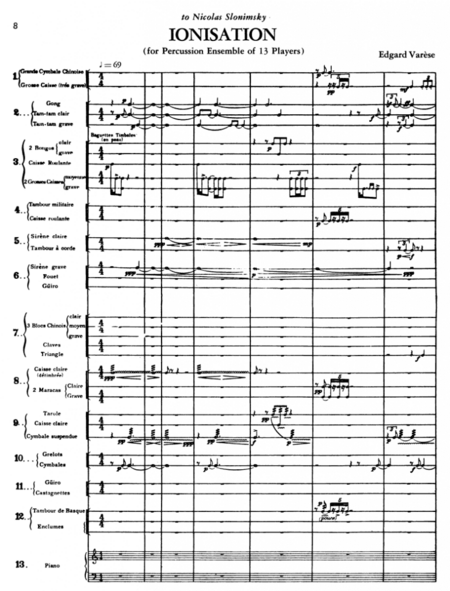
Nicolas Solominsky, conducting «Ionization» in Havana (1933). Score of «Ionization»
The development of industrial noise aesthetics continues in Edgar Varèse’s work, «Ionisation» (1931). The composition is built upon the collision of recurring rhythms, acoustic impulses, and noise textures. The absence of a melodic dominance sharpens the focus on the materiality of sound and its physical impact. The piece reflects the changing perception of musical composition during the era of industrialization. Thus, the works of Russolo and Varèse form the foundation for the further development of experimental sound, where mechanical noise becomes an integral part of artistic practice.
In the latter half of the 20th century, the perception of industrial sound gradually shifted toward an exploration of everyday environments. While Futurists perceived noise as a symbol of progress and the technological future, subsequent sound practices began to view it as an element of surrounding reality and an object for analytical listening.
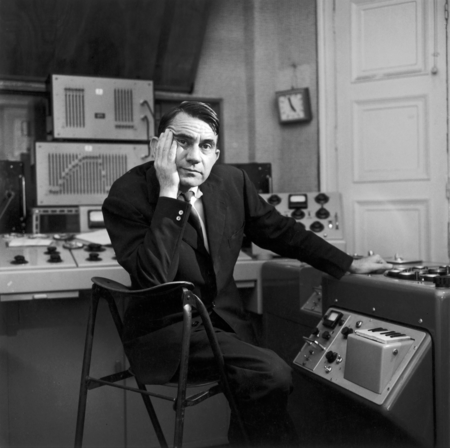
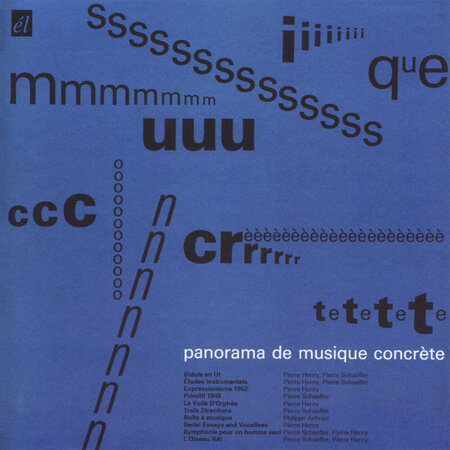
Pierre Schaeffer at work. Pierre Schaeffer, Pierre Henry. Panorama of Concrete Music (2010)
One of the key examples of this approach is Pierre Schaeffer’s piece, Étude aux chemins de fer (1948), which became one of the first compositions of concrete music. The work is based on recordings of railway sounds: the movement of trains, the screech of metal, and the rhythmic pounding of wheels. Unlike the Futurists, Schaeffer works directly with documentary recordings of the real sonic environment.
The recording technique itself takes on particular significance. Through the montage, repetition, and fragmentation of sound, Schaeffer transforms mechanical noise into an independent sonic structure. The rhythm of the railway evolves into an abstract composition, where the focus is on the timbre, texture, and materiality of the sound. This signals a major shift in how the industrial environment is perceived: the machine is no longer viewed solely as a symbol of progress but becomes an object for listening and investigation.
II. The Collapse of Mechanical Utopia
In the latter half of the 20th century, the perception of the machine and technological progress changed significantly. The experience of world wars, mass production, and total automation led to a profound crisis. Industrialization ceased to be associated exclusively with progress and began to be viewed as a source of alienation, destruction, and the loss of human control.
John Cage, Maelström Percussion Ensemble. Imaginary Landscapes. Dir. Jan Williams (1995)
John Cage’s work serves as an important transitional example, specifically «Imaginary Landscape No. 4» (1951). This piece was created for twelve radio receivers, operated by performers in real time. The composition is built upon random radio signals, static, and unstable acoustic flows. Unlike the modernist drive for control and structure, Cage deliberately introduces an element of unpredictability, challenging the notion of technology as a completely governed system.
Jean Tinguely is a leading critic of industrial utopia. Unlike the Futurists, the artist creates mechanical systems that demonstrate their own uselessness, instability, and propensity for destruction. His kinetic objects challenge the very notion of technological perfection.
The most illustrative piece is «Homage to New York» (1960), created for the Museum of Modern Art in New York. The work was a massive, self-destructing machine composed of metal structures, engines, bicycle wheels, musical elements, and mechanical devices. During the performance, the system began to move, emit noise, vibrate, and gradually dismantle itself.
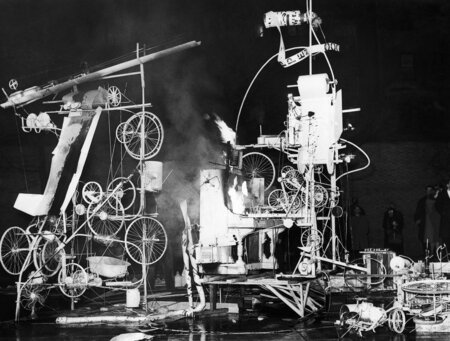
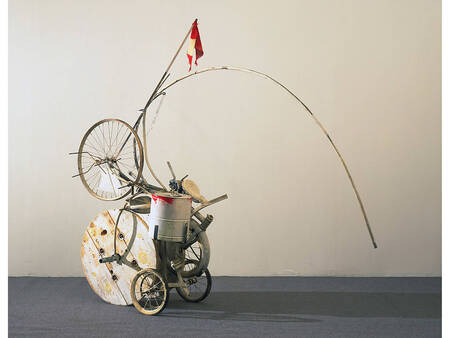
Jean Tinguely. Homage to New York (1960). Preserved fragment. MoMA
Furthermore, «Paying Homage to New York» deconstructs the notion of the machine as a functional object. The mechanism produces no useful result—its sole function is its own disintegration.