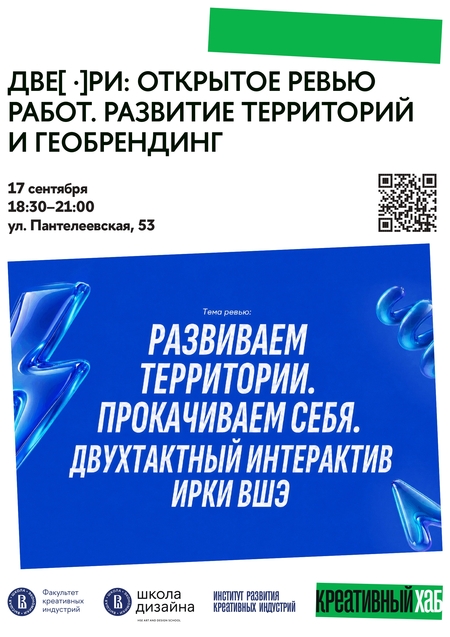
Bonus: 5% discount for participants for 10 days following the event on all HSE Art and Design School supplementary education programs
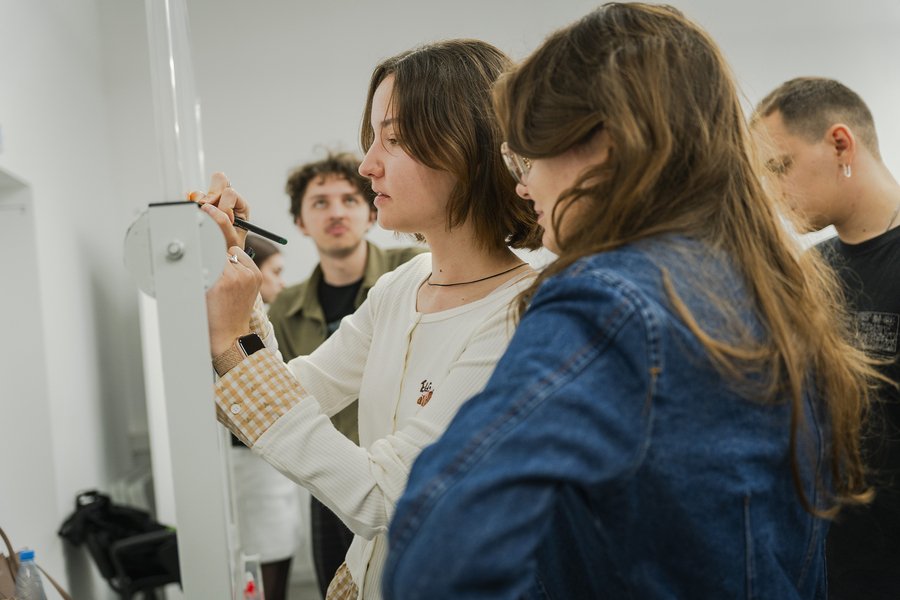

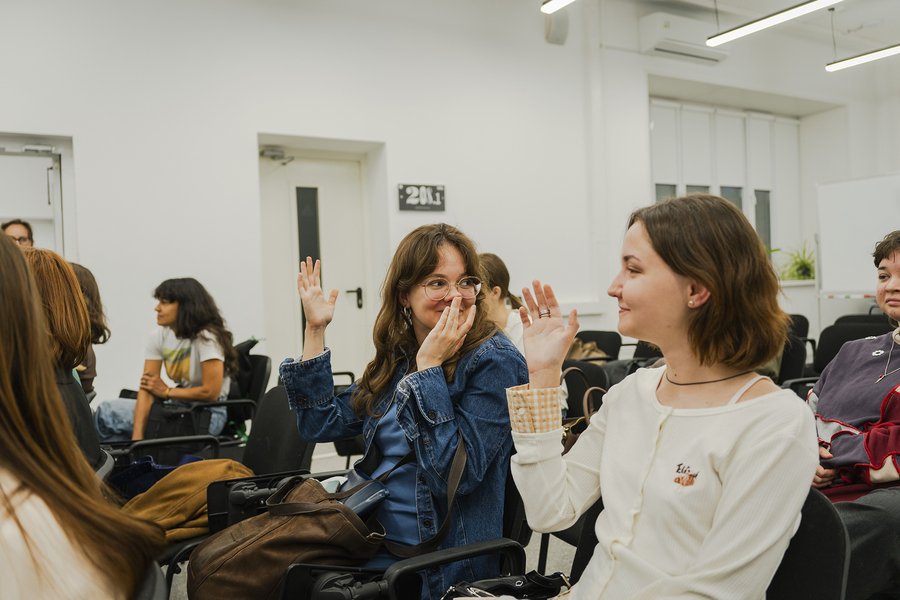

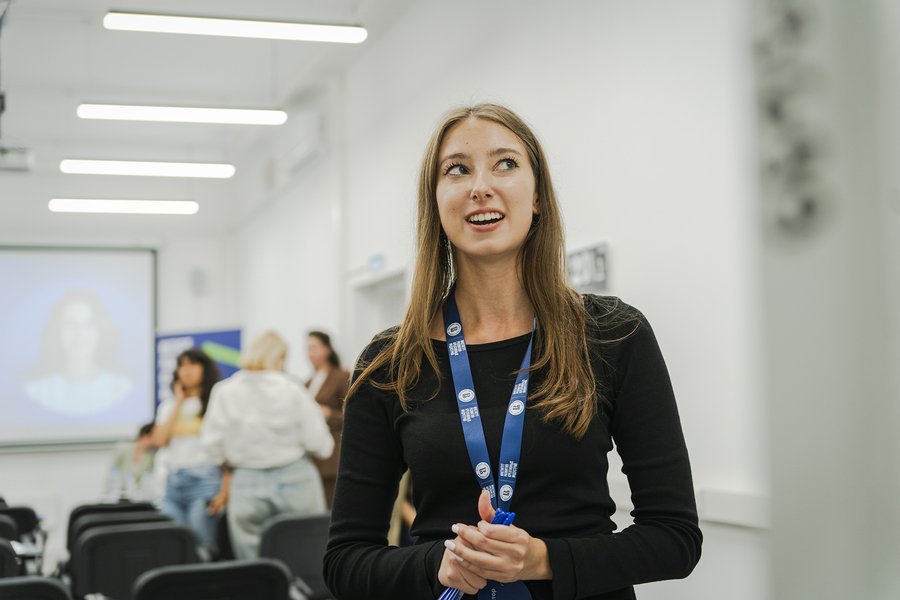
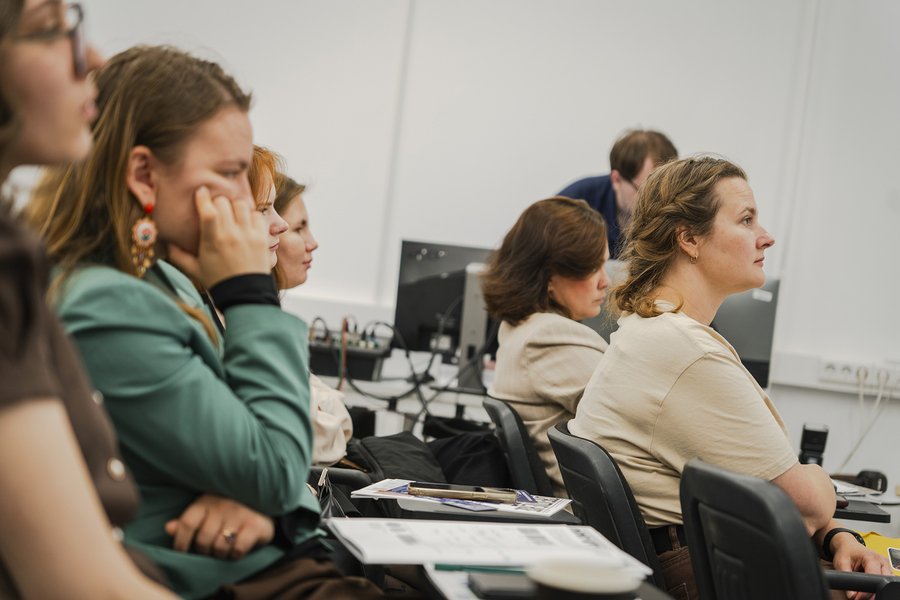
September 17, 2026, the event «TWO[·]DOORS: Open Portfolio Review. Territory Development and Geobranding» took place at the Creative Hub / HSE CREATIVE HUB in collaboration with the HSE Institute for Creative Industries Development.The evening was divided into two parts: addressing questions from the audience and presenting participants' projects.In brief, we tell you how the event went.
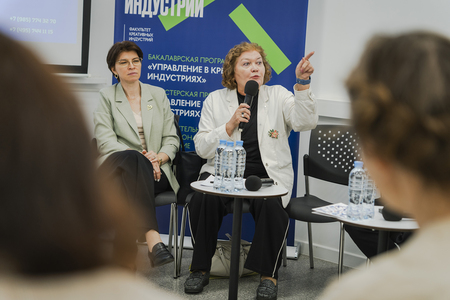
Act 1: Questions from the Audience
The event was opened by Natalya Platonova, an instructor of «Creative Entrepreneurship» at the HSE Art and Design School, a professor, Doctor of Economic Sciences, and Honorary Worker of Higher Professional Education of the Russian Federation.
In her opening remarks, she outlined the main goal of the meeting—to analyze the real barriers faced by project creators in order to adapt educational programs accordingly. The speaker paid particular attention to the heated debates surrounding the federal law on creative industries.
According to an expert, there is currently a serious push to integrate state cultural organizations into the creative economy. This transition signifies a paradigm shift—moving from full budgetary support to the necessity of independently generating revenue, developing marketing strategies, and attracting audiences. A successful example of regional support is the Vladimir Region, which provides millions in grants for the development of private museums, about which regrettably, few people are aware.
«The Ministry of Culture is dug in its heels to avoid including its organizations in the creative industries development law because KPIs and requirements will immediately appear—you all have to make money; you can’t all rely on state funding.»
Tatyana Khrapko, a faculty member of the HSE School of International Relations and Chair of the Culture Committee at the CIS Business Center, Director of «CREADEV,» founder of «Fijiatlon,» and curator of the «Regional Creative Brands Club,» continued the discussion on the specifics of creative products. She emphasized that creative industries are incredibly diverse, and the main barrier to their monetization often lies within the creators themselves. Artisans and makers of local products are frequently psychologically unprepared to scale production or delegate management to teams. To overcome these limitations, the speaker proposed three paths: forming communities for collaborations, launching educational schools to transfer methodology, or having the creator fully transition into a managerial role and enter export markets. When answering participants' questions about promoting educational projects, she also reiterated the importance of basic communication—specifically, the need to directly contact administrations with partnership proposals and request letters of support.
«Crafted products are complex, and the complexity often lies with the creators who are unwilling or unprepared to scale, as that requires shifting from the role of a creator to that of a management expert.»
Ilya Tokarev, Chairman of the Union of Creative Clusters, Managing Partner of the Polis Institute for Urban Development, and an expert at the HSE Institute for Regional Studies, discussed infrastructure and spatial development.
He explained that creative clusters can be established for purely commercial purposes or can serve as drivers for accumulating social capital within a given territory.
To avoid millions in losses when launching such spaces, he advised testing formats at a micro-level—hosting inexpensive film nights or lectures to gauge the genuine interest of the local community.
The speaker presented a universal formula for the survival of large-scale territorial initiatives. In his experience, a project is viable only when it integrates the resources of three parties: the financial capital of business, the political leverage of government, and the cultural capital of civil society organizations.The absence of any of these components leads either to conflicts with local residents or to bureaucratic blocking.
If you can bring together three social strata—business, power, and community leaders—your project is highly likely to succeed. The main reason most local projects stall is that they rely on a single stakeholder, depriving the project of other necessary resources.
Andrey Tatarnikov, an expert in urban economics, senior research fellow at TSEMI RAS, and Candidate of Economic Sciences, detailed the specifics of interacting with government bodies and the associated limitations. Building on his experience as a civil servant in the Moscow Oblast government, he cautioned participants against creating projects on sites subject to overlapping legal restrictions. In particular, restoration attempts within specially protected natural areas (SPNA) that also possess the status of a Cultural Heritage Object (CHO) could completely paralyze the work due to bans on using construction machinery.
The expert also referenced economic theory, recalling the «Bowman’s disease, ” which explains the chronic non-profitability of traditional culture due to genetically inherent costs. However, modern digitalization and the creative economy allow for the mass production of products, thereby lowering these costs and paving the way for real profit.
«If the building is a cultural heritage site, the costs associated with working on it increase by at least one and a half to two times. If you don’t have encumbrances right now, it’s best not to increase the complexity yourself.»
Anastasia Nidzy, Brand Director of BIOMED (SPLAT GLOBAL LLC) and an expert at HSE IRC, offered a perspective from the major corporate sector. She discussed how corporations utilize co-creation and attract young talent to develop innovative products, illustrating this with the case study of transforming a factory site in Valdai. As part of a social and marketing initiative, the company recycled plastic toothbrushes collected nationwide into sidewalk pavers for a single-industry town.
This unconventional move not only aided infrastructure development but also directly impacted business metrics by attracting young audiences and increasing sales.The speaker urged project creators to constantly ask themselves, «Why?», in order to clearly understand the ultimate goal of their initiative—whether that be finding advertisers, engaging in philanthropy, or securing personal employment.
«The creative industry is about specific business—about the value that can save costs or generate additional revenue.»
Act 2: Student Project Reviews
First to be presented was the project by Dani Hussein—a concept for the «Semenov Trail» festival and route in the Shakhovsky district, built around the legacy of the peasant writer and his friendship with Leo Tolstoy. The project aims to merge literature, local farming, and running events.
According to Dani, the Shakhovsky Trail could be transformed into a half-marathon route or a path for family walks. The project allows for «quests» to find sculptural representations of the Collipa bird. A festival could be established around the trail, attracting tourists from across the country.
Dani notes that the main task is to create a weekend itinerary and connect existing local businesses. The hard part is attracting the district administration’s attention to the project.
Milana Voronina, Brand Manager at the Siberian Strategic Development Center, shared her experience working with municipal identity, presenting a project for Tyumen’s 440th anniversary.
She described the complex process of manually managing the city’s brand, where every local business mockup is overseen by the creator. Despite bureaucratic hurdles, the team succeeded in embedding the «identity» into the urban environment: the main anniversary slogan transformed into a local meme actively used by businesses on their entrances.
«Our core slogan, 'Tyumen 440 on the Right Track, ' has become an unspoken local narrative. You can now often hear 'we are on the right track' at the end of any report or negotiation,» says Milana.
Continuing his series of presentations, Ilya Idrisov, a UX/UI designer, adapted product design methodologies to the physical space of Mytny Courtyard in Rostov Veliky. He developed a 35-page brand book where all graphic modules, colors, and typefaces are strictly based on the actual 19th-century architecture of the building.
The color of the historic roof became the foundation for public carriers (posters), while the arch forms and windows were transformed into the logo and patterns.
The author’s main concern was the methodology for testing hypotheses in an urban environment, and experts advised moving from office-based studies to implementation and direct dialogue with the object’s owners.
Maria Kravchenko concluded the presentation with an initiative to save the 300-year-old village of Pustyn in the Kostroma region. A team of enthusiasts is already restoring the historic house and raising funds for emergency repairs on the Old Believer church, but they are encountering logistical isolation and new legislation.
The problem is that the dying village cannot be restored due to a legal conundrum (the so-called «flooding zone»), and on the other hand, it will soon cease to exist as an independent territorial unit. As a result, local officials are reluctant to begin projects that will soon fall under the district’s jurisdiction, and the district does not want to interfere in the affairs of a settlement that is not yet under its purview.
One potential solution proposed by experts is to rely on enthusiasts and individuals interested in purchasing property within the village, rather than on the authorities.
A question came from the audience: how to proceed when restoring old churches.
Ilya Tokarev recommended against trying to create a secular space against tradition, but instead suggested establishing a direct dialogue with the diocese by proposing educational formats.
«You can only turn a former Orthodox church into a current Orthodox church. You cannot create any creative space there—you will be damned. Look for enlightened priests who are willing to support youth engagement without religious fanaticism.»
Participants in the event received valuable advice from experts in the fields of geo-branding and territory development, exchanged contacts with jury members and like-minded individuals, and concluded the event by receiving gifts from the Creative Hub and HSE’s IRK.We thank our informational partners for their support of this event:Vsyakaya Urbanistics
SVETLITSA | Russian Lifestyle
Visionism
VoronaCreativeTech Business Studio
UrbanDviz. Your LP
Urban-Naim
RUSTREND
URBANSHIT
Gradovod
Urbanissm
*Who is Your City
The event took place on September 17, 2026, from 7:00 PM to 10:00 PM at the Creative Hub / HSE CREATIVE HUB space. You can find more information about this event and other happenings at the venue on our Telegram channel.