
«CREATIVE HUB”—a promo code for a 5% discount on all continuing professional development courses
On September 9, 2026, a large-scale forum by the Beinopen × HSE Alliance, titled «Industrial Artificial Intelligence in Fashion and the Benchmark Factory,» took place at the Creative Hub / HSE CREATIVE HUB.
Here is a summary of the key takeaways from the event.



Industrial AI Architecture and Expert Frameworks
The forum was opened by Aleksey Bazhenov, Head of the Alliance Competence Center, who presented a systemic view on technology integration into industry. According to him, the sector is undergoing a period of significant consolidation: out of 70,000 companies in the market, about 50,000 remain, and sustainable C-level management teams can primarily afford businesses with turnover exceeding 1 billion rubles.In response to the sharp skills gap, the Alliance Competence Center is developing an industrial AI architecture, based on the description of 64 professional roles. The basic unit is the individual workstation, which relies on a three-tier structure: an open industry knowledge library, a trusted environment for residents, and a secured internal company network.«Industrial Artificial Intelligence isn’t a system without humans; it’s a system with humans, where the digital footprint documents and scales real-world outcomes.»
Alina Tsutsu, an expert and consultant in fashion industry business management and co-developer of the AI, illuminated the practical model of interacting with a digital assistant. She emphasized that when creating the system, maintaining an ethical framework and preserving authorship boundaries were top priorities. The industrial assistant does not generate predefined answers when given insufficient input; instead, it initiates a step-by-step qualification of the business problem through clarifying questions. If the task requires industry-specific expertise, the system passes the context to a live, verified expert, leaving the final responsibility and professional judgment with the human.
«For us, a successful system outcome isn’t always a single answer, but rather well-defined boundaries, a thoroughly qualified case, and a clear path forward.»
Elena Tishchenko, Associate Professor in the Department of Innovation Economics at Moscow State University, presented a scientific perspective on the sustainability of alliance formations. She noted that the viability of long-term partnerships rests on trust in experts, dynamic calibration to the external environment, and monetization distribution mechanisms.In a contracting market, coordination strategies necessitate creating guaranteed demand and expanding beyond local markets—specifically, actively engaging factories in Uzbekistan and Kyrgyzstan.To increase business trust in algorithms, developers must digitize and present precise metrics to the market regarding the reduction of transaction costs and inventory levels.
«All alliances that successfully endure for decades rely on an internal scientific group and an agency model: one participant assumes the pilot risk, while the community collectively covers any losses in case of failure.»
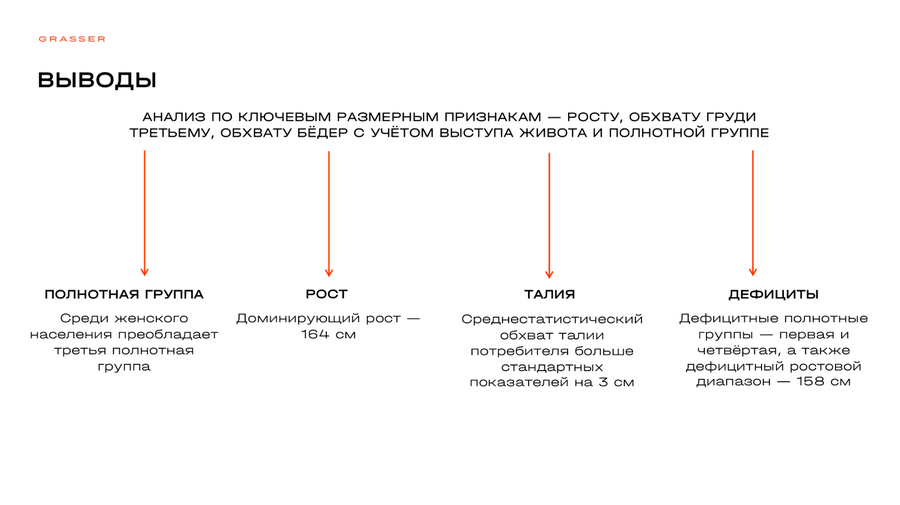

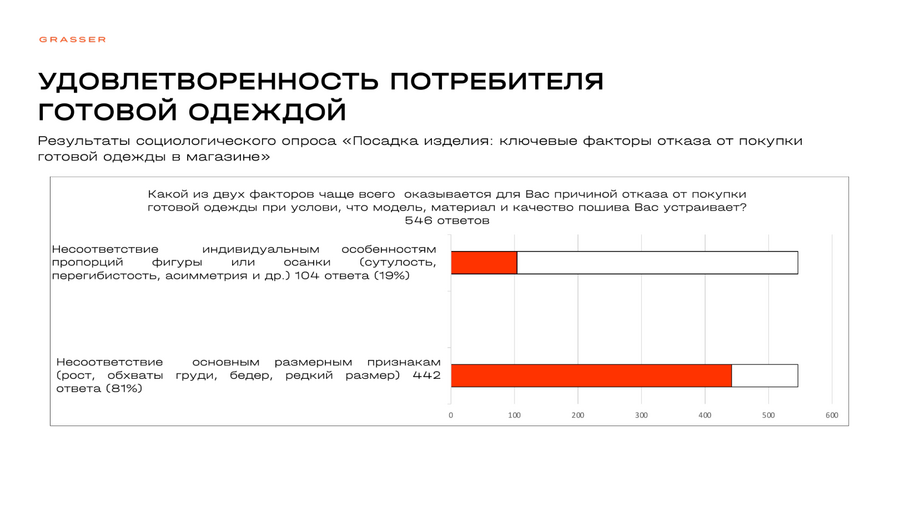
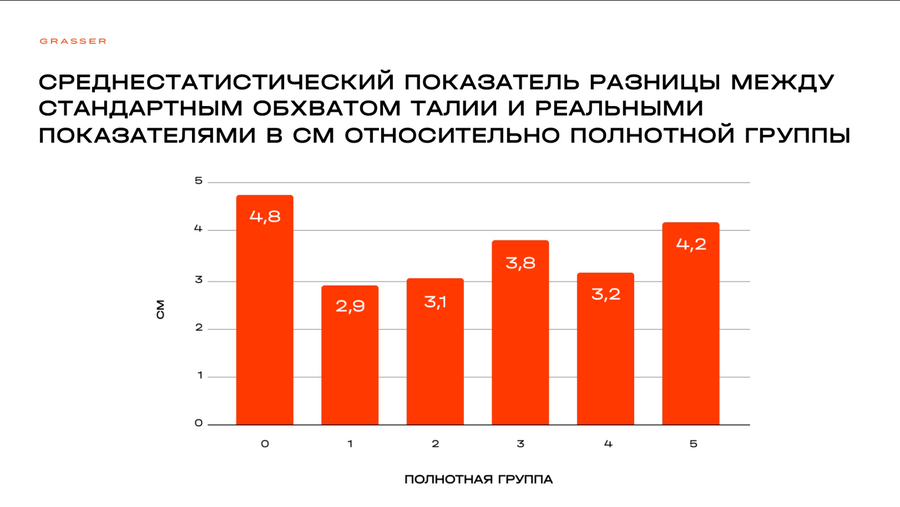
Olga Rodkina (Grasser) addressed the engineering aspects of customization and the challenges of industry patterns. She presented the findings of a large-scale study of female anthropometric parameters, based on a proprietary database of over 7,500 individuals. According to the measurements, the Russian industry faces standardization chaos: the 1972 GOST lacks full size groupings, the 1981 OST includes more accurate parameters due to a broad sample, and modern GOSTs lack practical sizing indicators. Consequently, most brands design collections around the second full size and a height of 170 cm, whereas among the actual growing population, the third full size grouping, an average height of 164 cm, and an increased waist circumference predominate.
«Mass customization is the ability to individualize a product on an industrial scale, and the Russian consumer primarily needs precise engineering fit, not design modification.»
Crisis Management Strategy, Risks, and Business Survival
The section on crisis management models and assortment strategy was moderated by **Nadezhda Sachek**, an expert in brand development, assortment strategy, and sales management.She emphasized that the current situation demands extreme sobriety from owners—a complete abandonment of illusions and an understanding that fashion no longer functions as a simple dopamine injection.Leaders must regularly measure their own resilience, critically assess their team’s real capabilities, and refrain from prematurely outsourcing managerial decisions to external consultants or unverified algorithms.
«A sound strategy in the current climate is, above all, a clear understanding of what a company absolutely should not do.»
Andrey Yakuntsev, CEO of Welltex, described the actual state of affairs in the B2B sector. He presented market analytics: of the cumulative revenue of 4 trillion rubles, approximately 2.5 trillion rubles of margin remains within the country, but more than 80% of the volume is still imported. The main danger within a company during a downturn is informational fog—leadership disorientation and focusing on P&L instead of controlling actual Cash Flow. Yakuntsev strongly recommended converting fixed costs into variable costs and continuously tracking the financial stability ratio.
«In a declining market, the situation is considered good if the actual gross revenue, excluding phantom shipments, exceeds the business’s operational needs by at least 10–15%.»
Alexey Kravtsov, founder of the 27-year-old brand Krakatau, shared his experience navigating prolonged crises. The brand underwent radical transformations—it closed its in-house experimental factory in favor of overseas contract manufacturing and completely abandoned fixed offices to reduce overhead. The brand’s current strategy is built on stringent commercialization: creative experimentation accounts for no more than 5% of the collection, materials and logistics are optimized, and scaling to international markets is aggressively pursued.
«Don’t be afraid to ruthlessly cut what is unnecessary. In a crisis, there should be no sacred cows—absolutely everything can be reviewed and optimized.»
Vladimir Yanushkevich, CEO of the Plan B brand, elaborated on the specifics of maintaining its own local production. The opening of the Moscow factory allowed the brand to become independent of third-party contractors, escape seasonal scheduling constraints, and quadruple its revenue since the end of 2023 while maintaining an average market profitability of 10–11%. Nevertheless, operating its own production facility carries the burden of fixed costs—including payroll, rent, and equipment depreciation—regardless of the season. Business sustainability relies on flexibility: the ability to scale up or contract quickly to a secure production core when necessary.
«Own production is simultaneously a reliable safety net and a heavy yoke that requires constant capacity utilization and continuous reinvestment of profit.»
Dasha Titova, co-founder of the Miditi brand, spoke about the transformation of their assortment strategy amidst a declining trend. Facing a 22% drop in turnover by the end of 2026, the brand has set a conservative organic growth target of 9,6% for 2027 through internal optimization.
Instead of proportionally cutting budgets, the company reallocated resources: they strengthened the design team to create more vibrant and memorable lines, presented a collection at Moscow Fashion Week, and focused on clearing inventory accumulated from excessive past-year production runs.
«Our optimization isn’t about drastic cuts; it’s about intelligent reallocation: we are rigorously removing inefficient scaffolding so we can invest in enhancing the product’s visual value.»
The analytical segment of the session was presented by Denis Simonov, co-founder of «Smart Fashion,» who introduced a structured map of risks and opportunities for the fashion sector through the end of 2027. The assessment was based on two rounds of anonymous expert panels covering 38 parameters. The most destructive factors in terms of impact strength were identified as the shortage of working capital and the freezing of liquidity in inventory. Among other high-probability threats, experts highlighted rising operating costs, narrowing of the average price segment, pressure from marketplaces, and dependence on currency exchange fluctuations.
«We assembled this map not to frighten businesses, but to provide guidance: today, profitability is facing simultaneous pressure from ten critical risk factors.»
Organizational Design, Competencies, and Digital Workforce
Natalia Bolmazova, founder of «Svoy HR» and career expert, brought forward the issues surrounding team transformation. She noted that the uncritical enthusiasm for artificial intelligence in recruiting has created a «robot battle»: neural networks generate irrelevant job descriptions, candidates respond with artificially embellished resumes, and genuine dialogue about competencies disappears. AI does not replace humans, but it sharpens the need for conscious architects of business processes—individuals capable of precisely decomposing tasks.
«Before delegating the process to a neural network, a leader must grasp its core mechanics firsthand; otherwise, we are simply praising technology where the fundamental managerial foundation is absent.»
Alina Tsutsu presented international practices for deploying agent systems using D2C brands in Singapore and Southeast Asia as a case study. According to first-quarter 2026 data, traffic from generative neural networks increased by over eight times, with a 49% higher conversion rate than organic traffic, and an average order value that was 14% higher.
Furthermore, over 55% of users go directly to the product page, bypassing the traditional brand awareness journey on the website. In this environment, the product page becomes a point of direct machine reading, requiring brands to develop a new competency—end-to-end management of product data integrity and distribution.
«Artificial intelligence, in and of itself, is empty—it is not a standalone skill but a powerful overlay atop your fundamental hard skills.»
Marketing Researcher Artem Borisov demonstrated the practical results of integrating specialized AI agents. He discussed the creation of autonomous digital assistants for estimation calculations and client sales. In a project for an international surfing instruction company, implementing an agent that operates 24/7 without language barriers reduced initial response time from 5 minutes to 5 seconds, shortened the deal closing cycle from 27 to 9 minutes, and boosted conversion rate from 24% to 35%.
«An agent is not some abstract AI magic; it is a structured engineering system that takes over routine tasks and saves businesses resources exponentially.»