Concept
Gothicism has remained one of the most enduring visual languages throughout European culture, associated with concepts of the sublime, the mysterious, the unsettling, and that which transcends the everyday norm. Originating in the Middle Ages as an artistic system linked to architecture, Christian symbolism, and particular emotional expressiveness, Gothicism gradually began to be perceived not just as a historical style, but as an autonomous symbolic code. Its visual characteristics—such as pointed arches, elongated silhouettes, the contrast of light and shadow, intricate ornamentation, and motifs of death and the mystical—eventually became integrated into literature, visual art, cinema, costume, and popular culture. Through these elements, Gothicism documented European culture’s evolving relationship with fear, physicality, otherness, and the aesthetics of the dark.
This visual study explores the transformation of Gothic aesthetics from the Middle Ages to the Gothic subculture of the 20th century. The work analyzes how medieval Gothicism, Gothic romance, Romantic culture, Victorian aesthetics, early horror cinema, and the music scene of the 1970s and 1980s shape different ways of depicting darkness, mystery, and the «other» person. Special attention is paid to how Gothic motifs migrate from architectural and religious settings into visual imagery, costume, makeup, accessories, stage photography, and subcultural identity. In this study, Gothicism is examined not as a separate historical style, but as a visual code through which different eras express their ideas about fear, beauty, death, inner drama, and the distance from ordinary daily life.
The key question of this work is to examine how the visual codes of medieval Gothic transformed into the foundation of Gothic subculture: from religious iconography, pointed forms, stained glass, somber symbolism, and the theme of death to black clothing, contrasting makeup, lace, leather, metal, theatrical silhouette, and the image of a person consciously separating themselves from the mass norm.
The study aims to demonstrate how Gothic transitioned in its visual and conceptual functions over time. In the Middle Ages, it was intertwined with religious experience, fear, salvation, and the representation of the supernatural world; in 19th-century Gothic literature and culture, it related to mystery, ruins, melancholy, death, and the romanticization of the somber; in 20th-century cinema, it manifested through images of the vampire, the monster, the dark castle, nocturnal spaces, and an atmosphere of anxiety; and in Gothic subculture, it encompasses costume, makeup, the music scene, the color black, religious and mourning symbols, alongside a deliberate visual expression of otherness. Consequently, this research will unveil the logic of the shift from medieval aesthetics of darkness to subcultural identity, as well as the ways in which Gothic became not merely a historical style but a resilient language of self-expression within visual culture.
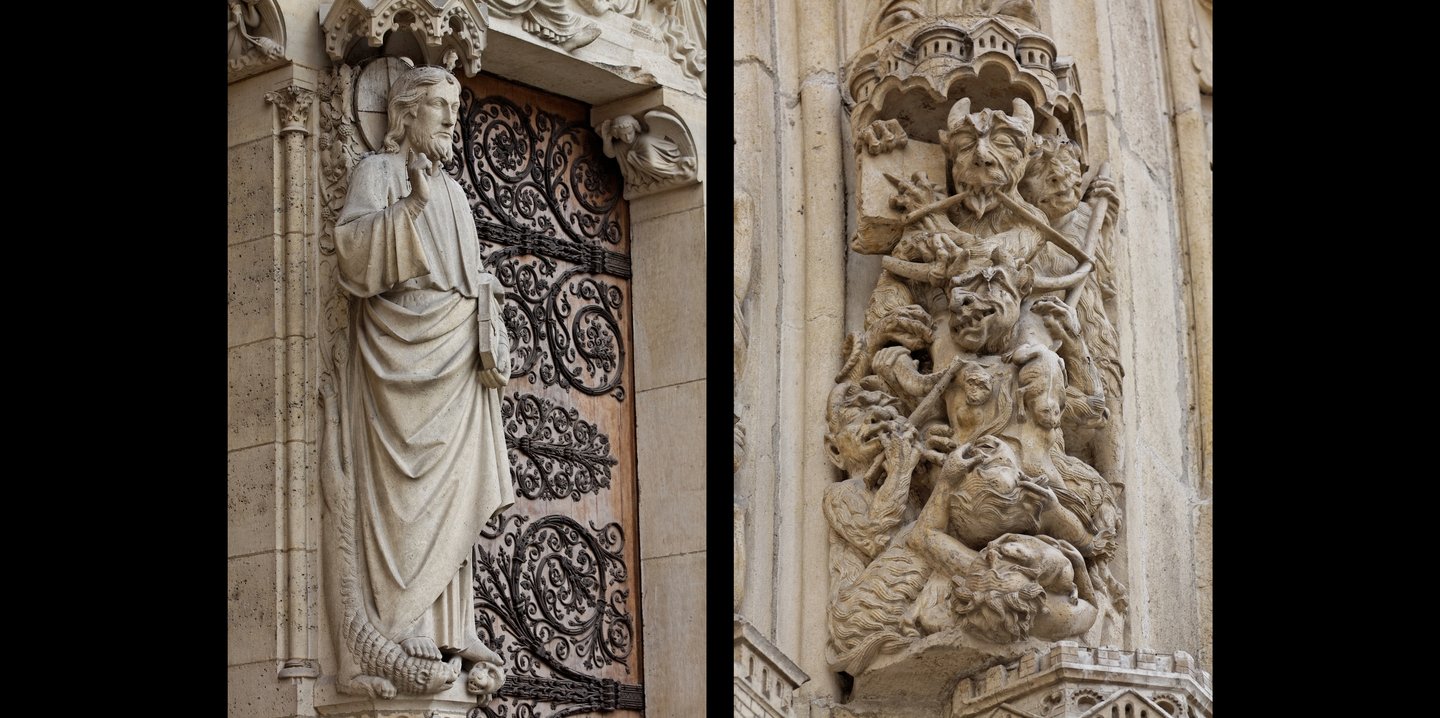
Notre-Dame de Paris, Portal of Judgment
The foundation of this research is built upon carefully curated visual materials related to Medieval Gothic, Romantic and Victorian culture, Gothic literature, cinema, and 20th–21st century musical subcultures. The selection principle is guided by three criteria: iconic representativeness—objects that most accurately embody the Gothic aesthetic of darkness, mystery, death, the supernatural, and otherness; visual expressiveness—the clear manifestation of silhouette, verticality, light and shadow contrast, texture, corporeality, decorative quality, and theatricality; and cultural significance—the object’s connection to a specific historical context in which Gothic evolved its function. In assembling the materials, I referenced Gothic cathedrals, portal reliefs, stained glass, depictions of chimeras and fantastic creatures, illustrations from Gothic novels, Neo-Gothic castles, Romantic depictions of ruins, Victorian mourning attire and commemorative ornamentation, spiritual photography, album covers, stage personas of Gothic bands, and films that shaped the recognizable visual lexicon of Gothic culture.
Notre-Dame de Paris, Last Judgment Portal
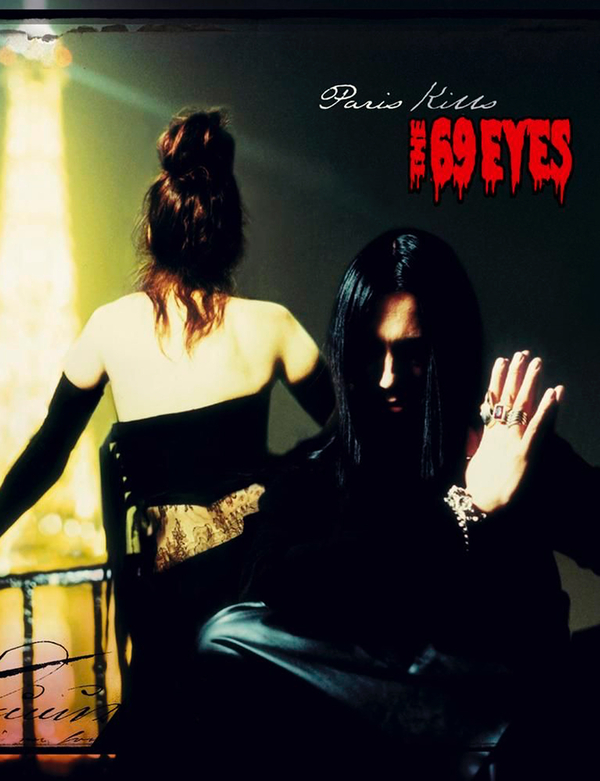
The research structure is organized around three sections, each detailing a distinct stage in the transformation of Gothic aesthetics—from a medieval artistic system to a subcultural visual code. The first section focuses on Medieval Gothic as a source of fundamental imagery and forms: it analyzes the Gothic cathedral as a space of the supernatural, pointed arches, rib vaults, stained-glass light, facade sculpture, gargoyles, scenes of the Last Judgment, and figures of saints and martyrs. Gothic is examined here as a visual system that connects religious experience, fear, beauty, physicality, and the sensation of another world’s presence. The second section concentrates on the 18th–19th-century culture, demonstrating how Gothic transcends the medieval church to become an archetype of a dark atmosphere. This is explored through Gothic novels and their illustrations, Neo-Gothic castles, romantic ruins, Victorian mourning, memorial adornments, spiritualist practices, and early representations of the vampire, ghost, and fateful woman. The third section addresses 20th–21st-century Gothic subculture, where historical and cultural Gothic motifs evolve into a personal visual identity. This section analyzes movements like Bauhaus, The Cure, The Sisters of Mercy, London After Midnight, and The 69 Eyes, as well as stage photography, album covers, iconic films such as Francis Ford Coppola’s Dracula, and the contemporary goth look—defined by black clothing, contrasting makeup, pallor, lace, leather, metal, crosses, chains, and funerary-religious symbolism.
As a result of this work, the viewer will see how Gothic maintains its recognizability while transforming its forms of existence—from the medieval cathedral and religious imagery to the novel, mourning culture, cinema, and subcultural style. The research will demonstrate how motifs of fear, death, mystery, and otherness transition across different visual media, gradually becoming the foundation for an independent language of self-expression.
Chapter 1
Medieval Gothic as a Source of Visual Code: Darkness, Verticality, and Religious Symbolism
Gothic architecture emerged in Europe in the mid-12th century and became one of the central artistic languages of the Middle Ages. At its core lies not only the new structural system of the cathedral but also a distinct approach to organizing visual impact: the verticality, the pointed arch, the ribbed vault, the stained-glass light, and the façade sculpture work together to create a feeling of intensely religious space. It is within this system that the images we later perceive as «Gothic» are formed—the dramatic contrast between light and shadow, motifs of death and salvation, figures of saints, martyrs, demons, and fantastical creatures.
St. Vitus Cathedral in Prague
Focusing on one of the key Gothic cathedrals, St. Vitus Cathedral in Prague, it is important to note that its facade is built upon the Gothic characteristic aspiration toward the heavens. Tall towers, pointed arches, acute detailing, and dense stone articulation give the building a sense of tension and upward momentum rather than static presence. Because of this, the cathedral is perceived not only as an architectural monument but also as an embodiment of a sacred space where grandeur, austerity, and somber expressiveness work in concert.
The Last Judgment Scene. St. Vitus Cathedral in Prague
On the south facade of St. Vitus Cathedral are the Golden Gates, which served as the ceremonial entrance to the church and were associated with the coronation processions of Bohemian kings. Above the triple pointed arch is a mosaic depicting the Last Judgment, executed by Venetian masters from numerous fragments of colored glass. Its golden background enhances the sense of solemnity, yet the composition itself is built upon the tense juxtaposition of salvation and doom.
At the center is Christ in glory, surrounded by angels and saints. Below, the scene of the final judgment unfolds: on the left, the righteous ascend toward the heavenly realm, while on the right, demonic figures lead the sinners into hell. This division makes the facade not merely decorative, but a semantic threshold: entering the cathedral is accompanied by a reminder of death, sin, salvation, and the highest judgment.
It is particularly significant that alongside the religious imagery, historical figures—Charles IV and his wife—appear here. They are included in the composition as supplicants, turning to Christ for the salvation of their souls. Because of this, the mosaic connects temporal power, Christian symbolism, and an eschatological narrative, transforming the entrance to the cathedral into a space of solemn, yet anxious, religious experience.
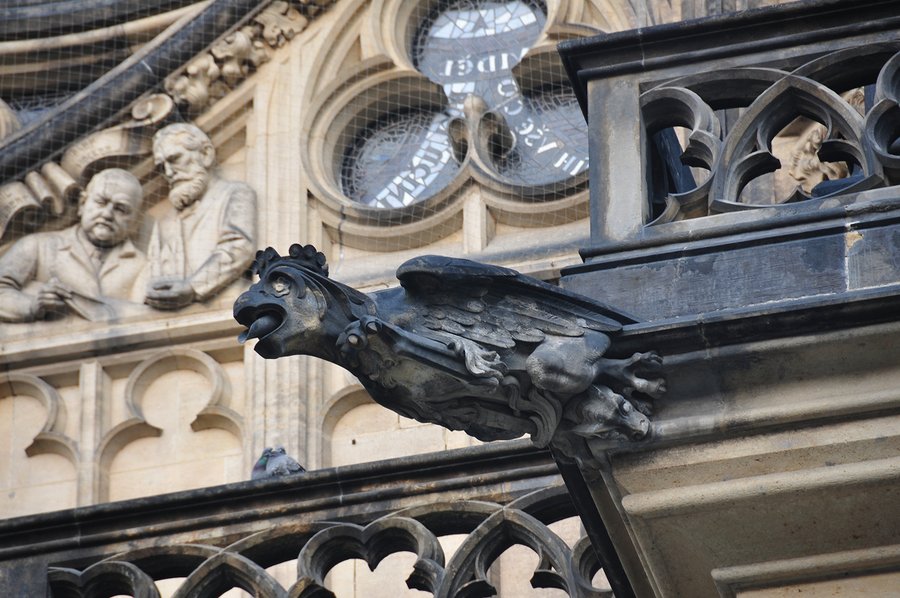
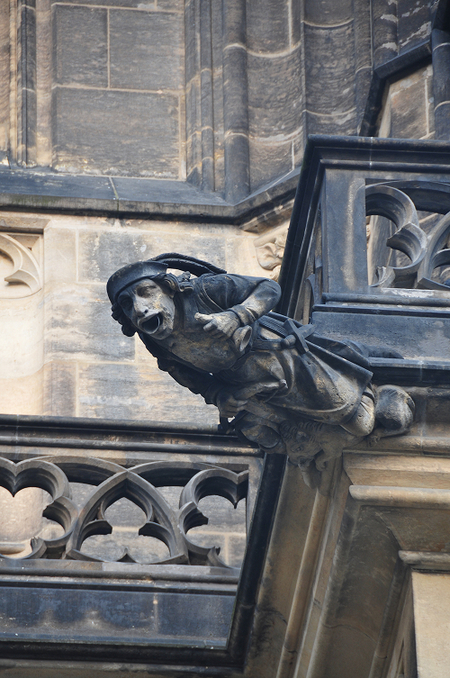
Gargoyles on the façade of St. Vitus Cathedral
One cannot fail to mention one of the most iconic Gothic symbols—the gargoyles—which in St. Vitus Cathedral become part of the overall image of dark and fantastical architecture. Their practical function was related to water drainage: the protruding stone figures diverted rainwater from the walls, protecting the facade from decay. However, in Gothic art, such a detail rarely remained a purely technical element; gargoyles were perceived as creatures on the boundary of the sanctuary—simultaneously frightening, guarding, and signifying the presence of the inhuman world.

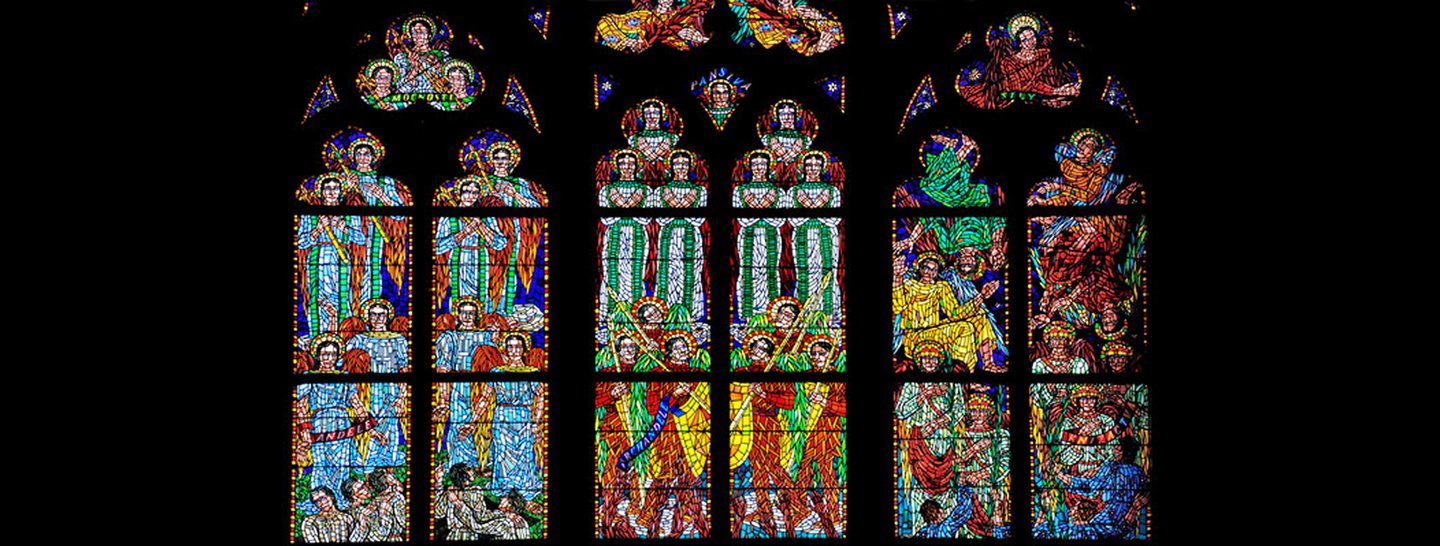
Stained Glass Windows in St. Vitus Cathedral
Stained Glass Windows in St. Vitus Cathedral
Stained glass windows play a crucial role inside the cathedral: they not only illuminate the space but also define its symbolic rhythm. The majority of the stained glass in St. Vitus Cathedral was created between 1925 and 1939 based on designs by Czech artists, including Alphonse Mucha, Max Schwabinsky, František Kisel, Karel Svobinský, and Cyril Bouda. Even though they are later additions, these windows sustain the Gothic idea of the cathedral as a space where light becomes part of the religious iconography.
Alphonse Mucha’s stained glass, installed in the north nave in 1931, is the most famous. At the center of the composition are the young saints Wenceslas and Ludmila, surrounded by scenes from the life of Cyril and Methodius, related to the spread of Christianity among the Slavs. This stained glass is important not merely as a decorative element; it unites Christian subject matter, national memory, and a soft, almost pictorial color palette, allowing the Gothic space to receive a later, Modernist interpretation.
Alphonse Mucha’s Stained Glass Window in St. Vitus Cathedral
Cologne Cathedral of Saint Peter and Mary
Cologne Cathedral of Saint Peter and Mary
The Cologne Cathedral is also counted among the most expressive examples of German Gothic architecture. Construction began in the 13th century, but the cathedral was only finally completed in the 19th century, making it an important monument not only to medieval tradition but also to the later resurgence of interest in Gothic as a national and historical style.
The visual image of the cathedral is built upon extreme verticality: two tall towers, sharp spires, a dense system of arches, buttresses, and stone carving create a sense of almost excessive formal tension. Unlike the lighter French cathedrals, the Cologne Cathedral is perceived as heavier and gloomier—its facade does not so much reveal itself to the viewer as it overwhelms them with its scale, height, and the complexity of its stone structure.
Cologne Cathedral of St. Peter and Mary
On the facade of the Cologne Cathedral, sculpture plays a role no less significant than the architecture itself. The entrance portals are filled with figures of saints, apostles, prophets, and biblical characters, causing the facade to be perceived as an unfolding religious program. Three portals on the western facade are particularly significant: the Portal of the Three Kings, the main portal, and St. Peter’s Portal; among these, only St. Peter’s Portal maintains a connection to the medieval sculptural tradition, as a substantial portion of the facade’s plasticity was executed in the 19th century by sculptors Christian Mor and Peter Fuchs.
These figures do not merely decorate the building; they establish a distinct boundary between the external world and the space of the sanctuary. The saints and prophets stand in niches and on the portals as participants in the sacred order: their elongated forms, rigid poses, and tight integration into the architecture enhance the vertical rhythm of the facade. Unlike gargoyles and grotesques, which relate to the fantastic and liminal, the figures of saints denote the side of ecclesiastical hierarchy, protection, and spiritual authority.

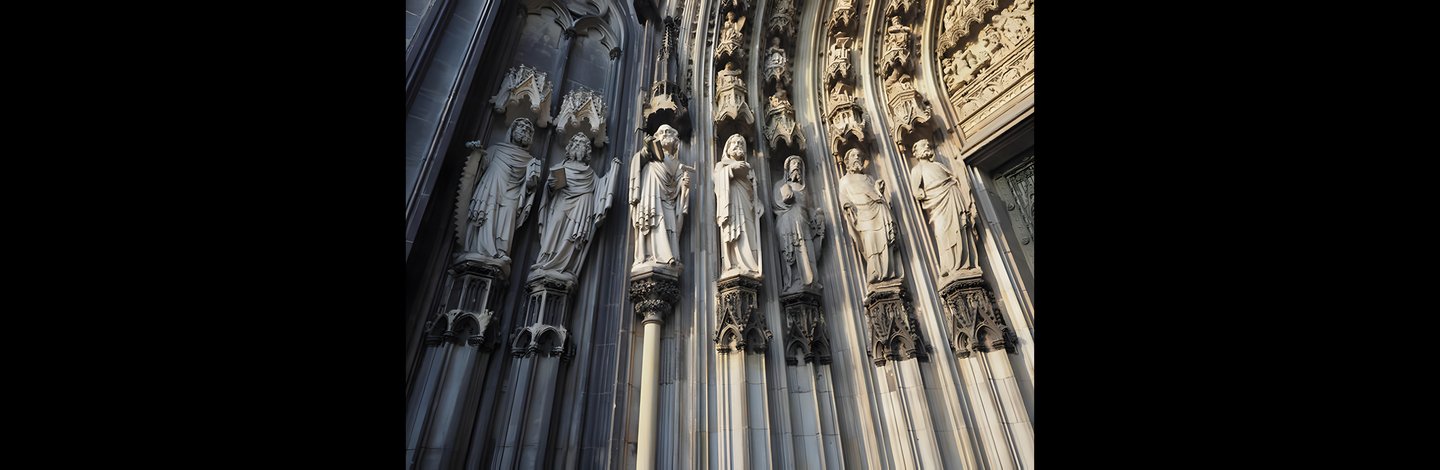
Cologne Cathedral Gargoyles
Reims Cathedral of Notre-Dame
General view of the cathedral’s upper section from the northeast
The Reims Cathedral, Notre Dame, offers an alternative vision of the Gothic facade. Unlike the Cathedral of Saint Vitus or the Cologne Cathedral, where the image is largely built upon sharp spires and intense vertical aspiration, the west facade of Reims appears broader, more solemn, and richly sculptural. The two towers here do not culminate in sharp peaks; their upper sections remain more open and planar, making the facade read less as a soaring silhouette and more as an unfolded stone stage.
Construction on the Reims Cathedral began in the 13th century, and it held particular significance as the place where French kings were crowned. This function is evident in the building’s visual character: the facade functions as a symbol of ecclesiastical and state grandeur. Its primary expressiveness is linked not only to the architectural form but also to the abundance of sculpture—the portals, niches, archivolts, and galleries are filled with figures of saints, angels, prophets, and biblical characters.