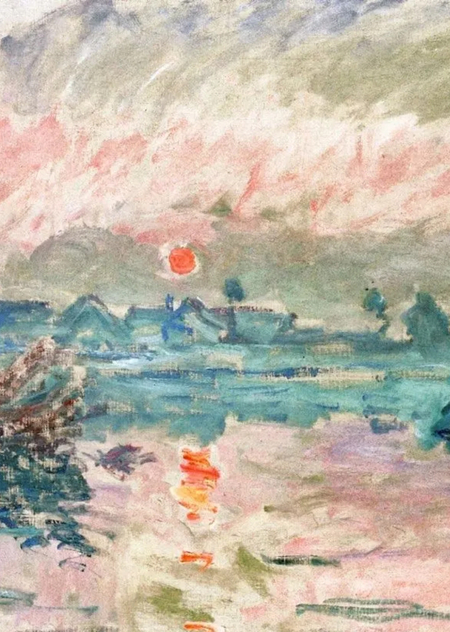
During the training process for the Stable Diffusion model, works by Claude Monet, which are in the public domain, were utilized. The materials were sourced from Artchive.ru, where they are available for non-commercial use, as well as from platforms offering the CC0 license.
Concept:
When selecting materials to train the model, I wanted to explore the potential of AI in emulating the artistic style of an established master. I chose Claude Monet, the great French Impressionist, whose style—built upon a delicate interplay of light and air—is utterly unique and instantly recognizable. Can an AI model grasp these elusive nuances—the vibration of the brushstroke, the color refractions, the very atmosphere of the «fleeting moment”—and then apply them when generating new images?
The subject of my research and generation was flowers and the water surface—the artist’s obsession that became the core of his later work. In the flowers and the reflections on the water, I was drawn to the elusive variability of nature, the way light plays at different times of day, blooming as a symbol of life’s infinite cycle, as well as the intimate, secluded beauty he created in his own garden at Giverny.
Among scholars of Monet’s work, there is a view that in his later years, he painted less about the water lilies themselves and more about the light dancing on the water’s surface—as if trying to capture not the form, but the very breath of nature. It seems to me that it is precisely this aspiration to convey not the object, but the feeling of it, that makes Monet’s style so vibrant and resonant with contemporary experiments in artificial intelligence: for both AI and the great Impressionist, in a sense, are learning to see the world not as we know it, but as we feel it.
Claude Monet’s Artistic Style and Dataset
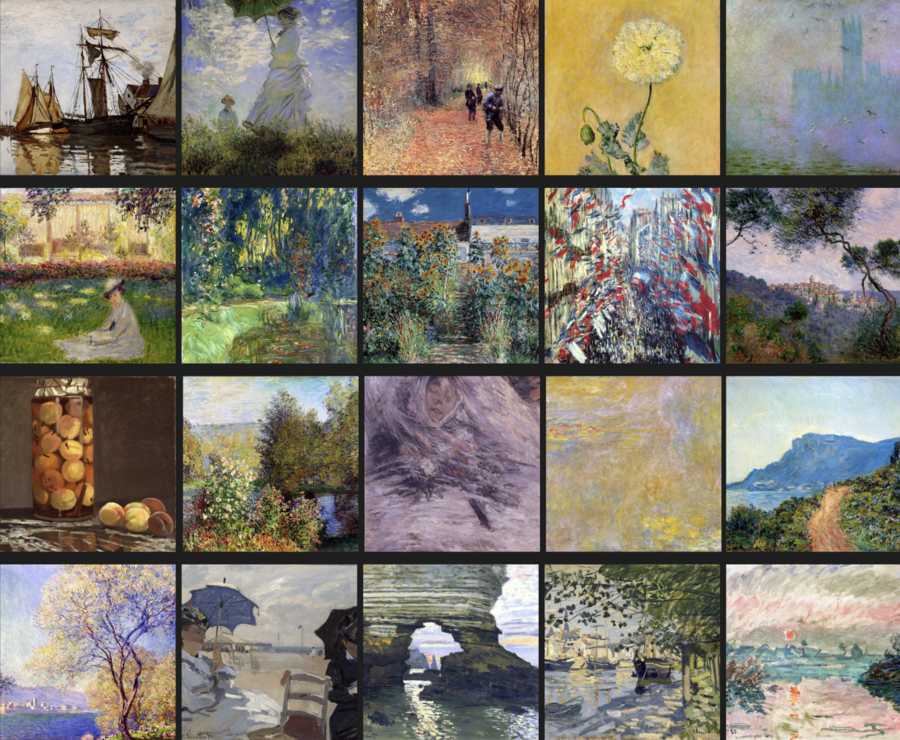
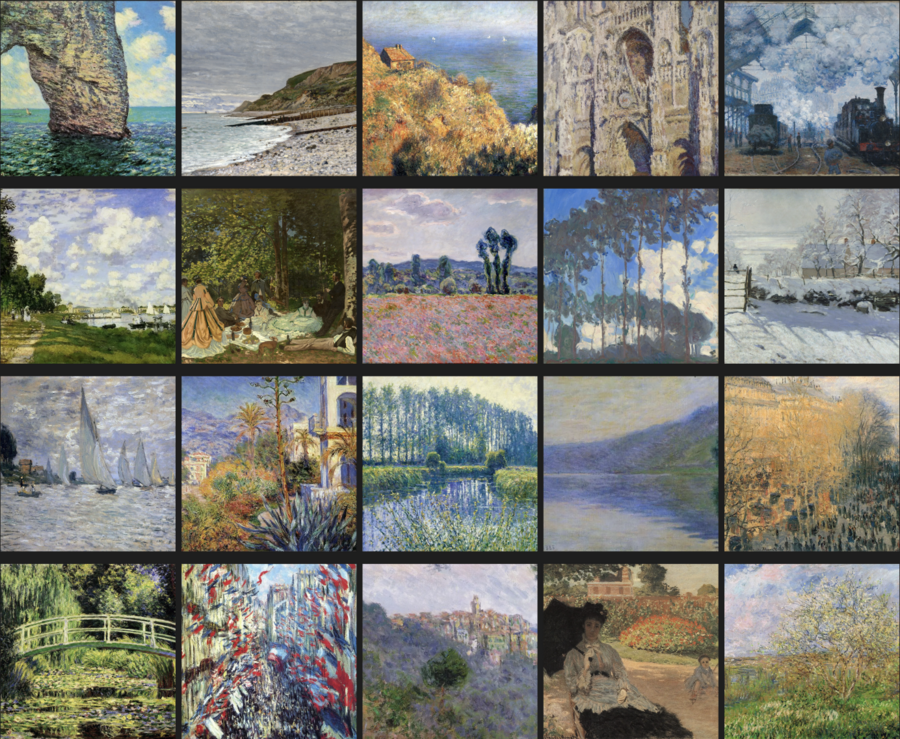
Claude Monet’s distinctive brushwork, when viewed through the lens of this project, caught my interest due to its potential for ideal compatibility with generative AI.
The flowers Monet painted are soft, tremulous interweavings of separate brushstrokes that create the illusion of light and air vibrating. For a model trained on the artist’s technique, sharp contours are not as critical as they might be when compared to conventional photorealistic models—quite the opposite. Rather, this very «blurriness, ” this effect of an elusive moment, becomes the primary objective for reproduction.
The resulting dataset comprises 40 images. These include fragments of paintings featuring water lilies, poppy fields, and meadows, as well as other works from the artist’s later period, all intended to give the model a scenario to work with regarding shifting light, water surfaces, and atmosphere.
Model Learning Code and Process
Google Colab served as the learning environment—due to its ease of use with the dataset and accessibility, unlike Kaggle, where verification for users in the Russian Federation is currently unavailable.
Before starting the main part, I prepared the environment: I imported the necessary libraries and scripts and checked the availability of a GPU.
After preparing the dataset, I uploaded it to the Google Colab runtime. The final dataset was placed in the ClaudeMonet directory.
After uploading the dataset, I checked its integrity and the correctness of its display. Using the preview, I brought up a tile on the screen featuring five images included in the dataset.
Using BLIP, unique descriptions were created for every image. The intermediate options seemed insufficient, but the training results showed otherwise. A prompt and prefix, «photo collage in ClaudeMonet style, ” were also assigned, which is subsequently used for stylistic tagging during the training and generation process.
Result: