Concept
Claude Monet is one of the most renowned Impressionist painters. The brushstrokes in his paintings appear so light, as if the paint has not yet dried, and a sudden gust of wind could scatter the flower petals at any moment. It is this feeling of lightness, vitality, and tremulous energy that makes Monet instantly recognizable.
However, his body of work does not feature much variation across the seasons. Most of his landscapes depict the warmer times of year, such as summer or early fall.
In my project, I decided to use AI tools to create a small series of images exploring how other seasons might look in the style of Monet.
Workflow
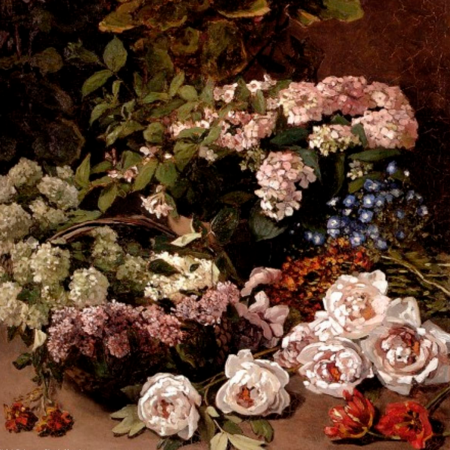
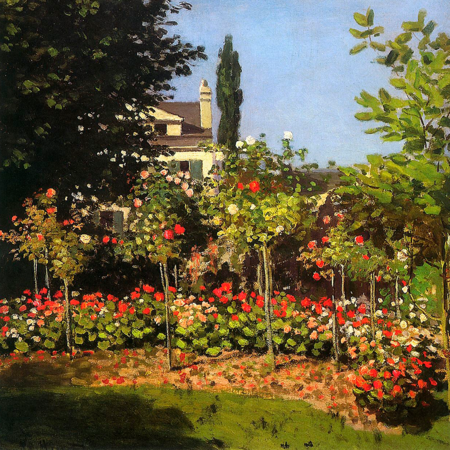
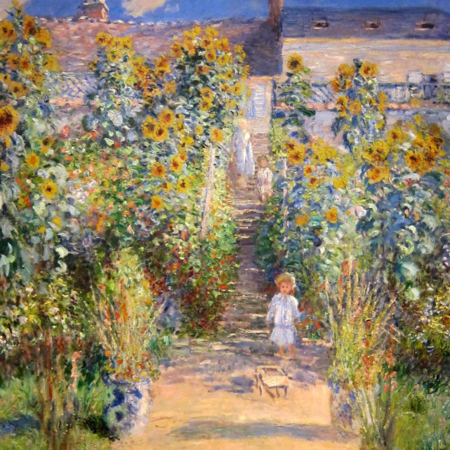
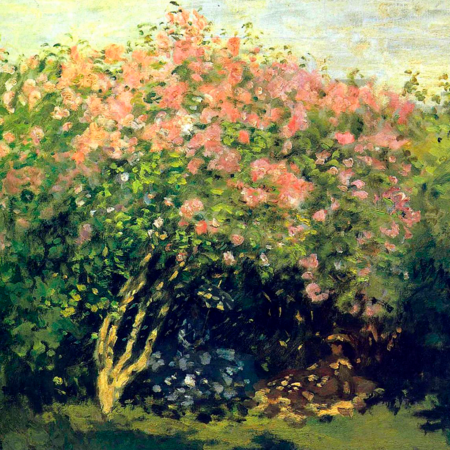
For training the model, I selected 16 reproductions of Claude Monet’s landscapes from open sources. All these images were resized to a square format. The work was conducted in the Google Colab environment.
During the process, several technical difficulties arose, which required me to use other neural networks (DeepSeek and ChatGPT) to find answers to questions. Ultimately, I managed to create a LoRA model suitable for solving the posed task.
Spring
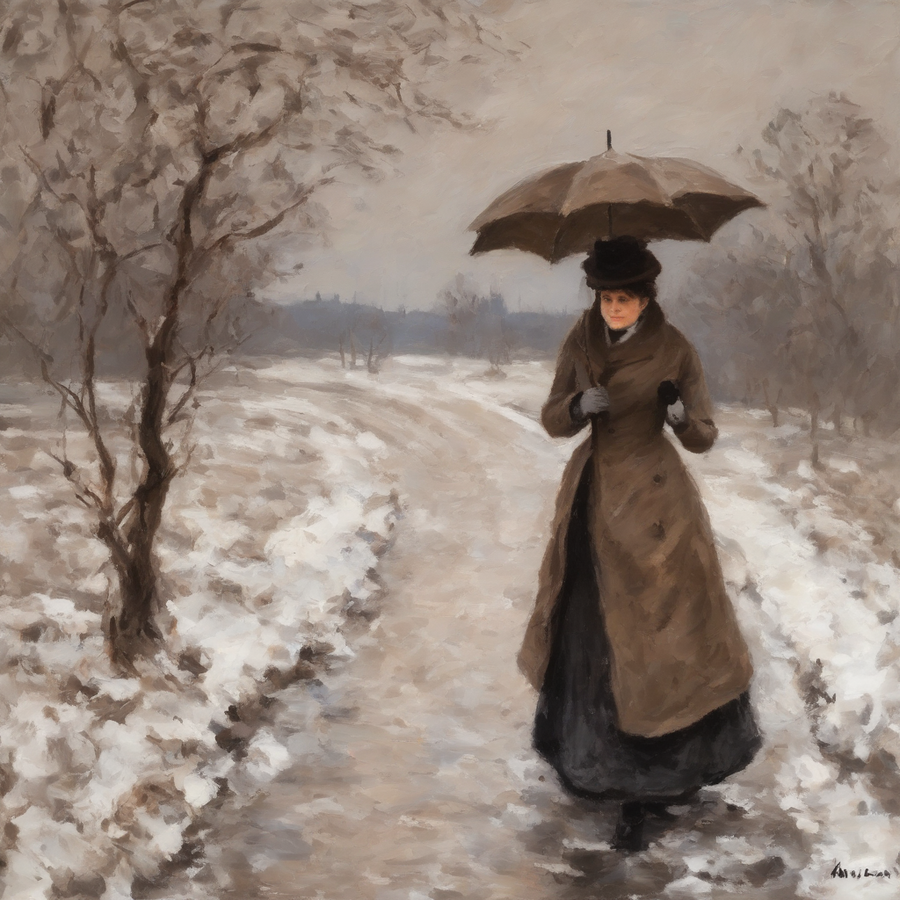
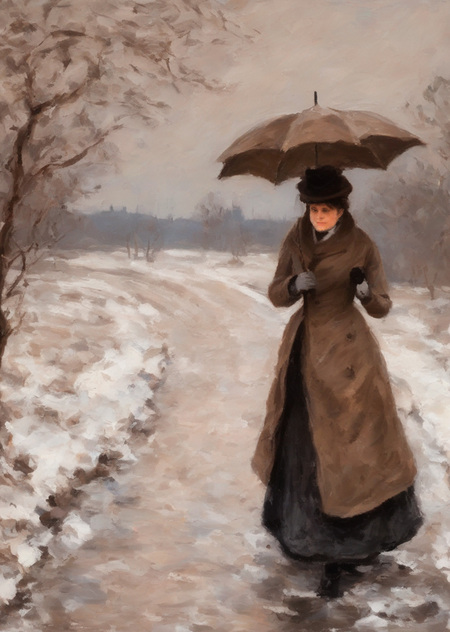
Prompt: monetgarden, woman in victorian coat, late winter, melting snow patches, bare branches, wet brown earth, cold grey sky, subtle pale lightI was curious to see how AI would handle a human subject, specifically a lady dressed in attire characteristic of the Impressionist era. I wanted to test whether the model could maintain both the style and the detail. It didn’t work on the first try—the model stubbornly drew the lady in a summer dress. I had to rewrite the prompt several times until I explicitly typed, «woman in victorian coat.» It became clear that the model doesn’t grasp contextual logic.
Prompt: monetgarden, wild overgrown garden in early spring, thawing snow patches, small streams of melting water running between grass, bare branches with first buds, soft morning lightI wanted to test if the model could capture that characteristic lightness of Monet using the example of awakening nature. It seemed that spring, with its streams and melting snow, was the perfect context for this task. The style the model chose was surprisingly successful, resulting in something very similar to Monet’s «House Among the Roses, ” which was a pleasure. It captured the atmosphere well: the brushstrokes were airy, vivid, and bright, conveying a sense of springtime light and the movement of water. However, it again leaned too heavily into a summer mood. For early spring, when the snow is just beginning to thaw, the patches of green look excessively bright. This second piece in a row demonstrates the same issue: the model struggles to sense seasonal nuances.
Prompt: monetgarden, japanese bridge over lily pond, thunderstorm, lightning flash, pouring rain, churning water, dramatic dark sky, purple and grey tonesI wanted to see if the model could capture the rain itself and the weight of the thunderstorm—the dynamism, the tension, the wind, the heavy sky. But I can’t call any of my attempts successful. I made many tries, but it never grasped the essence. I specifically studied how real artists depicted thunderstorms, and what the AI produced doesn’t even come close. The painting is static. But a thunderstorm is fundamentally about movement: wind breaking branches, heavy clouds, nearly black water. The model lacks all of that. The branches aren’t moving; the water is just half a tone grayer than Monet usually paints, and the rain is merely decorative. For me, this became the most telling failure. The model has learned well how Monet’s landscape looks in its calm, sunny state, but it fails outside of that familiar style.
Summer
Prompt: monetgarden, dusty country road through dried fields, blazing noon sun, burnt grass on both sides, shimmering heat waves above the road, faded colors, oppressive stillnessI wanted to test whether the model could convey a different quality of grass—not lush and green, but scorched, sun-baked. The style worked again: the brushstrokes rendered well, and it became clear that the model confidently understood how impressionistic texture should look. However, it didn’t succeed with the specific task. The model likely tried to convey the heat through an abundance of yellow and reddish tones, and the result was that the dried grass turned into a wheat field. I concluded that the model takes the easiest route when solving a problem—in this case, it needed to convey the heat, so it simply flooded the frame with warm colors.
Prompt: monetgarden, summer field of wild grasses after a thunderstorm,
grey heavy clouds breaking apart, pale sunlight piercing through, vivid rainbow arching over the field, light drizzle still falling, dull dusty grass slowly catching light, wet air, glowing raindrops, contrast between grey sky and bright rainbowThe goal was to see how the model handles contrast. The idea was: a grey, at times almost black sky, cut by rays of sunlight, and a rainbow gleaming in that sky. Therefore, the emphasis should have been on the transition and the dramatic contrast. The rainbow turned out natural—perhaps even too natural. It looks plausible, precise, and meticulous. And that is what kills the entire effect. Everything is in place, everything is correct, but nothing is happening. Here again is the same problem as with the thunderstorm: the model simply arranges objects in space but fails to create an event. To achieve a perfect result, you have to articulate every detail; otherwise, the model won’t understand.
Prompt: monetgarden, lily pond at night, moonlit path across still water, bridge silhouette, deep blue and silver tonesThere wasn’t a specific task here; I was simply curious how the model would render a different time of day. The result is decent, average. The model fulfilled the technical brief point by point, so there are no complaints. However, as I suspected, the work lacks any sense of mood or strong concept.
Fall
Prompt: monetgarden, fruit orchard in autumn storm, tornado of golden and red leaves, trees almost horizontal, rows dissolving into chaos, dramatic sky, swirling brushstrokesI wanted a storm of leaves—leaves flying, swirling, breaking the carefully measured geometry of the orchard. In other words, dynamics versus order. The final image is indeed vibrant and autumnal. But it’s still too composed—this time, the composition itself is too balanced. The trees are indeed lined up, and the model succeeded there. But the leaves, instead of swirling, are just lying under those same trees. It looks like there’s no wind at all—just autumn, falling leaves, everything peaceful. Conclusion: the model was trained on static Monet landscapes and cannot move beyond that.
Prompt: monetgarden, narrow autumn street after rain, wet cobblestone,
shop windows glowing, reflections in puddles,
umbrellas, warm and cool tonesThere was a conscious experiment here: I did not provide the model with city images during training, and I was interested to see how it would handle something it had never seen. The style, as always, is fine. Puddles reflect both people and the light from the windows. There are buildings, there are people, there are umbrellas. So, superficially, the task is accomplished: it’s a city, it’s autumn, it’s Monet. But upon closer inspection, problems in the street composition are visible. The sidewalks are unnaturally narrow, the umbrellas are suspended in the air, and the buildings are crooked. The perspective breaks down, and the proportions are unstable. It’s pointless to blame the model for this because I myself gave it the instruction without training it to draw a city. The conclusion is this: if you want the model to generate something specific and highly targeted, it absolutely needs examples, and preferably many. But here is the paradox: neural networks are often used precisely when there are no references, so that they can create them themselves.