Concept
This research focuses on a comparative visual and stylistic analysis of sculptural depictions of the Buddha from Gandhara and Mathura during the Kushan period (1st–3rd centuries CE, with a primary focus on the 2nd century). Although both traditions emerged almost simultaneously within the same empire, they created fundamentally different portrayals of the Enlightened One. The analysis is conducted across four parameters: historical context, material and technique, stylistic characteristics, iconography, and symbolism.
Hypothesis
In the 2nd century CE, the Gandharan and Mathuran schools of sculpture created fundamentally different depictions of the Buddha—not because one was under «foreign» influence while the other was under «indigenous Indian» influence, but because each school was solving different visual problems within the context of the unified Kushan Empire. Furthermore, in the second half of the 2nd century, neither school remained isolated: traces of their interaction should be evident in the changes to iconographic details (garment rendering, body proportions, hair modeling) across artifacts of both traditions.
Historical Context of Art Schools.
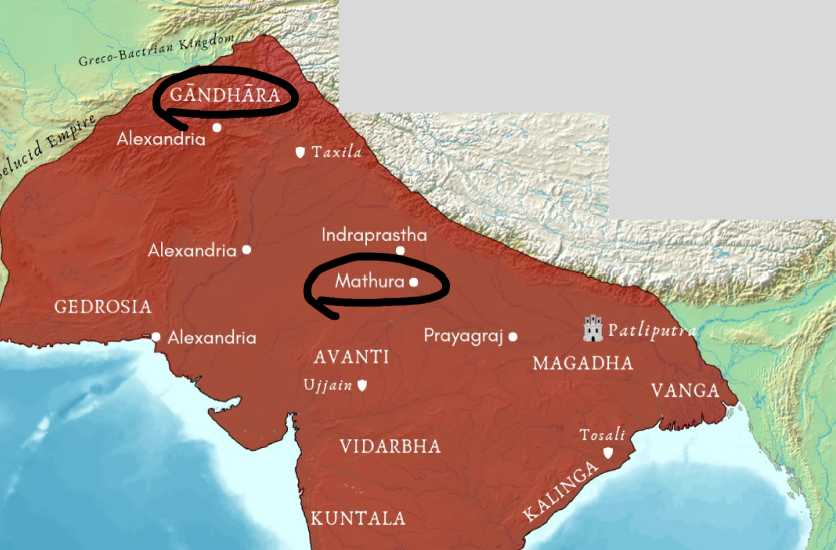
Gandhara is the ancient name for the region around the city of Peshawar in northern Pakistan. Buddhism was the predominant culture of Gandhara. The term «Gandhara» is used by Indo-linguists to describe sculptural finds not only around Peshawar but also outside the region, including the Swat Valley, the Buner and Taxila areas, eastern Afghanistan, and parts of Kashmir. This entire territory is commonly referred to as «Greater Gandhara.» Mathura, an ancient city revered in Brahmanic and Jain traditions, was an important administrative and religious center. Masters from Mathura created images of the Buddha, Jain Tirthankaras, Hindu deities (such as Vishnu and Shiva), as well as numerous female figures and secular representations. This is quite different from Gandhara. It does not focus exclusively on the Buddha and Buddhist imagery. The primary focus is on other religious and spiritual categories.
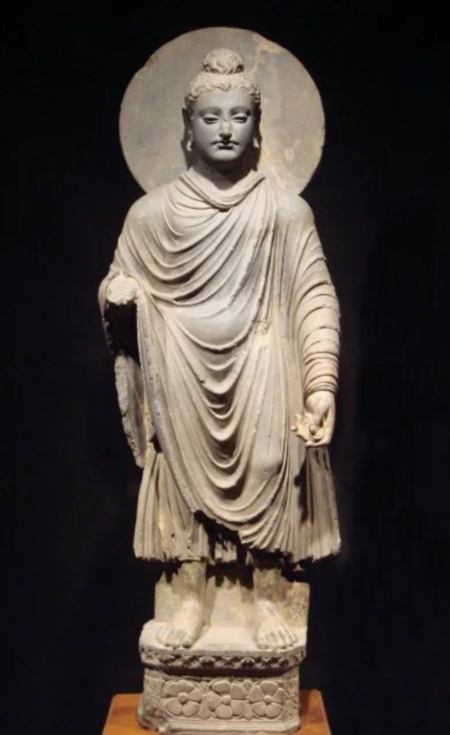
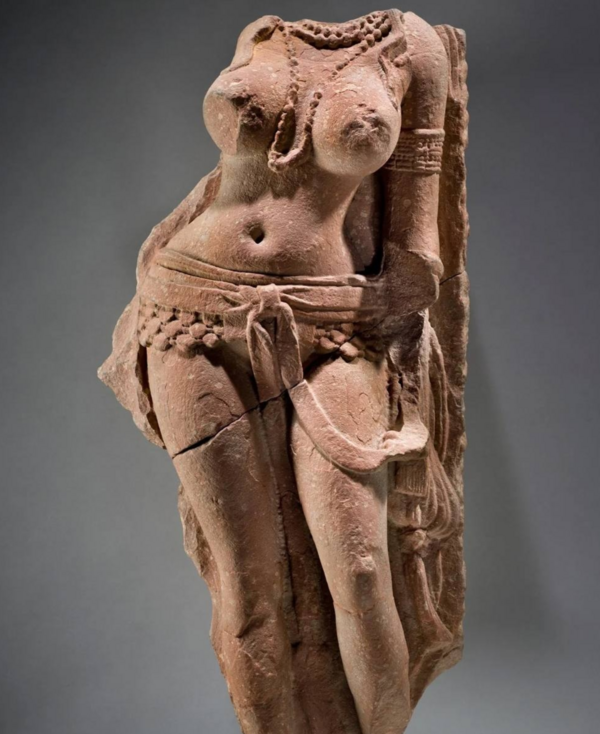
1. Buddha—Maitreya. 2nd Century CE. Gandhara. 2.Sculpture of a woman, likely a Yakshi (nature spirit). Mathura, circa 200 CE.
Mathura School of Art originated in the cultural heartland of the Indian subcontinent. Unlike Gandhara, the artistic roots of Mathura were deeply indigenous: it drew inspiration from the figures of yakshas and yakshinis, known even before the Mauryan period, and developed throughout the Mauryan and Shunga periods. During the Kushan rule, around the 1st century CE, Mathura experienced a significant artistic flourishing. Within this school, a unique style emerged that placed special emphasis on the local cultural concepts of beauty, tranquility, and divine presence—a style that laid the foundation for the visual language characteristic of the later Gupta era.
Materials and Techniques.
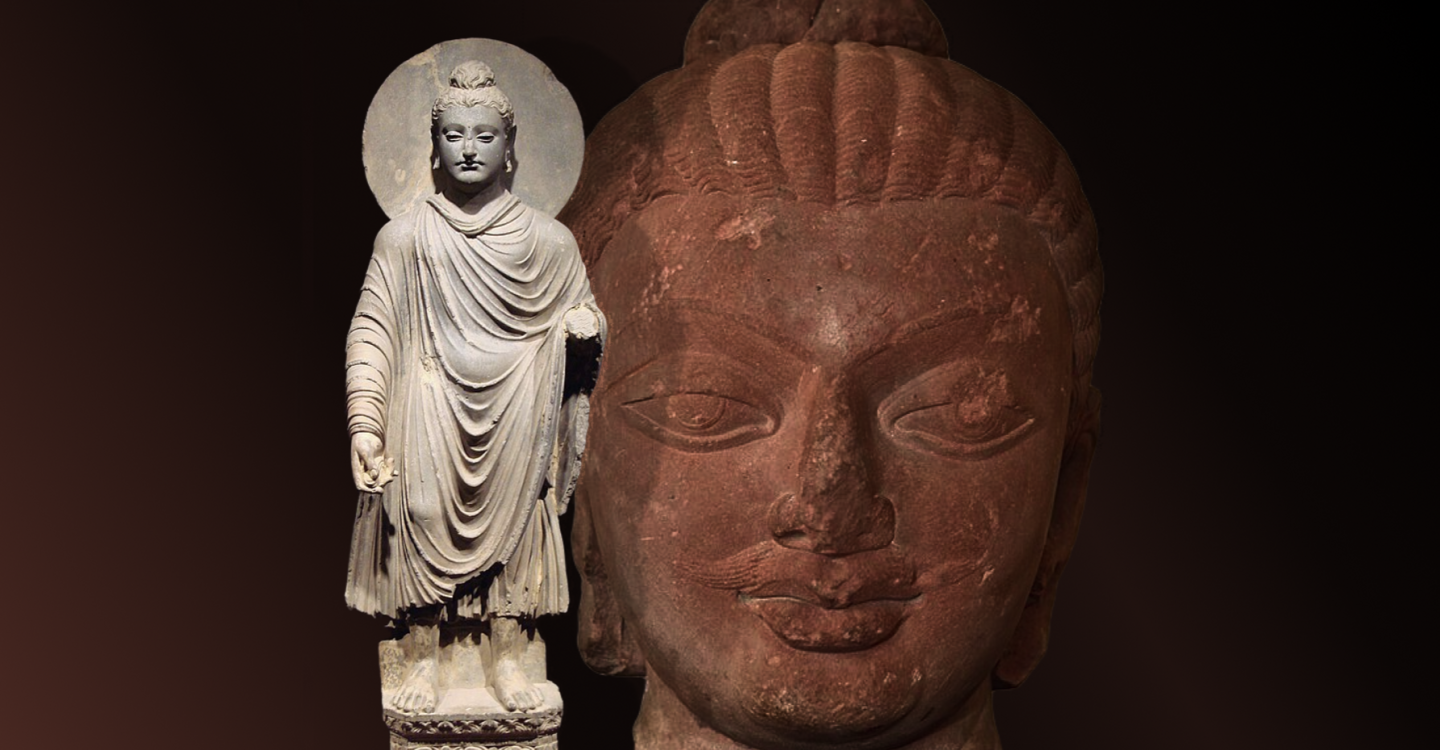
Mathur craftsmen primarily used sandstone with red inclusions—known locally as «Sikri sandstone”—which was mined in the Vindhyan Mountains. This relatively soft stone was ideal for creating symmetrical, flowing forms and lent the sculptures a characteristic reddish glow. In Gandhara, sculptures were executed in yellow sandstone, exhibited anthropological similarities to statues of Apollo (a straight Greek nose, deep-set eye sockets, wavy hair), and the drapery of the toga-like garments featured delicate folds. Occasionally, the characters' appearance was augmented with a halo and a mustache.
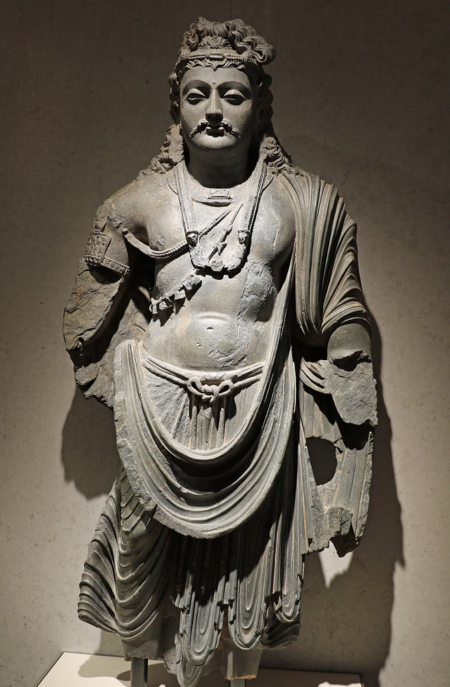
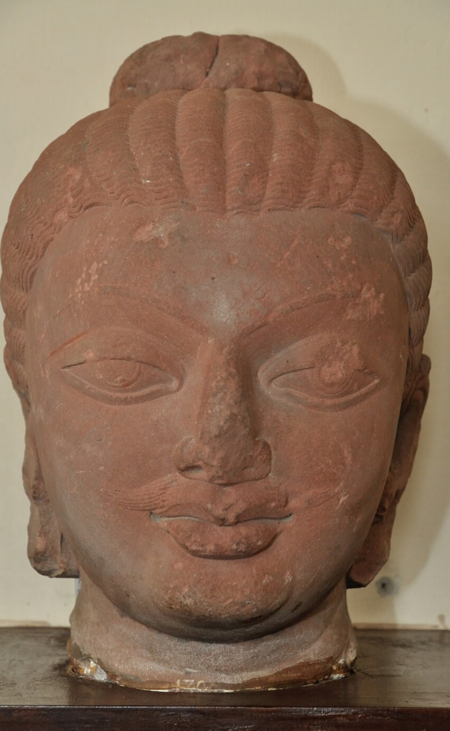
Mathura sculptures convey something primordial. They do not rely on minute details and realism, as is evident in Gandharan architecture. More emphasis is placed on facial expression and emotion in a typically Indian style. The freestanding forms are another characteristic feature of the Mathura artistic school. Mathura sculptures featured smoother contours and architectural framing compared to the works of Gandhara. The carving process often began with general outlines, followed by the detailing of facial features, adornments, and mudras. A significant characteristic of Mathura sculpture is the meticulous polishing of surfaces, which resonates with earlier traditions of the Mauryan period. This polishing lent the sculptures a spiritual aura and emphasized their divine energy («tejas»). On the other hand, we can see anthropomorphic depictions of the Buddha in the art of the Gandharan school. Musculature is softened and acquires the purity of an abstract, animate surface. The drapery becomes equally abstract—it thins out and merges with the body. All surfaces undergo careful polishing.
Stylistic Features.
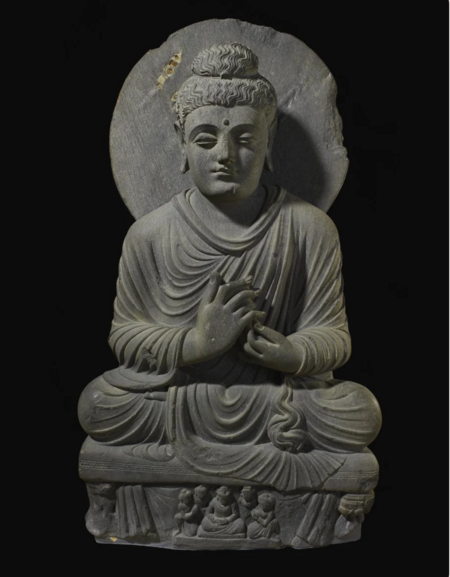
In the Mathura style, a distinctive language evolved where symbolic expressiveness and idealized form took precedence over naturalistic realism. Unlike the realistic depictions found in Gandhara, the Mathura style is more iconographic and spiritual. The Buddha is usually depicted with a bare chest, clad only in semi-transparent lower garments tied with a belt, which symbolizes detachment and asceticism. He possesses robust, frontal, and often symmetrical forms, along with the extensive use of mudras and iconographic elements. Furthermore, there is a serene face with a calm smile and wide-open eyes, contrasting with Gandharan art, where we often see closed eyes on many Buddha sculptures. The work of thought and spirit is emphasized by the energy of the gestures of the hands (hasta) and fingers (mudra), set against the overall stillness of the figure. The five most common mudras are: the gesture of reassurance («come to me without fear»)—the right hand is bent, with the palm and vertically positioned fingers extended toward the viewer; the posture of knowing the truth—palms turned upward rest one upon the other; the vow to the Earth («touching the Earth»)—when Mara tempted the Buddha, he called the Earth as a witness by touching it with the fingers of his right hand; the proclamation of the teaching «Wheel of Law”—the index and thumb of the right hand are bent in a circle, touching the middle finger of the left; and the bestowal of compassion—the left hand is lowered with an open palm extended forward.
Iconography and Symbolism.
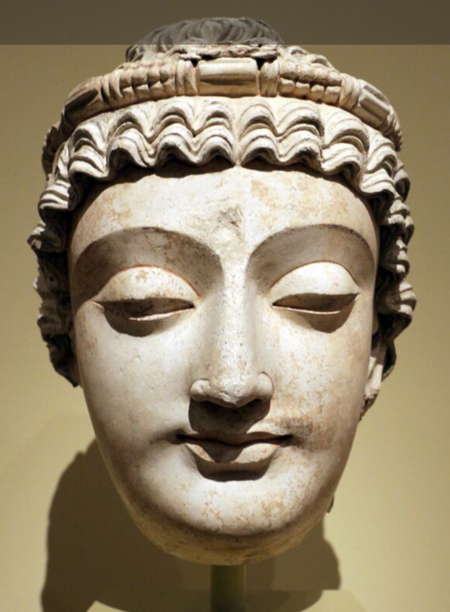
In the iconography of Mathura, the emphasis is placed on spiritual essence rather than physical realism. The depictions of the Buddha feature a characteristic Indian physiognomy: spiral curls resembling a snail shell, an expressive ushnisha (a traditional Indian hairstyle), and a gentle smile. The eyes are typically wide and serene, suggesting meditative concentration. Mathura iconography also incorporates symbols such as the lotus seat, the lion throne, the wheel (chakra), and the tree—an entire system of «identifying signs» unique to Buddha imagery that symbolizes his state of enlightenment. Most often, the Buddha is depicted seated in the pose of all ascetics—the lotus posture. A dot located between the eyebrows (urna) signifies the highest level of enlightenment. The cranial protuberance (ushnisha)—a symbol of attaining Nirvana—is covered by a tuft of hair. The earlobes are elongated, and a lotus is depicted on the soles of the feet, either within a circle or a square. The hair is arranged in neat rows of circular curls. Thus, the image of the Buddha transforms from a representation of a real person, as it was initially conceived, into an expression of mystical and philosophical ideas embodied in a divine figure.
Conclusion.
Gandhara gave the Buddhist image a realistic, universally accessible language and narrative. Mathura provided the strength, frontality, and connection to the Indian traditions of yakshas and kings. Together, they created the foundation for subsequent Buddhist art across Asia—an image that is simultaneously recognizable and imbued with sacred power.
Iconographic symbolism and the socio-religious background of the universal mission of the Buddha Siddhartha, as represented in Gandhara