Description
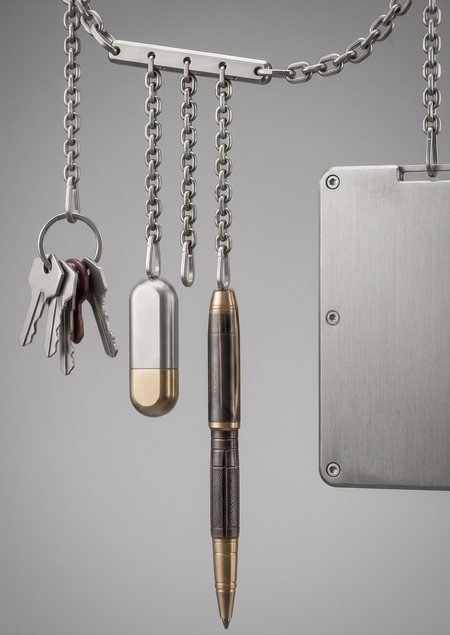
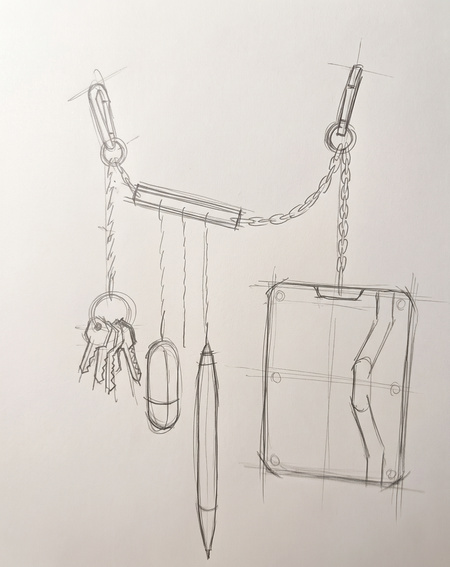
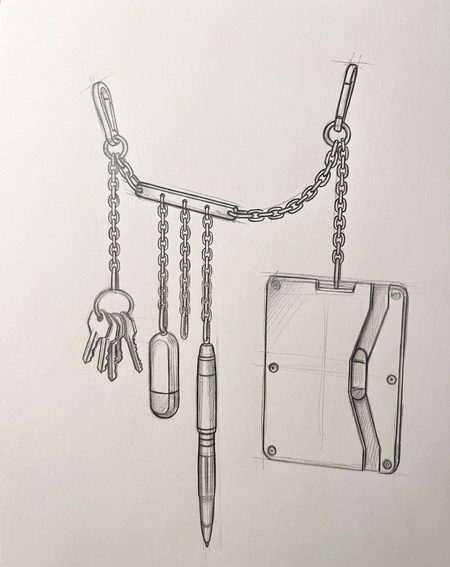
A contemporary satchel reimagined through the lens of Constructivism. This historical accessory—originally used for carrying items instead of a purse or pockets—lost its utility due to overly complex ornamentation. Now, it returns as a modular carrying organizer. The concept is built around the principle of an «open mechanism»: rather than concealing the clasps and fasteners, we elevate them to the central expressive element. A rigid distribution rail with visible latches allows the user to assemble a personalized set of modules (keys, cards, tools) for a specific day. The combination of industrial geometry and meticulous craftsmanship transforms this utilitarian object into an elegant piece of engineered jewelry.
Concept
The chatelaine (from the French châtelaine—"castle mistress») is an accessory worn on the waist or clothing, originally used to carry small, necessary items. Today, it is often viewed as a vintage ornament, but it was initially a highly practical object that served as a substitute for pockets and women’s handbags.
By the end of the 19th century, it evolved from a utilitarian item (a mistress’s key ring) into a piece of jewelry: the construction grew more complex, and the mechanics—fastenings, hinges, pendants, and locks—were concealed beneath ornamentation. A Victorian chatelaine is beautiful, but «opaque»: it is unclear how it is held, how the elements are removed, or why they do not fall out.
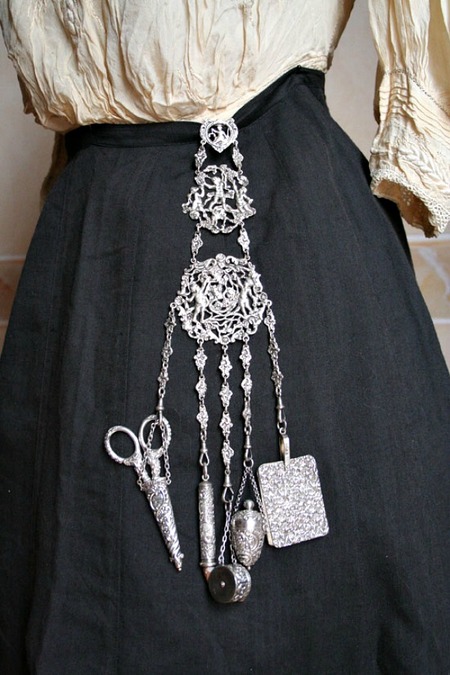
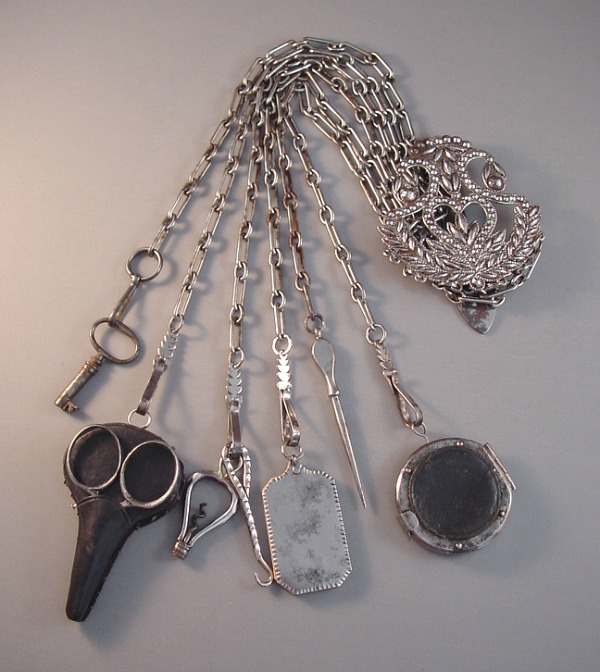
By the early 20th century, with the Industrial Revolution, the emergence of pockets, wristwatches, and capacious bags, the watch chain loses its utilitarian function and becomes merely an ornament—meaning its construction ceases to be honest.
During this period, Constructivism takes shape—a movement that proclaims function as primary, rejects «useless» decorative elements, and demands the revelation of the object’s structural basis. Constructivists contrasted the ostentatious luxury of bourgeois life with «the simplicity and pronounced utilitarianism of new object forms, ” making expediency the measure of aesthetic value for them. Their method was „functional“: the form was dictated by the function of the construction, not the other way around. Constructivism gives us the language for a reverse course: we take the idea of the watch chain (a modular organizer worn on the body) and restore its utilitarian purpose, but at a contemporary level—through honest, legible mechanics.
Use Case Scenario
User: A contemporary city dweller—designer, architect, or researcher—whose day involves constant context-switching (office, studio, meeting, evening out). They do not need to carry a bulky bag, but they require organized, accessible storage for essential, functional items.
Scenario: In the morning, the user assembles their «kit» for the current day. They attach the base to their pants belt. On the distribution bar, they hang the necessary modules for the day: studio keys, a card holder, a flash drive with projects, and a slim pencil case. Throughout the day, they change the configuration with one hand—the open latches allow them to effortlessly attach and remove blocks. In the evening, they unclip the excess items, leaving only the house keys and card, transforming the utilitarian organizer into an elegant accessory.
Sketch
Design and Size
Materials
Load-bearing structure and chains: stainless steel (matte and polished)—for the rigid frame, carabiners, rings, and chain links. This ensures strength and an industrial aesthetic.
Module casings: anodized aluminum and matte steel—for the cardholder and capsule (flash drive). Provides scratch resistance and a deep graphite color.
Accents: polished brass—for tips, clips, and screws. Adds a jewelry-like warmth and contrast.
Mechanisms: metal only (steel and brass)—for all visible clasps and hinges.
Coatings: DLC (diamond-like carbon) for black components—for wear resistance and matte finish; protective lacquer for brass—against oxidation.
Production Technology
Metalworking (Straps, Carabiners): CNC milling of solid steel and aluminum billets. This ensures jewelry-grade fit accuracy, perfect chamfers, and minimal tolerances.
Turning (Brass Accents): CNC turning to create ideal cylindrical geometry and precise threading.
Chains and Rings: Galvanic plating (for durability) and laser welding of links (to prevent breaks).
Finishing: Aluminum anodizing, bead blasting (for a matte steel finish), DLC coating application on polymers, and polishing brass with a protective lacquer.
Assembly: Hand assembly. Precision screws and pins are used. Mechanisms (latches, hinges) are assembled and tested manually to ensure smooth operation and reliable locking.
Visualizations
Estimate
Packaging
Transportation and Security
Rugged Aluminum Case: The anodized aluminum body protects delicate mechanics from impacts, crushing, and moisture during transport.
Precision Cradle: Inside, there is a milled EVA polymer featuring recesses precisely shaped for the modules. This eliminates metal-on-metal friction and prevents the latches from opening prematurely.
Open Locking Mechanism: Inside the case, the modules are held in place by visible brass pins. When the module is removed, these same pins do not interfere, as the system is designed for quick securing and extraction.
Water and Dust Protection: The case is equipped with a silicone seal around the perimeter, making it hermetic and safe for travel in a backpack or luggage without risking damage to metal or polymer components.