Media Concept
Wearing History—a styling course through the history of fashion
Semestermatic Course Outline
Month 1. Style Fundamentals Educational posts: what is an individual style, how color, silhouette, and proportion work. Carousels: comparing historical silhouettes with contemporary looks. Short videos: three ways to transform your image using proportions. Practice: creating your first personal style mood board.
Month 2. 19th-Century Fashion
Educational posts: Romanticism, corsets, voluminous sleeves, and the history of women’s attire.
Carousels: Historical clothing elements and their contemporary interpretations.
Short videos: Three ways to style a corset or a romantic blouse.
Practice: Creating a modern look incorporating 19th-century elements.
Month 3. Fashion 1900–1930s
Educational Posts: changes in the female silhouette, 1920s fashion, Art Deco, and the 1930s Hollywood style.
Carousels: comparisons of dresses, accessories, and silhouettes across different decades.
Short Videos: transforming a basic dress into an outfit inspired by the 1920s.
Practice: selecting accessories and creating an image within Art Deco aesthetics.
Month 4. Fashion of the 1940s–1960s Educational Posts: Christian Dior’s New Look, the femininity of the 1950s, and the youth fashion of the 1960s. Carousels: The evolution of skirts, dresses, and proportions from the 1940s to the 1960s. Short Videos: Three silhouettes from different decades on one model. Practical Work: Creating a contemporary ensemble referencing the New Look or 1960s fashion.
Month 5. Fashion of the 1970s–1990s Educational posts: hippy, punk, grunge, power dressing, and minimalism. Carousels: signature items and stylistic techniques of each subculture. Short videos: one white shirt in the aesthetics of the 1970s, 1980s, and 1990s. Practice: creating three looks based on one basic garment.
01. Why does fashion constantly cycle back?
Every season, we are presented with something new. But why do we keep seeing corsets, flared pants, and wide-shouldered jackets on runways? The answer lies in the history of fashion. In the 19th century, the corset was an essential part of women’s attire, helping to create a silhouette that matched the aesthetic of the time. Today, a corset top is paired with jeans, skirts, and even athletic pants. In the 1970s, flared pants were associated with youth culture and freedom of expression. Today, these pants are appearing in designers' collections again, but in different materials and combinations. Fashion does not replicate the past literally. It borrows recognizable shapes and imbues them with new meaning. Tip: The next time you see a new trend, try to find its historical prototype. Perhaps you already own an item that can be used to recreate it. The history of fashion is a vast archive of ideas that helps build an individual style.
10 Content Examples
Format: Post
Have you noticed how pieces worn decades ago are reappearing in stores and on runways?
Corsets, flared trousers, wide-shouldered jackets—all of this was once part of the fashion landscape. Yet, each time familiar silhouettes return, they do so with a new interpretation.
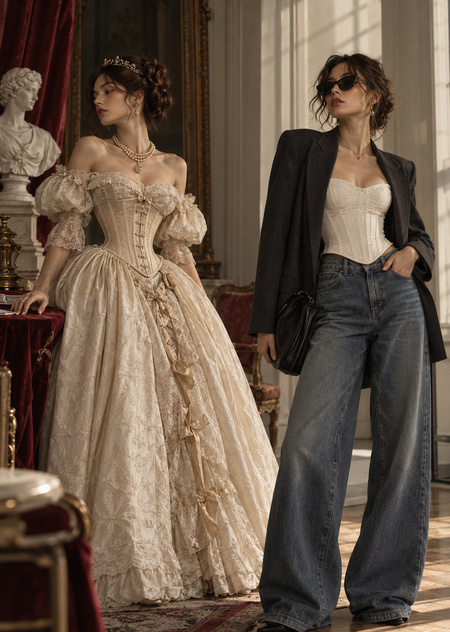
For example, the 19th-century corset was part of undergarments and helped shape the figure. Today, a corset top is styled with jeans, wide-leg trousers, and blazers.
This is why studying fashion history is so fascinating: it helps reveal the origins of trends and discover unique combinations for your own wardrobe.
Which trend from the past do you like the most?
Format: Short video
02. Mini Skirt: A Fashion Revolution
0–7 sec. A generated scene of 1960s London, a girl in a mini skirt.
Narration: «Today, the mini skirt seems like an ordinary item. But in the 1960s, it became one of the symbols of the youth fashion revolution.»
7–17 sec. Shots of A-line dresses, boots, and bright geometric prints.
Narration: «The younger generation was searching for its own style. Designers, including Mary Quant, helped popularize short skirts and new silhouettes.»
17–25 sec. A modern model showcases a mini paired with a turtleneck and high boots.
Narration: «Today, the aesthetic of the 1960s is easy to recreate: a mini skirt, a simple turtleneck, and high boots.»
25–30 sec. The final full look.
Narration: «Just three pieces—and a historical reference transforms into a contemporary look.»
Format: carousel
03. The Corset: Then and Now
Slide 1. The corset—from undergarment to a defining piece of an outfit.
Slide 2. In the 19th century, it supported the body and shaped the fashionable silhouette.
Slide 3. Today, corset elements are incorporated into everyday clothing.
Slide 4. Try pairing a corset top with wide-leg jeans or a jacket.
Historical form—modern styling.
Format: Post
04. The Freedom of 1920s Fashion
In the 1920s, women’s fashion became noticeably looser.
Straight dresses, dropped waists, and light fabrics created a silhouette distinct from many garments of previous decades.
Evening gowns were adorned with beads, embroidery, and Art Deco elements.
How to recreate this today? A straight dress, long jewelry, and a geometric bag.
Format: post
05. New Look: The Return of the Waist
In 1947, Christian Dior presented a collection that transformed post-war fashion.
A nipped waist, rounded shoulders, and a full skirt became the foundation of the famous New Look.
Today, this silhouette is easily recreated without the historical costume.
The formula: a fitted jacket + a voluminous midi skirt + sleek footwear.
Format: Short video
06. Miniskirt: A Fashion Revolution
0–5 sec. Model in a miniskirt. «How did the miniskirt become a symbol of a whole generation?» 5–12 sec. Stylization inspired by 1960s London. «Youth culture changes fashion. The miniskirt becomes a symbol of freedom and a new style.» 12–20 sec. Three modern looks: paired with a turtleneck, a jacket, and a sweater. 20–25 sec. «One piece—dozens of ways to wear it.» Visuals: AI-generated shots in 1960s aesthetics and contemporary ensembles.
Format: Post
07. Big Shoulders of the 1980s
In the 1980s, voluminous blazers became the symbol of power dressing—an aesthetic of confidence and business style. Wide shoulders gave the silhouette a strong, graphic presence.
Today, you don’t necessarily have to wear such a blazer to the office.
Try this: a voluminous blazer + straight-leg jeans + a basic top. The structured top half and relaxed bottom create an interesting contrast.
Format: Carousel