Ночная смена ‑ автоматизированное медиа
Данные, машина и человек
01 Media Concept
«Night Shift”—media about Moscow while everyone is asleep. Every week—one person in a nocturnal profession and one place open at 4 AM.
What This Is
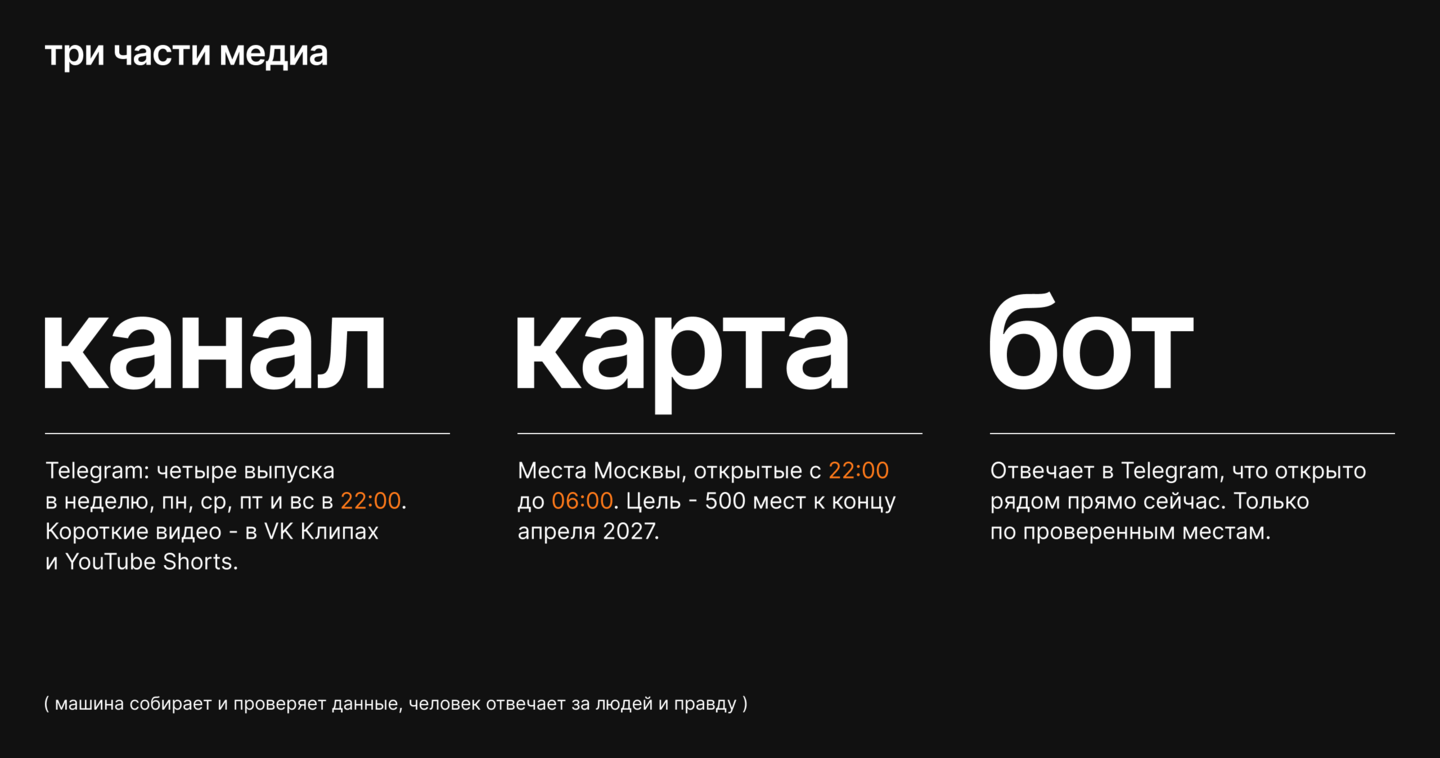
The basis is a Telegram channel: four posts per week—on Mondays, Wednesdays, Fridays, and Sundays at 10:00 PM, at the start of the night shift. Short videos are published on VK Clips and YouTube Shorts.
The second part is a night map of Moscow: locations that operate from 10:00 PM to 6:00 AM. A bot is integrated into the map on Telegram. You send it your needs and location, and it responds with what is open nearby right now.
Who It Is For
For those who work nights themselves, and for city residents aged 18–35 who are curious about how the city operates.
Tone
Calm and warm, like a conversation at three in the morning. No pretense or scare tactics.
Media Objectives
To tell stories. Show the people who keep the nocturnal city running: bakers, night bus drivers, nurses, dispatchers.
To help. A night map and bot answer a simple question: what is currently open nearby.
To give voice. Readers who work at night share their shifts in the «Your Shift» feature.
Where the machine ends and the person begins
The machine handles the routine: transcribing voice, organizing the narrative by hour, compiling location data, and ensuring it stays up to date. The person is responsible for everything related to people and truth: selecting the characters, verifying the quotes, calling the locations, and deciding what to publish. The AI does not invent the characters, quotes, or locations.
02 Data Sources
For «Night Shift,» three types of data are needed: people’s voices, location information, and statistics about the night city. These come from five sources.
1. Voices of the Characters
Interviews with people in nighttime professions: a 20–30 minute verbal account of their shift, with consent for publication. We extract stories hour-by-hour, quotes, and details from the recording.
2. Open City Data
Moscow’s open data portal, data.mos.ru: addresses and coordinates of cafes, pharmacies, and other city amenities.
Moscow Metro and Mosgortrans websites: operating hours for the metro and the routes of nighttime buses (lines «N» and the 24-hour line «B»).
News and press releases from city services on mos.ru: data for the «Night Figure» section.
We calculate sunrise and sunset times ourselves using NOAA formulas, and we gather weather data from the Open-Meteo forecast.
3. Locations Themselves
Operating hours are manually cross-referenced against venue websites and 2GIS and Yandex Maps directories—not gathered automatically—before calling the location. 24-hour locations can fill out the questionnaire themselves: operating hours, what is available at night, and who is working.
4. Contributors
Stories for the «Your Shift» section, submitted via text or voice; sound recordings for «Sounds of the Night»; map corrections (e.g., «place closed»); questions for the bot and responses to surveys.
5. Partners
Communities of night professions (delivery drivers, taxi drivers, medical staff) help find our subjects. Press services from municipal departments assist in arranging interviews.
Selection Criteria
Nighttime Only.** We collect time data from 10:00 PM to 6:00 AM. Verification Date.** Every location has a date of last verification. If no confirmation is received within 30 days, the location is scheduled for re-verification.Two Confirmations.** Operating hours are considered verified if two sources match or if the location answers the phone.Consent.** Voice, story, and sound recordings are published only with the author’s consent.Privacy.** No last names (unless the person permits it), home addresses, faces, or private conversations.
03 data schema: machine and human
The machine handles the routine; the human is responsible for people and truth. Nothing is published without an editor—the exception is bot responses, but the bot only replies based on verified data.
Stage 1. Collection
Machine: Weekly, it gathers open city data, accepts stories, sounds, and corrections via the bot, transcribes interviews, and decodes voice messages.
Human: Identifies subjects, records interviews, obtains consent, and drives around locations at night to record ambient sound.
Stage 2. Analysis
Machine: Removes last names, phone numbers, and addresses from transcripts, organizes the subject’s narrative chronologically, converts addresses into map points, and searches for repetitions.
Human: Verifies every quote against the recording and determines which parts of the story are too personal to share.
Stage 3. Verification
Machine: Compares operating hours from various sources and assigns a status: «verified, ” „pending verification, ” or „outdated.“ It separately notes any contradictions.
Human: Calls the locations flagged with disputed statuses at night, during their operating hours, to confirm or correct the record.
Phase 4. Archiving
A single database composed of three parts: locations (night map), people, and stories along with consents, and sounds. Each entry has a source, a verification date, and a status.
Phase 5. Publication
Machine: assembles the draft «Hours of the Night, ” trims the video and audio to 30 seconds, calculates the „Night Number, ” and schedules the posts.
Human: writes the text and headline, selects quotes, refines the tone, and approves the publication.
Phase 6. Bot and Feedback
Machine: responds with nearby options only for verified locations. Accepts corrections and immediately removes controversial locations from the responses. Without identifying names, it tracks what people ask about at night.
Human: reviews the corrections, responds to complex messages, and once a week reviews the inquiries to identify emerging themes.
04 Guidelines for Automated Services
These rules are embedded in the language model instructions, database filters, and bot scenarios.
1. We do not rewrite the character’s voice
The AI transcribes and condenses, but does not alter the meaning or add quotes. Every quote is cross-referenced with the recording.
2. The AI does not invent anything
No characters, locations, or numbers. If data is unavailable, the field remains empty, and the bot honestly responds: «I don’t know.»
3. Only verified locations
The bot’s responses include only locations marked as «verified.» Below each entry is the date: «verified November 5.»
4. Timing is everything
The bot will not write «open» unless it is certain the location is operating at that exact moment. If closing is less than 30 minutes away, it provides a warning.
5. Privacy
The system strips out last names, phone numbers, and home addresses before the text reaches the editor. Speech from people is redacted from the «Sound of the Night» recordings.
6. Safety
If the query seems like an emergency (someone is unwell, injury, danger), the bot first provides the numbers 103 and 112 before suggesting nearby locations. The bot does not provide medical advice.
7. AI-Generated Content is Labeled
The AI does not create photos of people or voices that sound «real.» If an image or text has been created with AI, it is indicated.
8. Each Number Has a Source
For the «Night Number, ” the AI performs the calculation, and the editor verifies it. Every post includes a link to the source.
9. Tone
Calm and warm, avoiding sensationalism or crime reporting. We do not romanticize night work, nor do we pity the subjects.
10. The Human Has the Final Say
The machine prepares the drafts, but the editor publishes them. Readers can correct any errors on the map with a single button in the bot, and the revision history is saved.
05 System Example
Wednesday, 03:40. A reader writes to the bot: «I need a pharmacy near Bauman.»
1. The Query. The machine understands what is needed (a pharmacy), where (near the «Baumanskaya» metro station), and when (now, at 03:40).
2. The Search. The bot searches the night map for vetted pharmacies operating at 03:40 and sorts them by distance.
3. The Response. Within a few seconds, the bot sends two pharmacies: 6 and 11 minutes away on foot, each marked «verified November 5th.» Below, there is a line: if the person feels unwell, call 103.
4. Correction. At 04:05, a reader writes: «The first one is closed.» The machine immediately removes the pharmacy from the results and sets its status to «pending verification.»
5. Verification. On Thursday at 22:30, an editor calls the pharmacy: it is closed for repairs until December 1st. The status is updated, and the verification date is saved.
6. Publication. At the end of the month, the machine calculates the most common nighttime searches, and the editor turns this into the «Nightly Figure.»
At night, the human received a response in seconds, and the map became more accurate. The machine responds and monitors the data; the human verifies and decides.