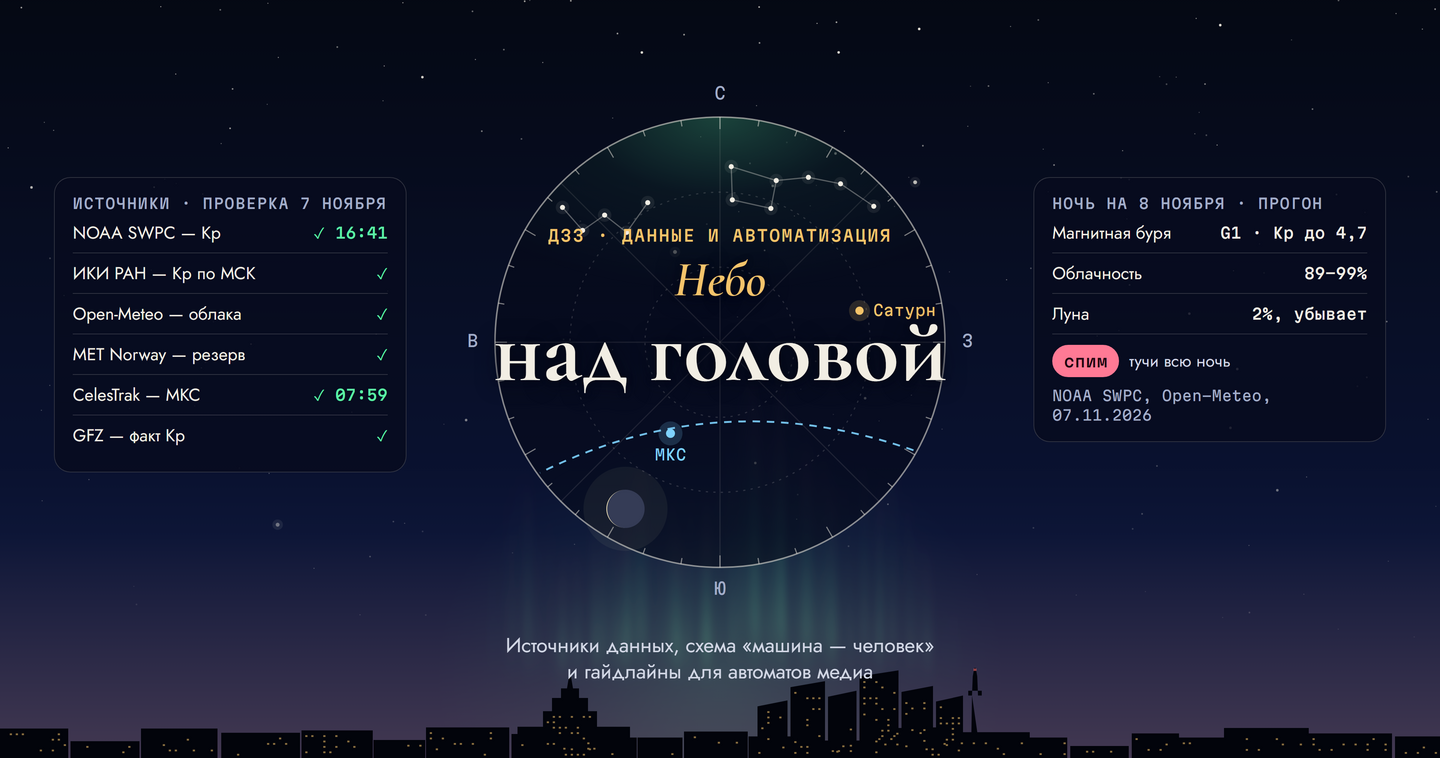
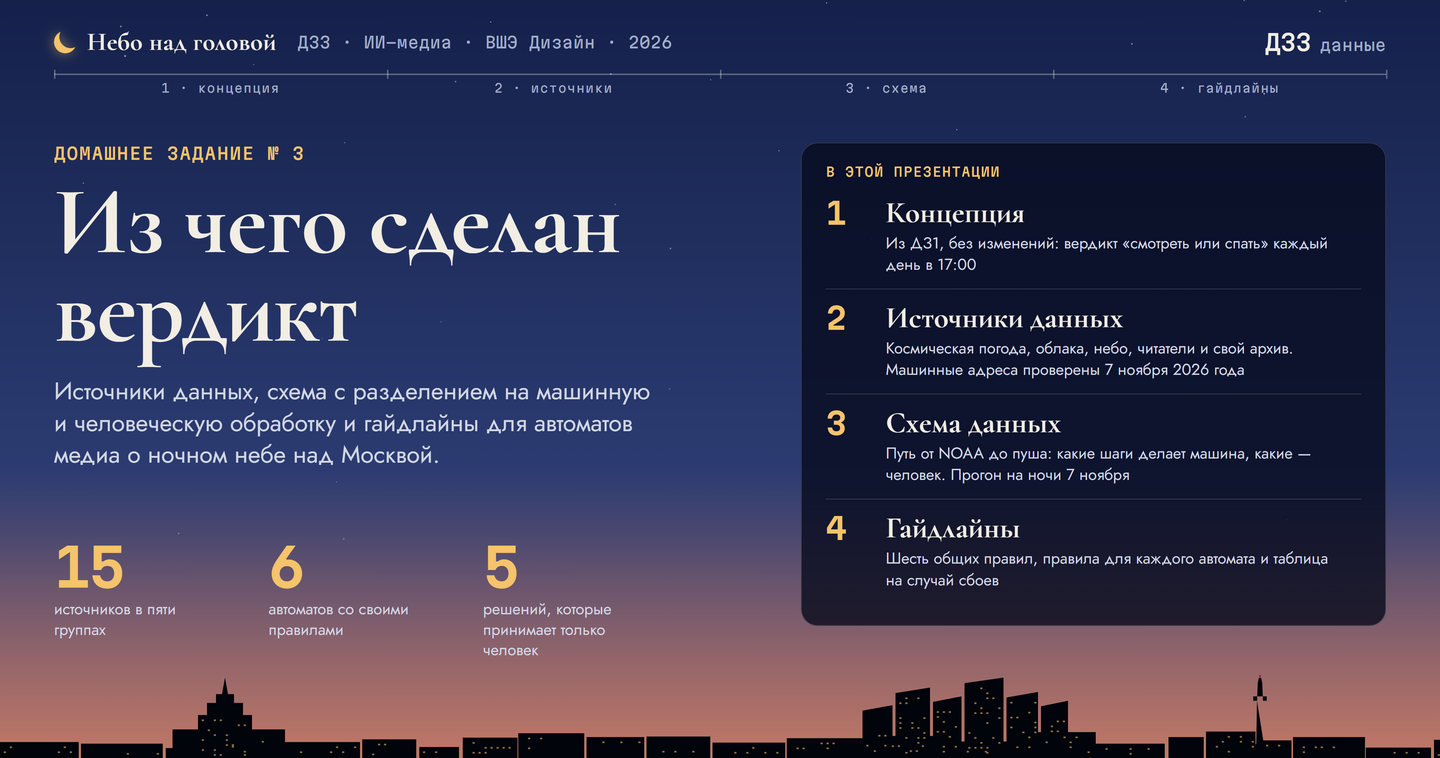
This is the third media assignment, «Sky Above, ” an AI-driven media piece about the night sky over Moscow. Every day at 5:00 PM, it answers one question: is it worth looking up today? Assignment 3 consists of four parts: the concept from the first assignment, data sources, a schematic dividing machine and human processing, and guidelines for the automated systems in this scheme. We verified the machine sources in person on November 7, 2026, and ran the schematic on a real night, from November 7 to November 8.
1. Media Concept
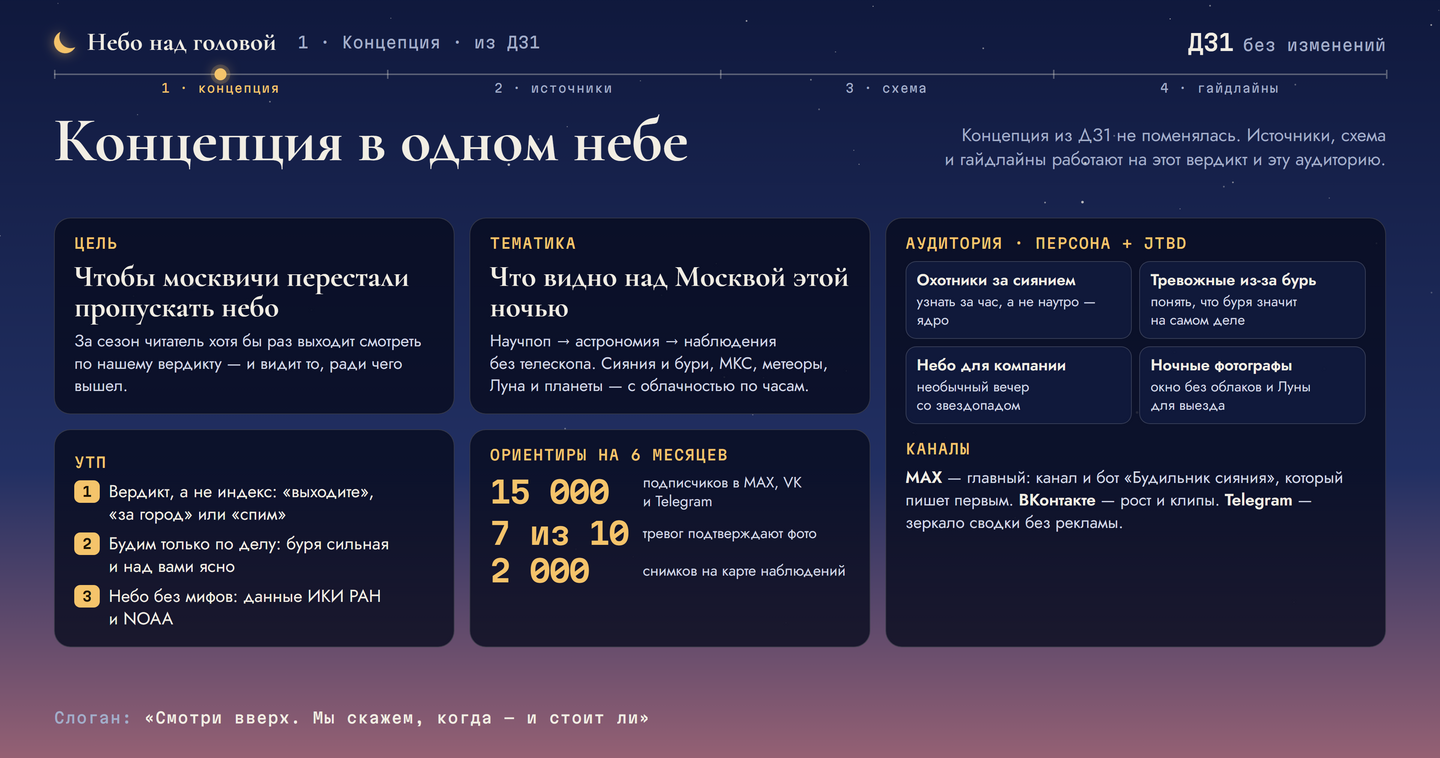
The concept has not changed since the first assignment. The goal is to get Muscovites to stop overlooking the sky: over the season, readers should at least once check our verdict and see what motivated them to look up. The theme is what is visible over Moscow tonight—auroras and geomagnetic storms, the ISS, meteors, the Moon, and planets, along with hourly cloud cover.
The community comprises four segments: glow hunters (the core), those prone to anxiety, casual observers, and night photographers. The primary channel is MAX with the «Glow Alarm» bot; VKontakte is for growth and clips; Telegram mirrors the briefing. Our USP: verdict, not index; we only report what matters; a sky free of myths. The sources, scheme, and guidelines further support this verdict.
2. Data Sources
For media, there are 15 sources across five groups. Space weather includes NOAA SWPC (Kp index forecast, storm alerts, OVATION aurora model), IKI RAS, GFZ Potsdam, and SILSO. Terrestrial weather is sourced from Open-Meteo and MET Norway as a backup. Sky and calendar data incorporates Moon calculations, ISS orbit from CelesTrak, the IMO meteor shower calendar, astronomical calendars, and light pollution maps. Two additional sources include user submissions with photos and «seen / not seen» markers, alongside our proprietary archive of night cards.
The rule is simple: the machine reads what is output in machine-readable format according to a schedule, and the human reads what is published annually or requires judgment. Four sources are already operating in the robot prototype; we are connecting six in Module 2, four are read by the editor, and one more is for readers.
Every machine source has a data sheet: format and access, update frequency, usage conditions, and what we derive from it. The primary sources are the Kp forecast from NOAA (a public domain resource of the U.S.; a link to NOAA is required) and cloud cover data from Open-Meteo (free for non-commercial projects, data licensed under CC BY 4.0). Each primary source has a backup: the Space Research Institute of the Russian Academy of Sciences (IKI RAS) publishes the same NOAA forecast, but for Moscow time, and MET Norway provides the cloud cover data and permits commercial use. Since the conditions for IKI RAS have not been published, we will coordinate them with the laboratory before launch.
On Saturday, November 7, 2026, at approximately 4:40 PM, we queried every address in the passport. All primary sources responded: the NOAA Kp forecast was updated at 4:41 PM, the ISS orbit from CelesTrak arrived at 7:59 AM, and the Open-Meteo cloud cover data arrived in 4.4 seconds. On the same day, NOAA announced a weak G1 storm for November 7–9.
Two discoveries changed the scheme. The NOAA solar wind file moved, and the old address now returns a 404 error—a robot reading it would silently lose its data. Also, the Kp forecast format changed this fall—instead of a table, it’s a list of records. Therefore, the first check in the guidelines is: «response 200, familiar format, and a recent date.»
3. Data Schema
The schema consists of three circuits. The summary is compiled at 5:00 PM: the assembler retrieves the data, the verification filters out old and damaged entries, the synoptician calculates the verdict according to established rules, the AI editor writes the text, the duty editor cross-references it with the sky, and then publishes it. The publication is sent to MAX, VKontakte, and Telegram. Night and Alerts: the watchman monitors the storm and clouds every 30 minutes, a person decides on the push notification, a bot alerts subscribers, readers submit photos, the moderator assistant checks them, and the moderator decides what makes it onto the map.
The third layer—week and year: an archive of night cards, an analysis of verdict accuracy, after which the person adjusts their thresholds, and an events calendar. There are only 15 steps: 9 involving the machine and AI, 5 involving the human, and 1 involving the readers. No graduation or push notification goes unnoticed by the person.
Everything media knows about the night resides in a single record—the night card. The slide shows an actual card that the robot saved on November 7th: a dark window from 8:00 PM–5:00 AM, Kp up to 4.67 (G1 storm), hourly cloud cover, 2% moon visibility, and the verdict «sleeping.» Each field has an owner: the machine, a human, or readers. A field filled by a human is not overwritten by the machine, and an empty field is an honest «we don’t know yet, ” not zero. Summaries, alerts, bot responses, and weekly analyses are compiled from these cards.
The machine handles everything that is repeatable and quantifiable: it gathers and verifies data, calculates the verdict, drafts content, publishes on schedule, prepares an alert draft, and checks photos. The human is responsible for everything the media communicates to the reader. Only humans issue the final summary, send nighttime push notifications, adjust thresholds, publish reader photos, and respond to complaints. A daily edition takes the on-call person 10 minutes, and for an editor, it takes about 6 hours per week, as per the homework plan (DZ2).
We ran the simulation on a real night, from November 7th to November 8th, 2026. NOAA announced a G1 storm in the morning. The forecast updated at 4:41 PM: Kp up to 4.7 from midnight to 3 AM. Open-Meteo predicted 89–99% cloud cover for the entire nine-hour dark window. Zero clear hours meant the verdict was «stay indoors, ” and even with a clear sky, a Kp of 4.7 was below the threshold for „going out.“ The machine steps—a true robot launch; the simulation gathered the prototype template, and we played the role of the duty staff. The same was true for November 8th: Kp up to 5.0, clouds 83–100%, meaning „stay indoors“ again.
4. Guidelines for Automated Systems
The guideline dictates what the bot must do and what it must never do. There are six general rules: no fresh data means no verdict; every figure must have a source and a timestamp; the code, not the neural network, calculates the numbers; decisions about people must be made by a person; a loud error is better than a silent one; everything must be documented. Following this are specific rules for each of the six bots.