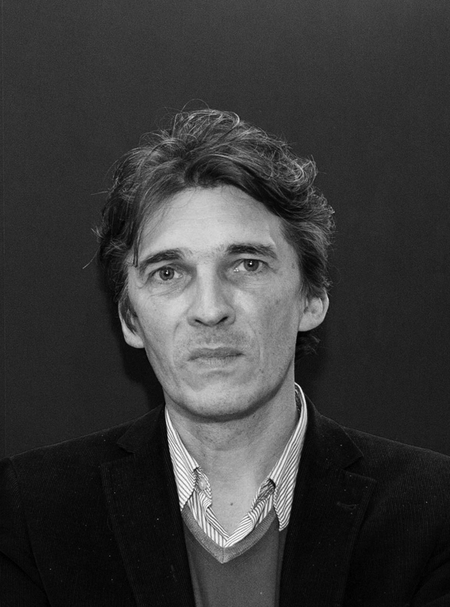
Discursive and Expository Strategies of Nicolas Bourriaud: From Micro-Utopias of Relational Aesthetics to the Molecular Anthropology of Capital-Price
Nicolas Bourriaud was born on April 13, 1965, in France. Bourriaud is an influential French curator, art historian, theorist of contemporary art, and art critic. He gained international renown as the originator of the concept of «relational aesthetics,» which has significantly shaped the development of current art since the 1990s.
French curator and philosopher Nicolas Bourriaud proposes that art should react to changes in the world—first to the emergence of the internet in the 90s, and now to the ecological crisis and global capitalism.In art theory, the curator today is not merely a person who hangs paintings on walls, but a full-fledged thinker who creates new meanings and ideas. The trajectory of the French critic Nicolas Bourriaud is a vivid example of this phenomenon. He did not simply describe what artists were doing; he created the very rules and concepts by which contemporary art evolved. Nicolas Bourriaud changed the approach to exhibition making:
— He rejected the notion that art should be isolated, with paintings or sculptures existing in a vacuum.
— He replaced the classical gallery model (the sterile white space where the viewer quietly contemplates the object) with a new format.
— For Bourriaud, the exhibition is a living platform for interaction, a space where social connections intersect and cultural meanings are «mixed.»
His terminology—from creating islands for human interaction and relational aesthetics to the ecological contemplation of humanity and molecular anthropology—has become the working language for modern curators worldwide.
Institutional Laboratories: Practical Verification of the Curatorial Method
Burrio’s theory is deeply pragmatic: his conceptual framework crystallized directly from the institutional experiments of the 1990s and 2000s.The «Traffic» Exhibition, 1996: Architecture of Co-presence
Burrio’s project «Traffic, ” realized at the CAPC Musée d’art contemporain de Bordeaux, became a manifesto for the emerging relational discourse. The curator gathered artists whose works fundamentally resisted traditional commercial and museum preservation. The exhibition was designed as an open space where the viewers' physical trajectories, their stops, communication, and moments of confusion acted as the primary formative material.Palais de Tokyo, 2000–2006: Deconstructing Museum Routine
The period when Burrio and Jérôme Sans served as co-directors at the Parisian Palais de Tokyo marked a milestone in the history of „insider“ institutional critique. The curators enacted a radical dismantling of traditional museum conventions:
— The architectural precedent of the „raw building“: The architectural intervention by Lacaton & Vassal preserved the raw, unfinished concrete aesthetic of the space, transforming it from a sacred „temple of arts“ into an industrial workshop open to interventions.
— Chronopolitical shift: Operating until midnight attracted a fundamentally new audience, deconstructing the bourgeois ritual of daytime museum visits.
— The concept of continuous production: Rigid spatial and economic boundaries between the exhibition area, the book corner, recreational spaces, and the café were abolished. The entire building functioned as a total relational landscape.Burrio’s Theoretical Evolution: From Micro-Utopias to Non-Human Agents
Burrio’s theoretical project unfolds within a strict internal logic, consistently responding to shifts in global macroeconomic and technological regimes.
Relational Aesthetics: Interstices Versus Total Alienation
In the book Esthétique relationnelle (1998), Bourriaud enacts an ontological shift by defining relational art as «practices whose starting point is the sphere of human relationships.» Drawing on a Marxist perspective, he observes that late capitalism has transformed not only material objects into commodities but also human interaction. In Bourriaud’s view, an exhibition should function as an interstice—a social gap temporarily free from the laws of market exchange.
— Curatorial Strategy: Creating conditions for collective form-making. A shift from contemplative distance (e.g., not touching with one’s hands) to interactive participation.
— Artists:
Rirkrit Tiravanija: In the iconic project Untitled (1990), the artist transformed white gallery spaces into free kitchens. Food and interpersonal communication became the true plastic medium, devaluing the commercial nature of art.
Felix Gonzalez-Torres: His installations—piles of candy—explicitly exposed the relational act of communion. By taking a piece of candy, the viewer became a participant in the distribution of weight and the physical disappearance of the body, alluding to the fading of his partner due to AIDS.
Postproduction and the Radicant: Art as Remix and Navigation
In his 2002 work, «Postproduction, ” Burriau identifies a global surplus of signs. The contemporary artist is no longer a creator of form ex nihilo, that is, from nothing. His role is that of a DJ, a web surfer, or a programmer. He takes existing cultural products and relaunches them into new semantic configurations.
This idea is further developed in the 2009 concept of the Radicant. Burriau contrasts modernist radicalism—specifically, the search for roots and the purity of origins—with the radicant concept—a biological property of ivy to send roots as it moves across a surface. The radicant artist is a nomad, translating meanings from one local context to another.
— Curatorial Strategy: The exhibition is constructed as a complex hypertext.
— Artists:
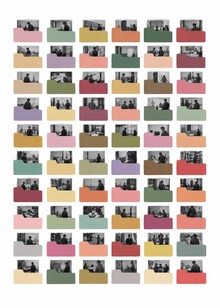
— Douglas Gordon: In the video installation 24 Hour Psycho (1993), the curatorial and artistic gesture merge. Slowing Hitchcock’s film down to two frames per second transforms the cinematic narrative into a spatial, physiopsychological architecture.
— Pierre Huyghe and Philippe Parreno: The project No Ghost Just a Shell (1999–2002), in which the artists bought the rights to the manga character Annlee, demonstrated the transformation of a commercial sign into a decentralized, collectively editable platform.From Exform to the Molecular Anthropology of the Capitalocene
Burriau’s later texts—The Exform (2016) and Inclusions: Aesthetics of the Capitalocene (2020–2022)—elevate his theory to the level of ecological and post-anthropocentric critique. Burriau moves away from the „cozy human micro-utopias“ of the 1990s toward a molecular anthropology. He argues that the strict division between „subject”—human—and „object”—nature, thing—which underpins capitalism, has led to ecological catastrophe. The task of contemporary art is to capture the coactivity of human and non-human agents—that is, minerals, plants, digital algorithms, viruses.
Curatorial Strategy: The exhibition as an ecosystem where the boundaries between the organic and the technological are erased, and the curator acts as an anthropologist-researcher.
Clare Bishop’s Critique Theorist Clare Bishop offers a critical deconstruction of Bourriaud’s theory in her canonical article, «Antagonism and Relational Aesthetics» (2004). Bishop puts forth three fundamental objections against Bourriaud:
- The Illusion of Micro-Utopias: Relational exhibitions create zones of comfort for a socially homogenous community—members of the creative class and gallery attendees. This feigned consensus masks real social inequality.
- The Abolition of Political Antagonism: Drawing on the theories of Chantal Mouffe and Ernesto Laclau, Bishop argues that genuine democratic space is built not on amiable agreement, but on conflict and rupture.
- Aesthetic Indistinguishability: Bourriaud overlooks the criterion of the aesthetic quality of relationships by proclaiming any human interaction within the art gallery as art. As an alternative, Bishop proposes a curatorial focus on the practices of Santiago Sierra and Thomas Hirschhorn, whose work does not smooth over contradictions but explicates the violence of the system, compelling the viewer to experience ethical discomfort.
Sources
- Bourriaud, N. Relational Aesthetics. Postproduction / Translated from French by A. Shestakov. — Moscow: Ad Marginem Press, Garage Museum of Contemporary Art
- Bishop, K. Antagonism and Relational Aesthetics / Art Journal. — 2005
- Bishop, K. Artificial Hell. Participatory Art and the Politics of Viewing
- Bourriaud, N. The Radicant. — New York: Lukas & Sternberg, 2009.
- Bourriaud, N. Inclusions: Aesthetics of the Capitalocene. Berlin: Sternberg Press, 2022.