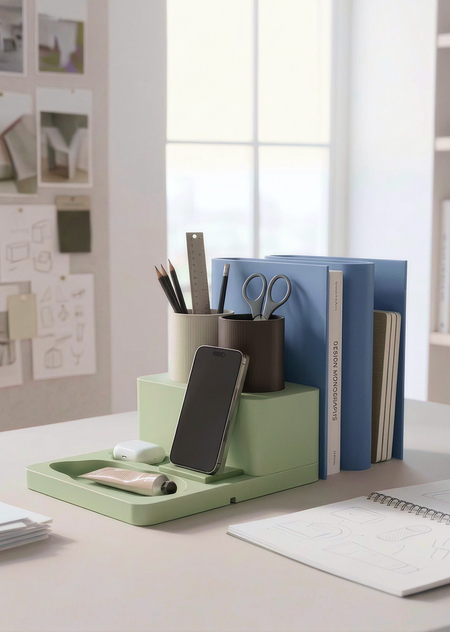
A desk organizer for those tired of clutter on their workspace.
The design is inspired by Edvard Munch’s painting, «Summer Night on the Beach.» Its atmosphere of silence, long horizontal lines, and muted colors have been translated into the design of an object that helps capture focus and concentrate on what matters.
No visual noise: the phone stand features integrated wireless charging, allowing you to completely eliminate excess cords.

Five key principles translated from the painting into the object:
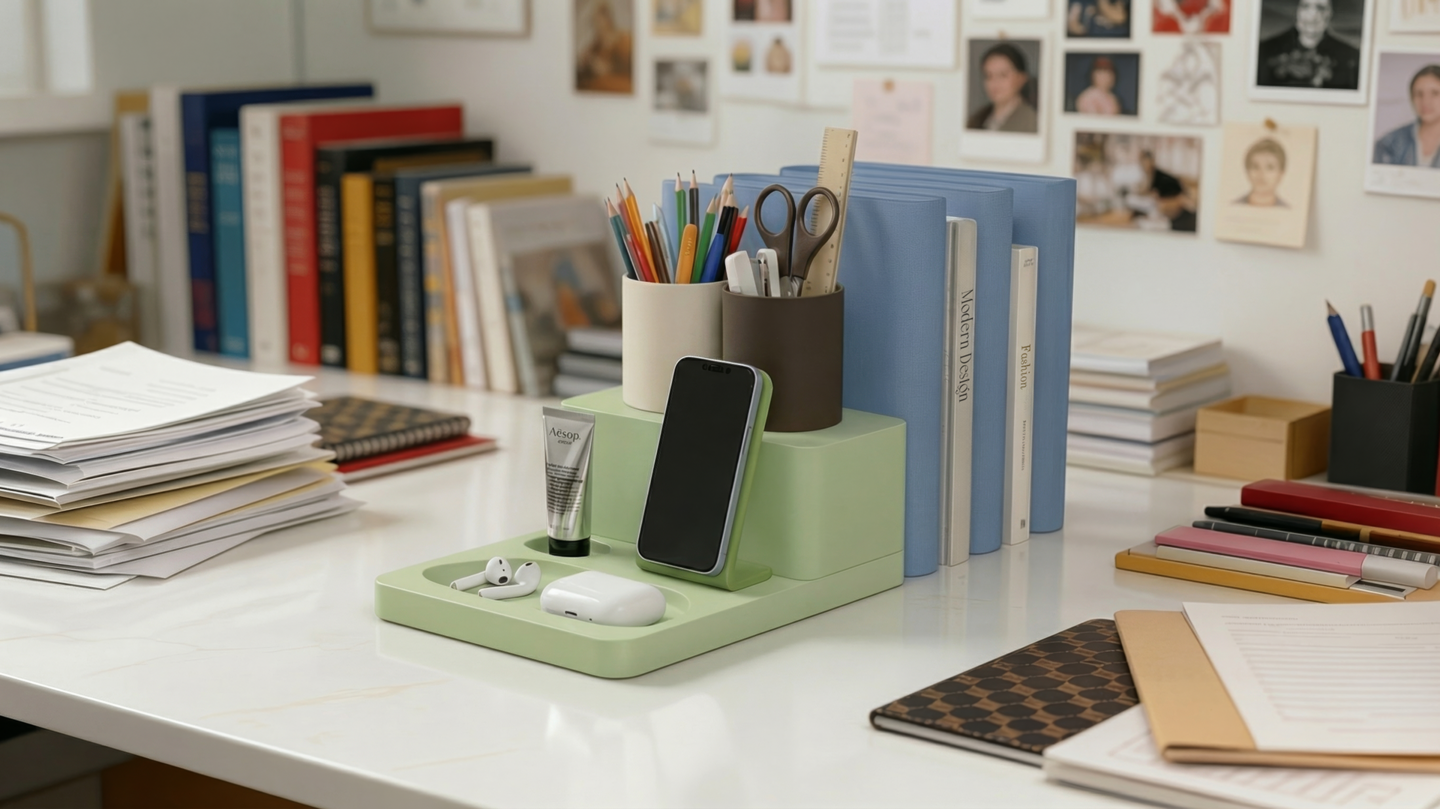
Long Horizontals. The low profile of the organizer stretches along the table, visually expanding the space.
Layering. Similar to Munch’s landscape, the foreground, middle ground, and background are clearly separated: compartments for small items, holders for pens, and a book stand.
Fluidity. The compartments feature free, organic shapes, and the book holder is crafted in the form of a single, curved ribbon.
Softness. The objects completely lack sharp corners, making them pleasant to the touch and the lines smooth.
Neutral Surface. The matte texture, free of glare, does not distract the eye and absorbs excess light.
The project’s color palette mirrors Munch’s original.

Ergonomics and Use Scenarios
The organizer sits to the right of the laptop—directly under the dominant hand. This is a natural zone of activity where items intuitively move during the work process. In the morning, the phone is placed on the stand to charge wirelessly. Pens and markers are kept in cups, while glasses, headphones, and important small items are housed in the base compartments. The book, notebook, and tablet rest in the stand’s slots, freeing up desk space. When a completely clear surface is needed for large-scale projects, the modules easily detach from their magnetic mounts and can be moved aside in seconds.
Sketches
The project began with a conceptual question: how to distribute items across plans while replicating the composition of a painting? The logic emerged from ergonomics: items needed constantly were placed in the foreground, while less frequently used items went to the back.
The initial sketches presented a single, monolithic tray. It looked too cumbersome. To lighten the structure, the organizer was divided into magnetic modules.
The book stand, which initially consisted of a series of separate panels, was transformed into a single, sleek wave.
Modeling
3D Printing
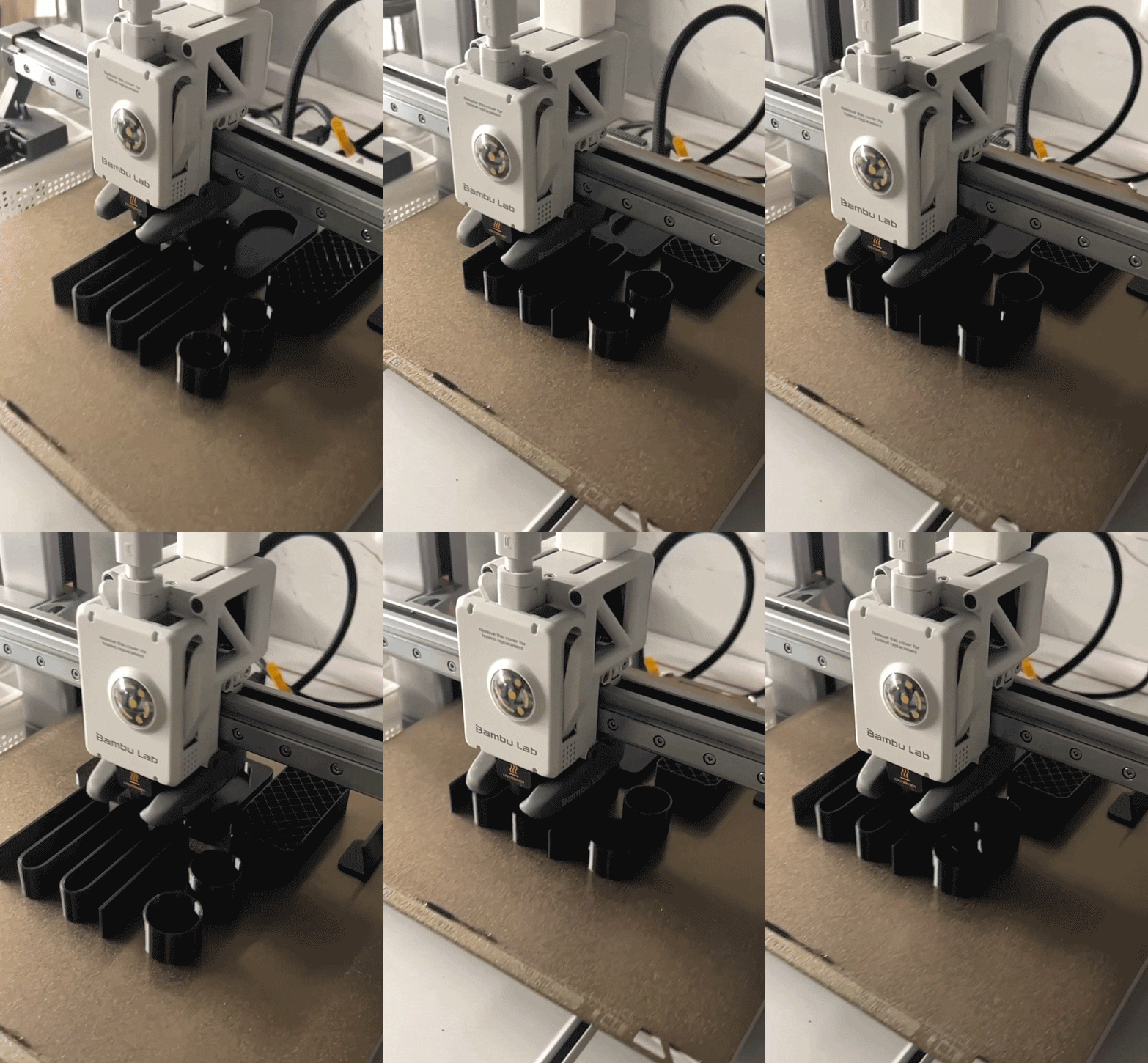
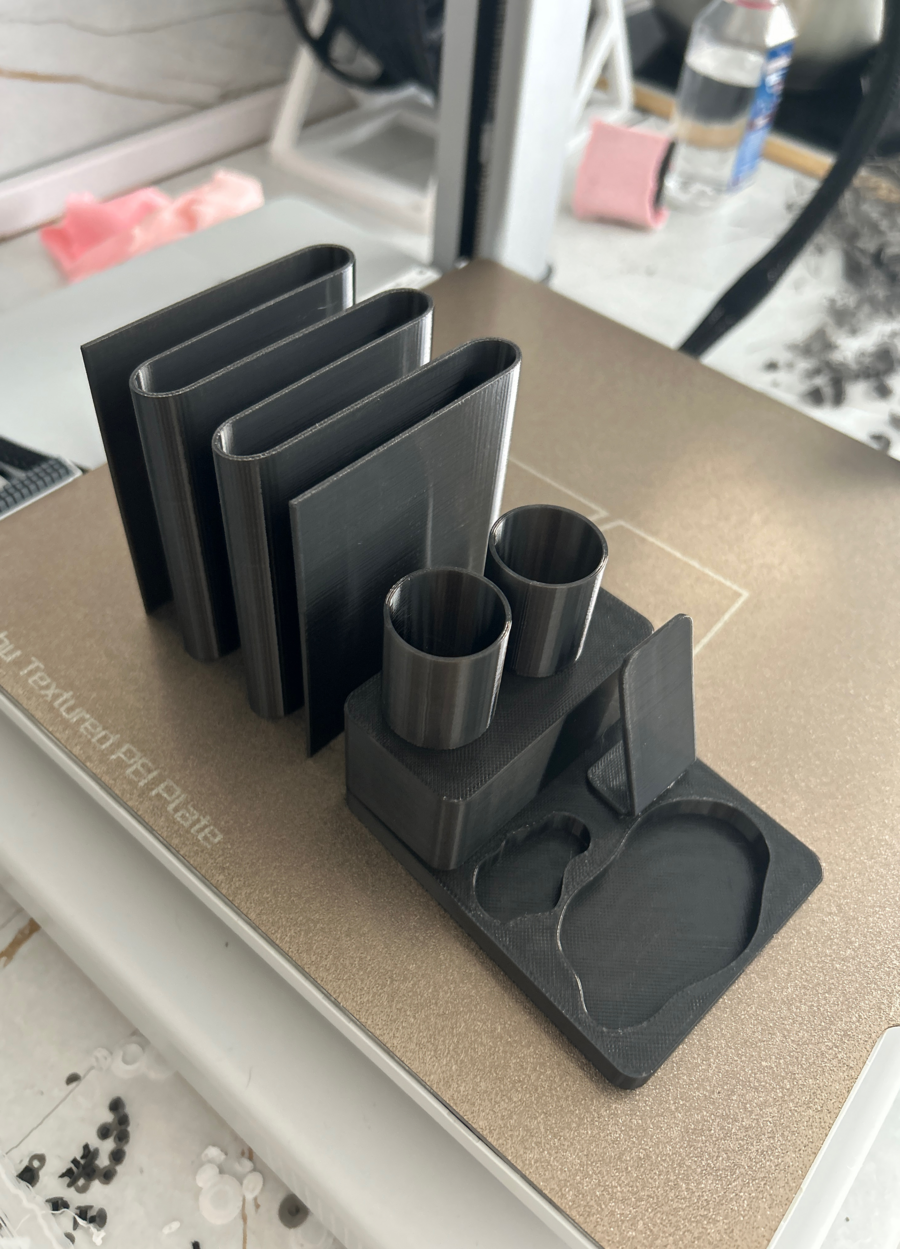
Post-press changes
The first prototype was printed on a 3D printer to check the shape and proportions. Based on its results, three sections were revised.
Previous: The phone stand was solid—there was no space to fit the charging module. Revised: The plate was made thicker, incorporating an internal compartment for the module, and a cover was added to the back.
Previous: The book slots were 23 mm—a standard book wouldn’t fit. Revised: There are now three slots—a 50 mm slot for a book, a 35 mm slot for a notebook, and one for a tablet.
Previous: The modules were not connected; the cups rested on the flat surface. Revised: The modules are now held by magnets, and the cups sit within dedicated holders.
Dimensions
Organizer 393 × 207 × 245 mm, assembled from printed parts.Bookstand — 138 × 207 × 245 mm
Base with compartments — 254 × 207 × 22 mm
Cup holder module — 105 × 207 × 84 mm
Cups, 2 pcs. — Ø73 × 84 mm
Charging stand — 65 × 72 × 133 mm
Assembly
The modules rest on a base and are held in place by 10×3 mm magnets, making them easy to remove and rearrange. The cups sit in shallow recesses within the block.Four silicone feet are glued to the bottom of the base to prevent the organizer from slipping on the table.
Warm-up
The finished wireless charging module is located in the pocket on the back of the stand and covered by a lid.The magnetic ring positions the phone directly over the coil. The cable is concealed: it runs inside the stand and exits through a slot at the base.
Production
Materials
All details are 3D-printed using PETG plastic and painted with matte paint matching the palette colors.For a small series, the printed parts serve as master models for casting in polyurethane into silicone molds.
Hardware and Components
• Neodymium magnets Ø10 × 3 mm — 16 pcs.; • Silicone feet Ø10 mm — 4 pcs.; • Qi/MagSafe wireless charging module — 1 pc.; • USB-C cable — 1 pc.Cost
One instance 3D-printed costs approximately ₽7,100. A batch of 20 pieces cast in silicone molds costs approximately ₽5,800 per set.Minimum run: 1 piece for 3D printing, starting from 20 pieces for casting.
Process
3D printing of parts → sanding → primer and matte paint → affixing magnets and feet → installing charging module → assemblyPackaging
The organizer comes in a corrugated cardboard box. The pieces are arranged in three layers on cardboard inserts, which prevents them from rubbing against each other or shifting during transport. The cable, spare magnets, and assembly instructions are placed in a paper bag inside the container. All packaging is made of cardboard and paper and is fully recyclable.