Bridge
Essay
If metal possessed a soul, it would reside in this bridge—a resilient structure imbued with the memory of decades and the countless people who crossed it. It stands over the Tonky Strait, between the mainland of Genichesk and the sand spit of Arabat Strelka, like an old soldier who has served his time and now only watches the sea. Few of its peers have lived two lives in two different worlds, and even fewer have managed to remain not merely a construction, but a living history.
His path did not begin with a roar, but with a blueprint. In 1915, amidst the chaos of World War I, the young Austrian engineer Friedrich Roth developed a modular truss system for the Viennese firm Waagner-Biró. This was an engineering idea born from the demands of the front lines: the need to quickly assemble crossings without waiting for permanent construction. The structure was composed of standardized bolted and nutted elements, with no welding—like a giant prefabricated kit. However, the bridge standing today over the strait was assembled later, specifically during World War II, by German engineers across the Dnieper River near the Belarusian city of Orsha. There, it served as a temporary crossing—a captured, prefabricated span. Thus, a concept born of one war was realized in metal for another.
Trains carrying cannons, bread, and people traveled across it. Perhaps the young soldiers looked down from the height at the dark Dnieper water, and in their eyes there was neither heroism nor understanding of why they were going to kill other young people, simply dressed in a different uniform. The bridge was made of iron, and its purpose was to connect the banks, not to help people sever their lives. In 1951, it was dismantled. Every beam, every rivet was removed from the supports and taken south, toward the warm sea. It traveled across the steppes and cities, and the memory of Belarusian mists rang within it. When it was reassembled, it saw a different sky—high and white from the sun—and the water was not dark, but turquoise. Here, within twenty meters of where the wooden bridge, destroyed by war, once stood, its second life began. Military trains no longer thundered across it. Now, trains carried salt, fish, and southern grapes instead. The small steam engine «Cuckoo,» with one passenger car, transported people to the Arabat Spit and back. It connected the mainland to the long sandy spit, and locals said this crossing served as their road to the sea, to life. In the late sixties, a storm destroyed the railway track. The rails were never restored, and the bridge was left without trains.
Cars began using it until a concrete roadway bridge was constructed one and a half kilometers away. Since then, the old structure has seen little use, but it has not died. It has witnessed sunsets, dyeing its metal the color of ruddy gold, wedding kisses, fishing gatherings, children jumping into the clear water, and quiet conversations of lovers on its spans. Henichesk grew accustomed to it and no longer noticed that this old bridge was not just part of the landscape—it was part of the city’s soul. When it was almost sent to the scrapyard in 2016, the city suddenly realized what it was losing. Activists wrote letters to distant Vienna, to the firm Waagner-Biró, which once built such bridges. This organization, which constructed the Bundestag dome and the Sydney Opera House stages, confirmed that they were dealing with a unique piece of engineering heritage. People took photos against its backdrop, held exhibitions directly on its trusses, and wrote articles about it. They were saving not rusty beams, but their own history, which they had nearly lost. Thanks to the «100 Years and 100 Selfies» and «First Bridge Festival» initiatives, the old crossing remains standing. Now, no trains run across it. Only the wind and tourists walk across the bridge. It stands over the strait, listening to how the Sea of Azov whispers to the Sivash, how birds argue with the waves, and how time hums within its old trusses.
The bridge that once crossed from one life into another and remained forever. It holds the banks, and thus, it holds the connection. And within this connection lies a truth stronger than any war. As long as it stands over the strait, the past does not drift into the sea, and history does not dissolve. The memory of thousands of people is held in its rivets. And if metal possessed a soul, it would reside here.
Legend
It is said that in ancient times, when the old iron bridge across the Tonky Strait was already in place, there lived a scholar. He was intelligent, educated, and respected. For many years, he studied the nature of things, read ancient texts, conducted experiments, and derived formulas. He wanted to understand how the world worked, and almost everything was clear to him. Almost…
One question remained, haunting him day and night. The ultimate question: What is the meaning? What is that final truth for which the sea, the sky, and humanity itself exist? The longer he searched, the deeper his yearning became. Our protagonist reread every sacred text he could find. He studied the works of great sages and ancient philosophers. And the more he read, the stranger it seemed to him. They all spoke as if about the same thing, yet using different words. This caused him to feel dizzy. His thoughts revolved around why everyone was skirting the issue—what kind of truth could not be captured by words? The books fell silent. The formulas crumbled. People spoke hollow words. And then our protagonist told himself, «If the truth cannot be found in life, then it can only be revealed outside of it. Where the earthly ends and the eternal begins. Where everything goes and from which no one returns…» He thought for a long time and finally chose a place. It was an old, yet sturdy, iron bridge. He remembered the war, he remembered foreign lands, he remembered being dismantled and transported across the steppes toward the warm sea. The scholar decided that from this bridge, he would take his final step. Not out of despair, no. Our protagonist was calm, like a man who was certain of his calculation.
His thoughts were centered on the fall—the theory that at the boundary between life and non-existence, he would discover what is hidden from all who live. He would learn the ultimate truth, and then everything would fall into place. The scientist arrived at the bridge at sunset. The sun was sinking behind a distant cape, and the water burned with such pure gold that it was painful to look at. The wind carried the smell of salt and wormwood. He stood at the railing, looked down, and was about to take a step. But something stopped him—not fear at all. A strange feeling washed over our hero, as if the bridge itself were holding him, not letting him go, whispering: «Don’t rush…» He paused, but ultimately, he took a step. Time suddenly stopped—or so it seemed to him… Our hero hung suspended between the sky and the water; in that moment, the truth was revealed to him. Theory became fact. He saw everything—his entire life, from the first cry to the last breath. All the encounters, all the words, all the unrealized dreams. The scientist saw how the world was structured, saw its ultimate origin and final purpose. He saw what everything existed for. And it was… boring. The truth turned out to be neither majestic nor terrifying nor beautiful. It was as simple as grey dust on an old road. It held no mystery, no miracle, no fire. It was absolute, like a sentence, and empty. The scientist understood that by knowing it, he had ceased to be alive. His search, his hopes, his questions—all of it had been beautiful precisely because it had no answer. Now that the answer existed, it changed nothing; in fact, it took everything away. And then, in the hero’s heart, already preparing to stop, a desperate desire flared: to go back. To not know. To not understand. Just to live. To feel. To love. To breathe.
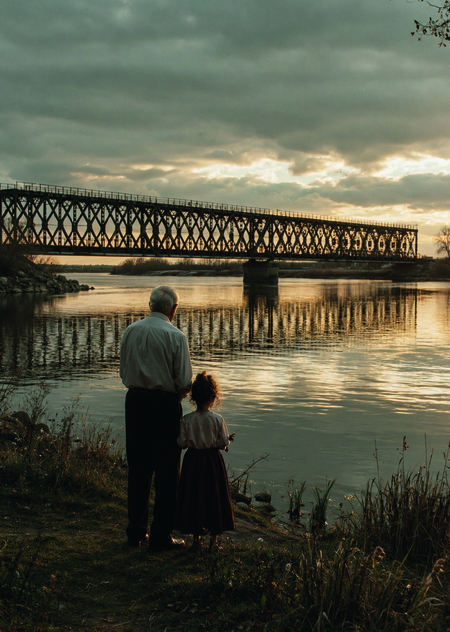
He understood that the great gift of the soul was not to find the truth, but to search for it one’s entire life and never find it. To wake up each morning with a question and fall asleep with hope. To rejoice in the small things: the smell of rain, a child’s laughter, the warmth of a stranger’s hand, the crunch of bread. To love without asking why. Our protagonist sharply inhaled and awoke. He was standing by the railing, gripping it tightly with both hands. The sun had not yet set. The water was still glowing gold. The wind smelled of salt. The scholar did not move. Perhaps it had all been a vision. Or perhaps it hadn’t. Who knew. Life went on… Since then, our hero stopped searching for the ultimate truth. He set aside his theories, his calculations, his pursuit of the inscrutable. The scholar simply began to live. To read by the shore, listen to the birds, converse with people, and help those who were struggling. On one of those «simple» days, he was walking with his granddaughter, passing by that very spot. The girl loved to ask a thousand questions—why the water was salty, why the seagulls cried, why the sun set over the sea. Our protagonist answered with tenderness and warmth, as if every one of her words were a small miracle to him. He was happy.
— So, what is «meaning»?
Perhaps she learned a new word at school, maybe heard it somewhere. But in that moment, time paused—though only for an instant. Our hero smiled and replied with the same charm in his eyes:
— It is a gift given to the human soul. Meaning isn’t hidden far away; it is born within, like magic. Everything you see, feel, and touch instantly gains «meaning.» They walked further across the bridge. Birds flew in flocks in the sky, and the old bridge, which had survived war and foreign lands, quietly held them. And in its metal framework buzzed something like the quiet laughter of someone who had understood everything long ago but would never tell anyone. Because the greatest joy is not knowing. And the highest wisdom is not demanding an answer.