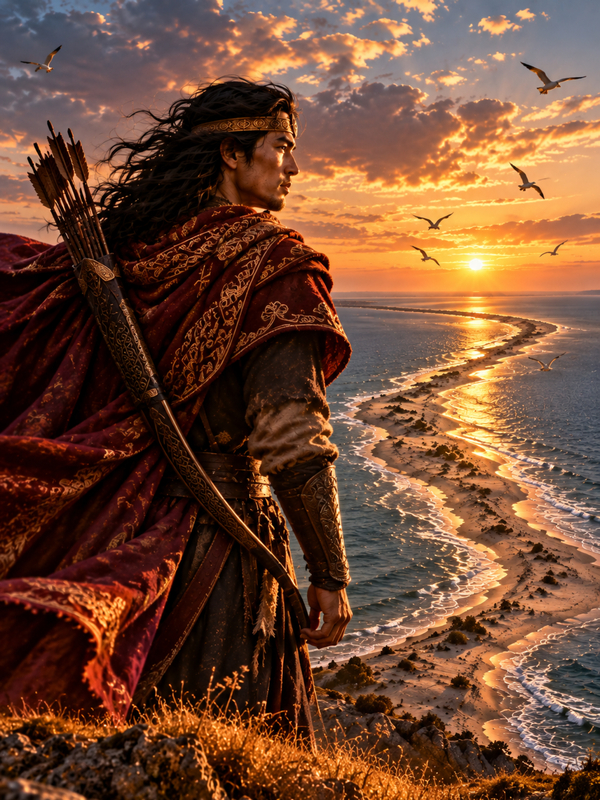
They say this happened in the times when the steppe knew neither roads nor stone cities, and Meotida lay beneath the sky like a massive dark bowl. Colaxai lived then—the youngest son of Targitai. His brothers were older, stronger, and had long believed that they would inherit the power over the land. But when sacred gold fell from the sky, only Colaxai could approach it. The gold did not burn his hands, and the elders bowed their heads. «Then, you shall rule this land, ” they said. Colaxai said nothing. He gazed into the distance—where Meotida was blue on the horizon. That evening, he climbed to a high bank. Below, the sea surged. Waves crashed onto the sand one after another, as if arguing over who would receive the shore.
Kolaxai stared at the water for a long time. He owned the land, but the sea belonged to no one. The next day, he commanded that his finest bow be brought. «What are you planning?» asked an old warrior who had served Targitai. «I want to know where my land ends.» The warrior smirked. «The land ends where the water begins.» Kolaxai took an arrow. The shaft was long and dark, the arrowhead glittering in the sun. The young king drew the string so tightly that the bow wood creaked. The wind died down, and even the sea seemed to hold its breath for a moment. The string released. The arrow soared over the shore. It flew for a long time—over the foam, over the green water, over the flocks of birds—and finally disappeared far ahead.
— This is where my land ends now.
The old warrior said nothing. Only the sea laughed with its waves. At night, the wind rose. It came from the steppe—dry and hot—driving sand ahead, whipping the grass, whistling between the rocks. By morning, the shore had changed. Where yesterday the water reached the very toes, there lay a thin strip of sand. Kolaksai noticed it first. «See?» He pointed toward the sea. «The land follows my arrow.»
The following night, the wind picked up. It swept up grains of sand, small shells, bits of grass debris, and carried them along the shore. The waves lifted all of this from the seabed, rolling it, throwing it, and then reclaiming it again. In the morning, the strip of sand had grown longer. Kolaksai ordered his horse to move forward.
«Where are you going?» the old warrior asked.
«Beyond the arrow.»
The horse started off easily. Then the sand became loose. The hooves sank in, and the water advanced ever closer. To the left, the water was calm, almost smooth. To the right, the waves hit harder and heavier, casting shells onto the beach. The farther Kolaksai traveled, the narrower the land became. Finally, the horse stopped. The sea was before him again, but the arrow was nowhere in sight. Kolaksai dismounted. He walked a few steps through the water. The cold Meotida rose up to his knees.
— Where is my arrow? — he yelled.
In response, a wave crashed against his chest. Kolaksai barely managed to stay on his feet.
— I asked where my arrow was!
The wind whipped his cloak from his shoulders. The sea offered no answer. Then the young king returned to the shore.
He was angry. It felt to him as if the earth itself was laughing at him, along with the sea.
That next night, he did not sleep. He sat by the fire, listening to the waves roll across the darkness. An old warrior settled down nearby.
— When I was a boy, — he said, — I thought the steppe belonged to whoever could cross it.
— Later, I thought it belonged to whoever could defend it.
Kolosai tossed a branch into the fire.
— And now?
— Now I think the steppe belongs to no one at all.
Kolaksai turned sharply toward him.
— Are you saying that to the king?
Kolaksai stood up and left, but the old man’s words remained with him.
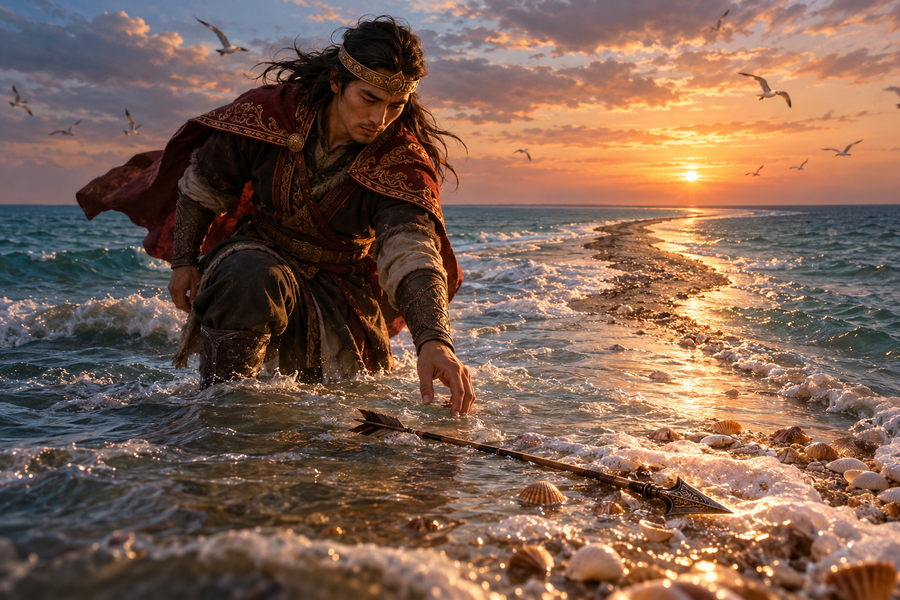
At dawn, the sea retreated. Kolaksay once again walked along the sandy strip, this time without a horse. White and pink shells crunched underfoot. The wind drove thin streams of sand, as if drawing invisible script. The wave on one side of the shore was heavy and noisy, while on the other, the water whispered almost inaudibly. Every step left a print, and every print soon disappeared. The sun rose high. The sandy ground grew thinner, like a taut bowstring. Finally, he saw something dark ahead—an arrow. It lay in the shallow water. The arrowhead was half-buried in the sand, and small shells had already gathered around the shaft. Kolaksay laughed. He waded into the water and reached out his hand. Once he pulled out the arrow—it would all be over. He would return to the people with proof of his shot.
I would say: «This is the boundary. I defined it myself.»
His fingers had just brushed the shaft, but then a wave came. It hit the arrow, rolled past it, and, receding, left a little more sand around it. Another came next, then a third. Kolaksai froze. He watched the sea build a bank around what he had once thrown the challenge toward. The water took the arrow and did with it what it wished. The wind howled behind him. It brought dry sand from the steppe and scattered it over the new ground. Kolaksai slowly withdrew his hand and decided to leave the arrow. When the king returned, the old warrior was sitting on the shore.
— Did you find it?
— I did.
— Why didn’t you bring it?
Kolaksai looked toward the thin strip of sand that faded far into Meotidia.
— Let it lie.
— And the border?
— There is no border there.
Years passed. The wind continued to carry sand. The sea pulled shells from the seabed, tossing them onto the tidal flats. Waves washed the land, then receded, only to return again, altering the coastline’s contours. The sandy strip grew. It became wider at the base and thinner where it dissolved into the sea. Grass began to sprout on it, and birds started to settle there. People would go there for fish, to build fires, or to look for shells. But no one saw the arrow anymore. Some said it had rotted away long ago. Others claimed the sea had carried it even further out. A third insisted that the arrow still lay beneath the sand, and the entire long stretch of land was held in place around its shaft. But the elders told a different story. They said searching for the tip was futile. One needed to ascend high above the coast and view the land as a whole. From there, among the vast Meotida, one could see a long sandy strip stretching from the shore into the sea—wide at its beginning and tapering toward the front. As if someone, many centuries ago, had drawn back an enormous bow and shot toward where the water meets the sky. And if the wind blows from the steppe on that day, and the sea roars particularly loud, the old people say: — Do you hear it? This Meotida is still laughing at the young Kolaxas. And then they add: — It’s a good thing he never took his arrow.