Concept
Marginalia are decorative images, ornamental elements, inscriptions, and other visual embellishments found in the margins of manuscripts. They play a significant role in medieval manuscripts, often engaging in a dialogue with the main text.
Of particular interest are the mythical and hybrid creatures that inhabit the same space as religious texts. This combination creates a unique visual contrast—strange, sometimes frightening, and far from elevated imagery accompanies sacred texts, thereby raising questions about their symbolic meaning and role in medieval culture.
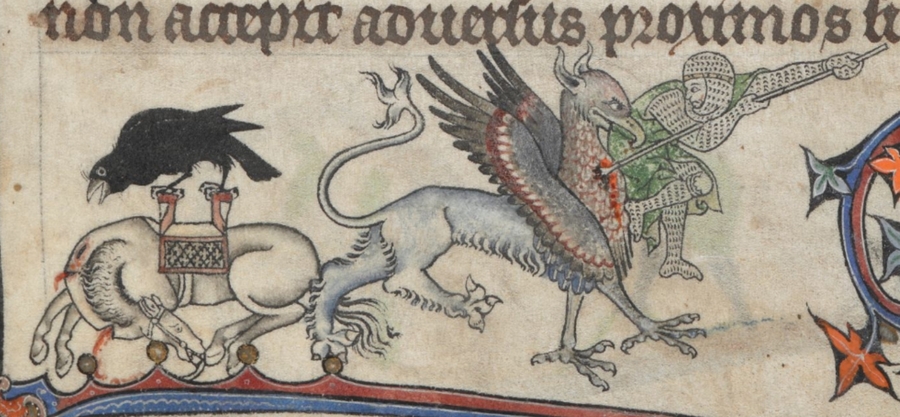
Unknown master (England), «Alphonso Psalter,» 1284.
Fantastic creatures and hybrids continue to thrive in contemporary popular culture—in literature, film, animation, and video games. Many recent archetypes have historical and cultural roots that trace back to medieval tradition. For instance, it is impossible to imagine modern fantasy cinema without dragons, unicorns, and centaurs.Studying medieval depictions of fantastic creatures allows us to understand the transformation of their symbolism and to identify the connection between the past and the present. Thus, examining medieval manuscripts is relevant for increasing awareness of the evolution of visual imagery in world culture.
Medieval fantasy imagery has not disappeared with time; it remains alive in contemporary culture.
The main focus of the research is to study the diversity of symbolic meanings of mythical creatures, their visual characteristics, and their role within the context of religious manuscripts. When selecting visual material, it is important to pay close attention to depictions that showcase the most characteristic form of these creatures, emphasizing their physical features. Crucial components include reliable information about the source of the image, its preservation and expressiveness, as well as the possibility of interpretation within a historical and cultural context. Furthermore, the material’s belonging to the specified chronological period and its placement within the margins of religious manuscripts must be considered.
What is written or drawn in the margins adds an extra dimension—a supplement capable of embellishing, parodying, reinterpreting, and questioning the authority of the text without undermining it entirely.
The foundation of the textual sources consists of scholarly literature dedicated to the marginalia of medieval manuscripts, alongside competent electronic resources containing information about mythical and hybrid creatures. Of particular value are materials that focus on the direct analysis of the manuscripts and marginalia in particular.Regarding the principle of rubrication, the primary method is the thematic grouping of images based on the nature of the figures. Each individual creature might appear on the manuscript pages countless times, without necessarily carrying a special meaning.
Why did medieval religious manuscripts feature mythical and monstrous creatures in the margins, and what role did they play next to the sacred texts?
Chapter 1. Dragons
Dragon image. Psalter of Alfonso, 1284.
The hybridization motif allowed people to express a visible form of evil. The animal nature often symbolized sin, base desires, and instincts. It was believed that the devil aroused a person’s lowliest core through temptation; therefore, if a character needed to be depicted as morally corrupt, giving them bestial features was sufficient. For this same reason, Satan himself and demons were typically portrayed as aggressive hybrids.Undoubtedly, dragons and serpents held the most malevolent reputations.
Image of a dragon. Alfonso Psalter, 1284.
In medieval manuscripts, the dragon was one of the most dangerous creatures of the animal kingdom. Its external appearance combines features of snakes, other reptiles, and birds. It possesses a toothy maw, a crest on its head, wings, a long tail, and clawed paws.The individual features of this terrifying beast have specific interpretations: the crest symbolizes the Devil, crowned by his pride; the emitted flame relates to Satan’s desire to appear in angelic light, deceiving fools; and the long tail is always ready to coil around a victim, suffocating them with sin.
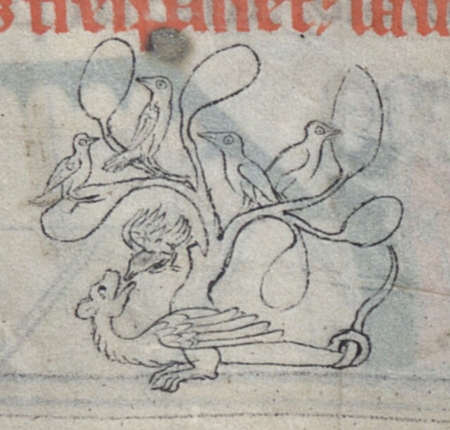
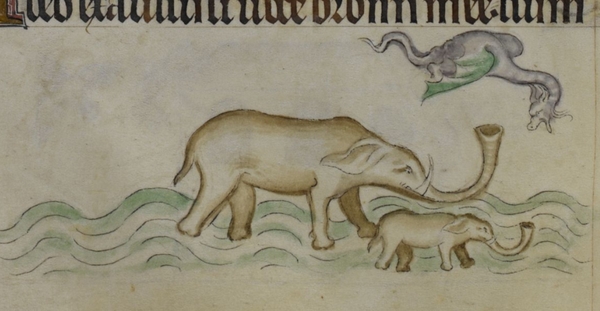
Dragon catching a pigeon beneath the Tree of Peridexion, Psalter of Isabella of France, 1303–1308; Dragon threatening a calving elephant, Psalter of Queen Mary, 1310–1320.
Scenes depicting the dragon interacting with other animals hold a special place. For instance, Isabelle of France’s Psalter shows a dragon lurking near prey under a peridecion tree. The image of the dove is associated with Christ and the faithful, while the tree symbolizes the Church, which provides protection from the Devil. This is why the dragon fears even its shadow and cannot reach the doves while they are under the protection of the holy branches. However, in the illustration, one of the doves leaves the safe spot and is immediately caught in the dragon’s jaws.
In Queen Marie’s Psalter, there is a scene of the dragon attacking an elephant that has just given birth to a calf in the water. Elephants typically serve as an allegory for Adam and Eve—and consequently, for all humanity susceptible to sin. The dragon cannot approach the water, but it continues to stalk its victims, striving to lure them into sin.
Such scenes are intended to reinforce the meaning of the religious text, to frighten the faithful, and to call them to adhere to church order.
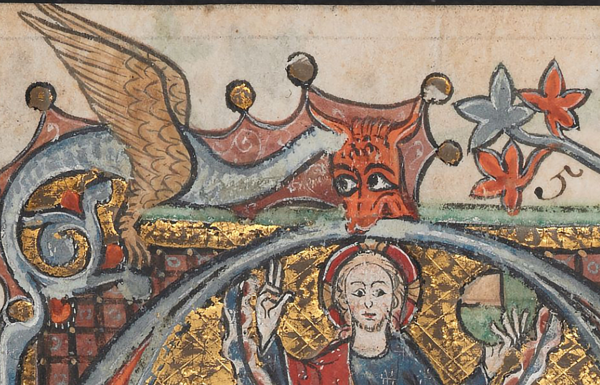
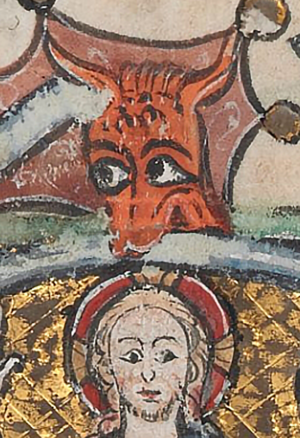
Dragon image, Pers Psalter, 1280–1290.
In the Psalter of Persis, there is a rather intriguing composition: a dragon stretches along the upper part of the page’s decorative border, biting into the image below depicting Christ in heaven. It is reminiscent of the Devil, who stands against light and virtue, striving to disrupt them, yet when confronted by the power of faith, it is unable to accomplish anything but continuing its senseless attempts.
In medieval culture, the dragon served as a vivid embodiment of evil—temptation—that trailed the human on the path to the salvation of the soul.
What is interesting is that even within a relatively stable symbolic interpretation, the dragon image maintains a diversity of visual manifestations, remaining one of the most recognizable creatures in medieval art.
Chapter 2. Sirens
About us
Contact