INTRODUCTION
In the 19th and 20th centuries, flowers, feathers, birds, and even entire animals were used to adorn women’s attire. Artificial flowers decorated dresses and hairstyles, while real feathers and bird wings adorned headdresses.
These ornaments were valued for their beauty and unique appearance. However, they represented completely different modes of interacting with nature: some forms were crafted by hand from fabric, while others were taken from real animals.
In this study, I am interested in exploring why such ornaments became a part of women’s fashion in the Russian Empire, how they were made, and what their use reveals about people’s attitude toward nature at that time.
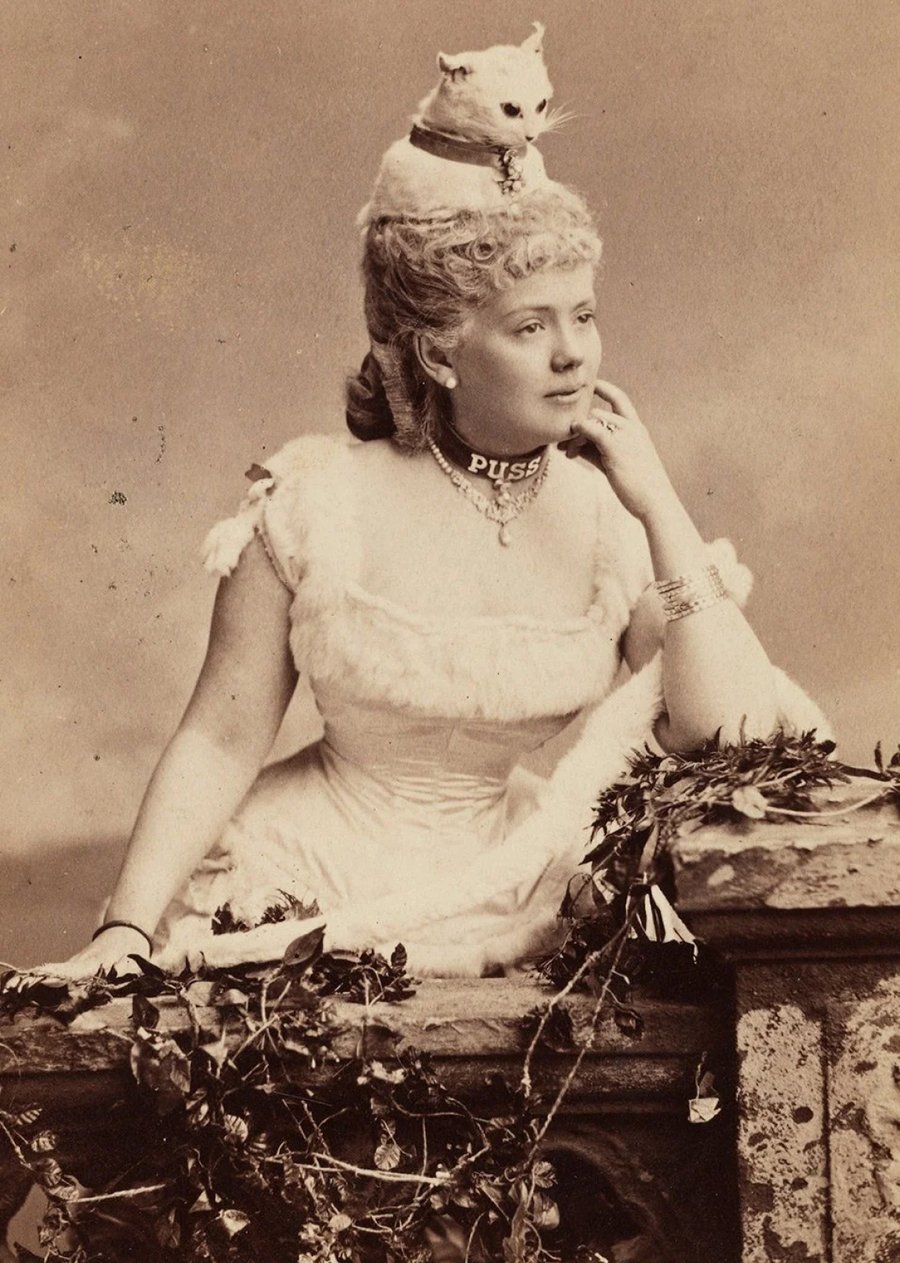
Kate Feering Strong (1886)
On March 27, 1886, The New York Times covered a magnificent costume ball hosted by the Vanderbilt family. Special attention was drawn to the attire of the young heiress, Kate Finning Strong. Her dress featured an original design: the upper skirt was adorned with appliquéd white cat tails, while the bodice and headpiece mimicked numerous white cat heads.
CONCEPT
For my visual study, I have chosen the theme of the use of color, feathers, and animals in the costumes of women of the Russian Empire. I am interested in how natural materials became part of clothing and adornment, and why certain accessories that were once considered beautiful and unusual can evoke entirely different feelings today.
Flowers and plants have long been used to decorate women’s costumes. They were woven into wreaths, braided into hair, and added to festive outfits. Later, artificial flowers appeared, crafted from fabric, paper, wax, and other materials. These preserved the appearance of real plants but did not wilt and could be used repeatedly.
However, nature was not only imitated. In the 19th century, women’s hats were decorated with real feathers, wings, and even entire bird effigies. Fur items that retained the heads and paws of animals were used as accessories. I am particularly interested in this combination of beauty and decoration using real animal parts.
In this study, I want to trace the development of such adornments in Russia—from traditional floral wreaths to the unusual accessories of the late 19th and early 20th centuries. I will pay special attention to the influence of European fashion, as many trends arrived in the Russian Empire from abroad. Foreign examples will be used to compare with Russian materials.
The foundation of the visual component will be historical photographs, female portraits, illustrations from fashion magazines, and surviving garments from museum collections. It is important to me not just to gather images, but to examine the adornments themselves: their shape, materials, size, and placement on the clothing, as well as how accurately they reproduced natural forms.
HYPOTHESIS
The central question of my research is: why, in the costume of the Russian Empire, was nature sought not only to be depicted but also to be transformed into part of clothing and accessories?
I hypothesize that natural ornaments were valued not only for their beauty but also for the possibility of creating unusual and expressive looks. Furthermore, artificial flowers and accessories made from real animal parts represented different modes of engaging with nature: in one case, people attempted to replicate its forms, while in another, they preserved and utilized them in their authentic state.
As a result, I aim to demonstrate how the role of nature changed within women’s costume and why such adornments were appealing to people of that era. It is important for me to examine this fashion not only from a contemporary perspective but also within its historical context.
William Charles Brown — «Fashions 1837–1887» (1888)
BIBLIOGRAPHY
Introduction
— Concept
— Nature as Ornamentation
— From Living to Artificial
— Flowers That Do Not Wilt
— Birds That Do Not Fly
— Animals as Accessories
— The Other Side of Beauty
Conclusion
NATURE AS DECORATION