Feud: Two Evolutions, One Ocean
The Earth is suffocating. Ecological well-being is compromised, and scientists see salvation in the ocean. Yet, the exploration of the ocean is dividing humanity into two camps.
TIKTAALIKI
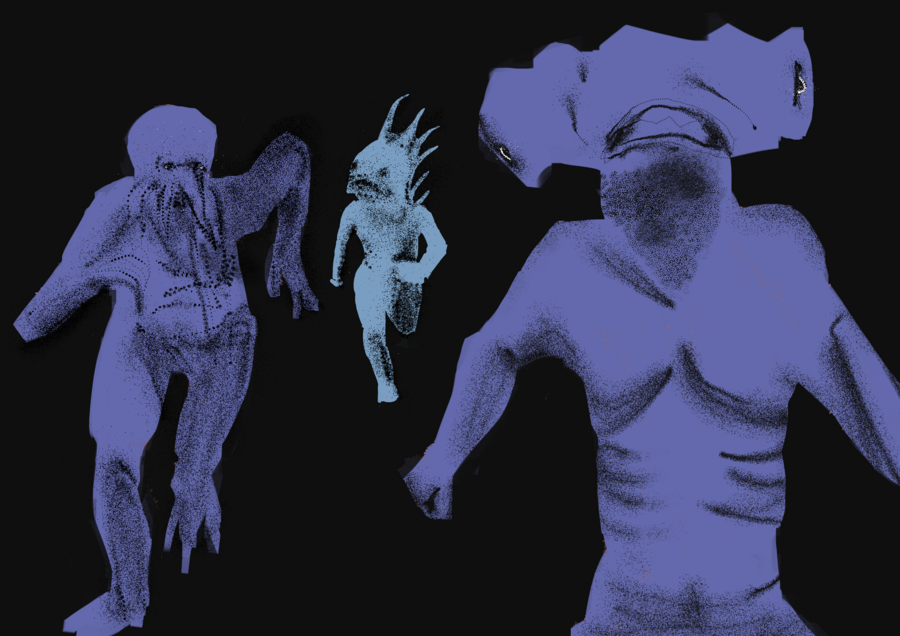
Tiktaaliki (evolutionary biologists of amphibians) believe that humans must be perfected from within—by introducing DNA mutations and restoring ancient transitional forms to the body, and by teaching the body to breathe, hear, and feel like a fish.
Images of amphibian-human-dolphin hybrids, human-jellyfish hybrids, and human-whale hybrids (or individual human archetypes, or all amphibians possessing several human traits). Amphibian humans in large «test tubes» and in the ocean.
SYNTHS (OR POSTCARDS)
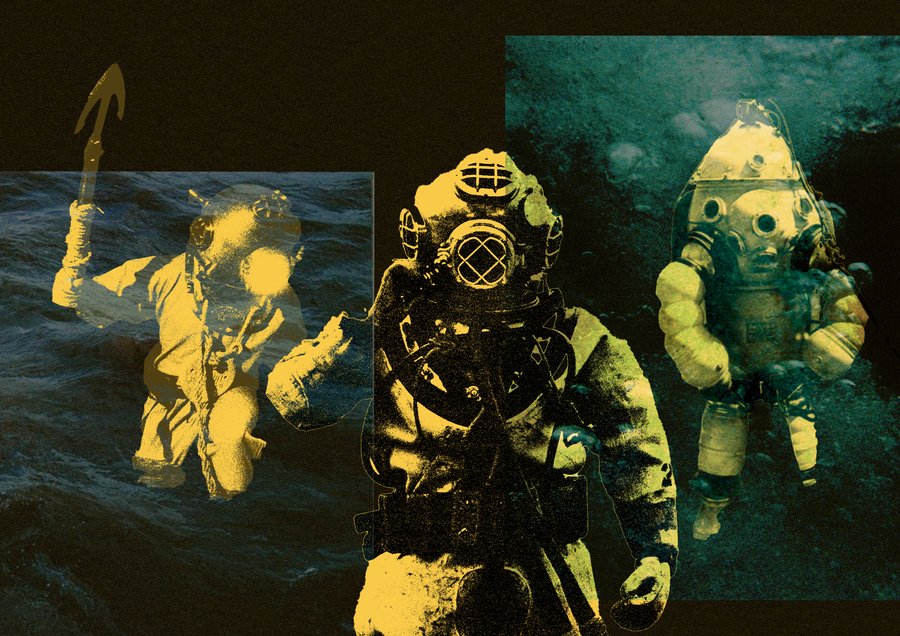
Synth-enthusiasts (techno-devotees) view the body as an outdated mechanism that should—and can—be physically perfected: implants, replacement parts, ballast lungs, claws, and gills. Humanity is an evolutionary link—a machine built for upgrading.
Image of the talking helmet
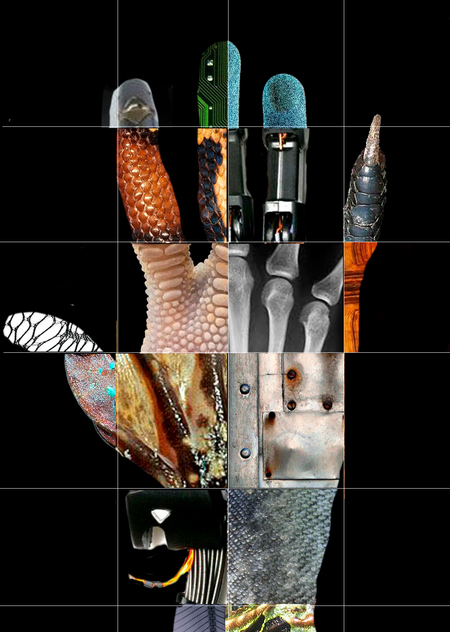
Tech people imagery—hand-last modifications, quick legs
The conflict begins with academic papers, moves to the courts, and then spills into ports and docks. Each faction builds its own ocean: some with bio-domes housing mutated volunteers, others with hermetically sealed factories on stilts. The ocean becomes the frontline.
Image of gills, mouths, lungs, and some visualization of speech (maybe a picture of two amphibians facing each other)
World: Truce in the Depths
War benefits no one—it is too costly and too messy. The Deep Pact is established: the ocean is divided into spheres of influence, and technological exchange is limited but permitted. Mixed stations emerge, where tiktachronics and exo-meridians are forced to work together. This is a fragile, cynical world: biologists disdainfully call implants «invasives, ” and engineers refer to mutants as „tik-taks.“ Yet, the stations operate, children from both factions attend the same schools on the shelf, and the ocean is gradually becoming a shared home. The world is held together by irony and mutual benefit.
Cracks: The robotic civilization crumbles
The techno-camp progresses until it leaps beyond its capabilities. Exo-mercedes construct autonomous city-platforms where humans are gradually replaced by implants and automated modules. A robot civilization emerges: a network of self-serving machines, with humans relegated to an increasingly thin stratum. Then, the system collapses. The reason is simple and grotesque: the self-sustaining technosphere cannot repair itself without a living operator.
«You gave me life—without you, I will die.»
The ballast lungs fill with salt, the hydraulics corrode, the power grids fray, and there are no more «spare parts.» The machine brain tries over and over to replicate the first successful experiments, but the results become worse with every version. Robo-civilization crumbles not from machine rebellion, but from the lack of a living human to tighten a bolt.
Request for Help: Robots Approach Fish-People
The surviving robot-humans approach the ichthyoid people. They ask for help: to repair, to support, to provide biology that can survive where metal has failed. But they do not come to humans. While the techno-camp was building platforms, the evolutionary biologists went into the depths and ceased to be humans in the conventional sense. These are now fish-people: creatures with gills, scales, echolocation, pressure-sensing skin, and speech built on sound and vibration. They remember humans, but they do not consider themselves to be them. The robot-humans stand before them—iron against scale—and ask for assistance from those once called «tick-tacs.»
Awareness
Evolution, by itself or by any single means, does not function. Pure biology is a regression back into the water and to the beast. Pure mechanics is a brilliant corpse. A third path is needed.
Solution
The third path is articulated by fish-people and surviving robot-people together: humans should not have to «choose» between DNA and implant, but rather adopt animal traits. Forced mutation becomes a component—like a language, a skill, or a feeling.
A small pixel animation with hands reaching toward an amphibian
Amphibian image